

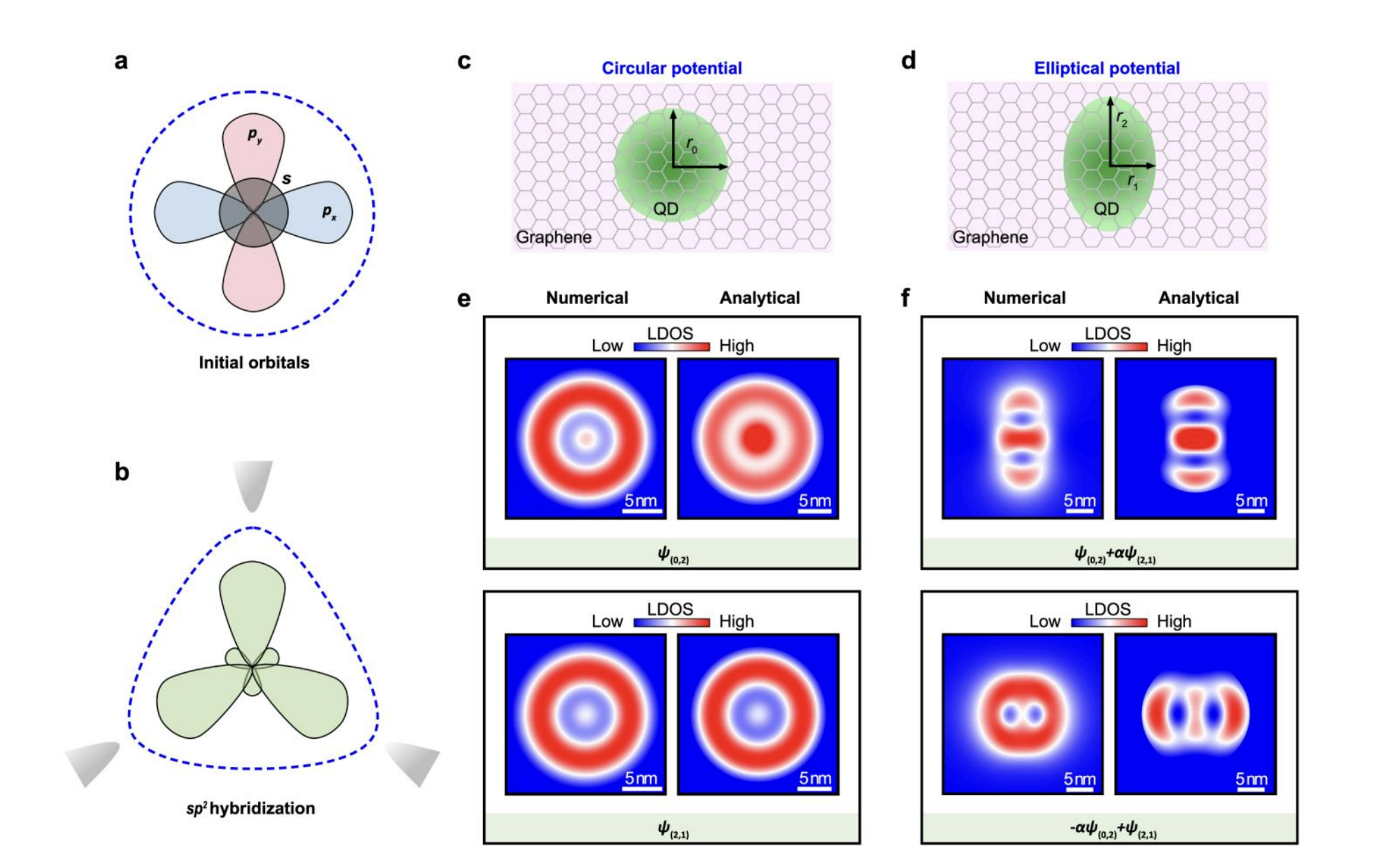
The behaviour of electrons within confined spaces mimics the fundamental processes occurring within real atoms, offering scientists a powerful way to explore the building blocks of matter. Yue Mao, Hui-Ying Ren, and Xiao-Feng Zhou, along with their colleagues, now demonstrate a key aspect of this mimicry, the hybridisation of electron orbitals, within artificially created ‘atoms’ built from graphene. While evidence of bonding between these artificial atoms exists, direct observation of hybridisation within a single artificial atom has remained elusive until now. This team successfully alters the shape of these graphene structures, inducing hybridisation and directly visualising the resulting electron orbits, a feat that unlocks new possibilities for designing materials with properties unattainable in naturally occurring atoms and offers progressive control of states in diverse systems.
Intraatomic orbital hybridisation and interatomic bond formation represent the two fundamental processes occurring when real atoms condense to form matter. Artificial atoms mimic real atoms by exhibiting discrete energy levels resulting from quantum confinement. As such, they offer a solid-state analogue for simulating intraatomic orbital hybridisation and interatomic bond formation. These systems provide a unique platform to investigate the complex interplay between electronic structure and material properties, potentially leading to the design of novel materials with tailored functionalities. Understanding these fundamental processes within artificial atoms is therefore crucial for advancing materials science and quantum technologies.
Graphene Quantum Dot Local Density of States Calculation
This research involves simulating and visualizing the electronic structure of graphene quantum dots, which are small, confined regions of graphene. The primary goal is to calculate the Local Density of States (LDOS), a measure of the probability of finding an electron at a specific location and energy within the quantum dot. By visualizing the LDOS, scientists can map the electron density and investigate quasibound states, which are confined but can slightly leak out of the quantum dot. The simulation allows for adjustments to parameters like the quantum dot size and potential strength to explore their effects on the electronic structure.
The process begins by defining the shape of the simulation region as a rectangle and creating a model of a graphene monolayer with specific hopping and energy parameters. A potential is then applied to confine the electrons within the quantum dot. A k-point mesh is generated to facilitate the calculation of the LDOS at various energies. The simulation calculates the LDOS across a range of energies and maps the resulting data onto a grid, providing a spatial distribution of electron density. This data can then be saved and analyzed to understand the electronic properties of the graphene quantum dot.
The simulation utilizes established numerical methods and libraries, including pybinding for tight-binding calculations and numpy for numerical operations. The scipy library is used for data input/output and nearest-neighbor searches, while matplotlib is employed for visualization. By combining these tools, scientists can accurately simulate the electronic structure of graphene quantum dots and gain insights into their behavior.
Artificial Atoms Exhibit s-d Orbital Hybridization
Scientists have, for the first time, demonstrated orbital hybridization within artificial atoms, mimicking a fundamental process observed in real atoms during the formation of matter. This breakthrough delivers direct evidence of intraatomic orbital hybridization and opens new avenues for designing materials with properties inaccessible in naturally occurring substances. The team achieved this by manipulating the shape of graphene quantum dots, effectively creating artificial atoms with anisotropic confining potentials. Experiments reveal that altering the quantum dots from circular to elliptical shapes induces hybridization between quasibound states, specifically between s- and d-orbitals within the artificial atom.
These hybridized orbitals are directly visualized in real space using scanning tunneling microscopy, confirming the theoretical predictions and analytical derivations. This visualization provides compelling evidence of the orbital mixing occurring within the artificial atom. Crucially, the research demonstrates that increasing the anisotropy of the quantum dots enhances the orbital hybridization, evidenced by a measurable increase in the energy splitting between the newly formed states. The findings show a clear analogy to real atomic orbitals, where the s and d states recombine to form new states with distinct spatial distributions. The team’s ability to control this hybridization within artificial atoms provides a powerful platform for exploring and manipulating quantum states in diverse systems, paving the way for the creation of novel quantum materials with tailored electronic properties.
Artificial Atoms Demonstrate Orbital Hybridization
This research demonstrates, for the first time, orbital hybridization within artificial atoms, a phenomenon previously observed in natural atoms but challenging to replicate in solid-state systems. By manipulating the shape of these artificial atoms, scientists induced hybridization between quasibound states, directly visualizing the resulting hybridized orbits in real space. Both numerical calculations and analytical derivations corroborate these experimental findings, confirming the anisotropy-induced orbital hybridization and the associated energy splitting. These results represent a significant advancement in the field of quantum simulation, offering a new avenue for designing artificial matter with properties not readily accessible in natural atoms.
The ability to control and observe orbital hybridization in artificial atoms expands the potential for simulating complex atomic behaviours and exploring novel quantum phenomena. This work provides a foundation for progressive control of states in diverse systems and underscores the transformative potential of quantum simulation in physics and engineering. By creating artificial atoms that mimic the behaviour of natural atoms, scientists are opening up new possibilities for understanding and manipulating quantum phenomena, potentially leading to breakthroughs in materials science and quantum technologies.
🗞 Orbital hybridization in graphene-based artificial atoms
🧠 ArXiv: https://arxiv.org/abs/2509.04012


