
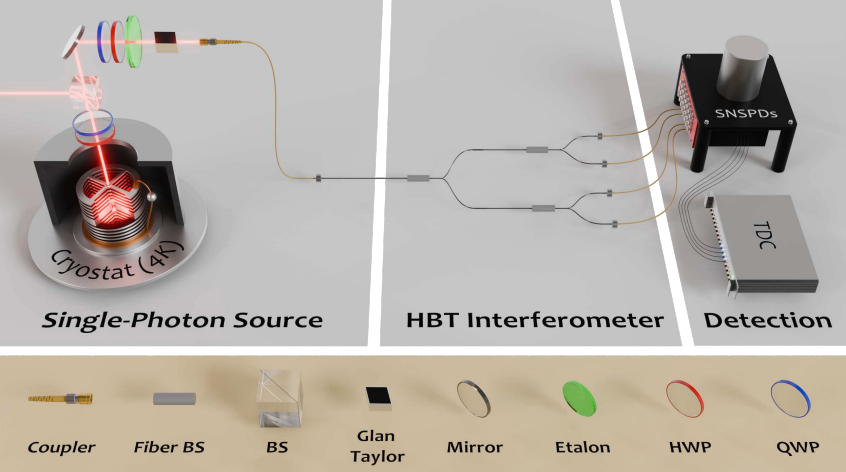
The generation of non-classical light, crucial for advancements in quantum technologies such as quantum computing and secure communication, typically focuses on the emission of single photons. However, any resonant excitation of an atom, even artificial ones, inevitably produces multi-photon emission alongside the desired single photons. Researchers at the University of Vienna, led by F. Giorgino and P. Zahálka, alongside L. Jehle, L. Carosini, L. M. Hansen, J. C. Loredo, and P. Walther, investigate the extent and dynamics of these multi-photon processes in a semiconductor quantum dot embedded within a micropillar cavity. Their work, detailed in the article “Multi-photon emission from a resonantly pumped quantum dot”, quantifies these emissions using high-resolution temporal measurements and fourth-order auto-correlation functions, revealing the emission of up to four photons from a single excitation pulse. Furthermore, they demonstrate a technique utilising time-gated acquisition to improve the purity of single-photon sources without compromising efficiency, offering a practical approach to refining quantum light sources.
Quantum light generation relies on precise control of light-matter interactions at the atomic scale. Semiconductor quantum dots, possessing strong optical properties and compatibility with solid-state fabrication, are increasingly employed as platforms for generating specific quantum states of light and investigating fundamental quantum phenomena. Resonance fluorescence, a technique used to create enhanced light properties like single-photon emission, is crucial for applications in quantum cryptography and computing. However, real atomic systems deviate from ideal two-level systems, resulting in unwanted spontaneous emission alongside desired resonant excitation, complicating the process.
This research addresses this complexity by meticulously quantifying multi-photon emission statistics from a semiconductor quantum dot embedded within a micropillar cavity. Researchers employ autocorrelation measurements to characterise the probability of emitting two, three, or even four photons from a single excitation pulse, providing a nuanced understanding of light-matter interactions within these quantum dots. The study extends beyond simple two-photon correlations, utilising higher-order correlation functions – specifically, the second, third, and fourth-order correlation functions (g(2), g(3), and g(4)) – to comprehensively assess the photon statistics.
Central to the methodology is the extraction of photon number probabilities (PNPs), which define the likelihood of each possible photon emission event. Researchers measure the brightness of detected light and calculate these higher-order autocorrelation functions, quantifying the correlations between photons. These measured quantities are then related to the unknown PNPs through a system of equations, requiring careful mathematical manipulation and accounting for inefficiencies in the detection system, represented by a loss parameter.
The study demonstrates that a bunched source, indicated by a g(2)(0) value exceeding one, does not necessarily imply a higher probability of emitting two photons compared to one. The vacuum probability, representing the likelihood of emitting no photons, plays a critical role; a sufficiently high vacuum probability is essential for observing bunching statistics, highlighting the complex interplay between different emission probabilities. Researchers quantify the probability of emitting multiple photons following a single excitation pulse, revealing emission events involving up to four photons.
This detailed analysis provides crucial insight into the dynamics governing light emission from coherently driven artificial atoms, establishing that while single-photon emission is present, it coexists with probabilities of detecting two, three, and even four photons from a single excitation. Finely resolved temporal measurements further elucidate the emission dynamics, revealing the timing and characteristics of both single and multi-photon emissions. This temporal resolution is critical for understanding the underlying physical processes and for developing strategies to suppress unwanted multi-photon contributions.
A key outcome of this work is the proposal of a time-gating technique to enhance the purity of the single-photon source. By selectively acquiring photons within a specific time window after excitation, researchers demonstrate the potential to significantly reduce the contribution of multi-photon events while maintaining high detection efficiency, offering a practical approach to improving the performance of single-photon sources for quantum applications. The researchers demonstrate that the observed multi-photon emission arises from the coherent driving of the quantum dot, highlighting the importance of controlling the excitation conditions to optimise single-photon purity.
👉 More information
🗞 Multi-photon emission from a resonantly pumped quantum dot
🧠 DOI: https://doi.org/10.48550/arXiv.2507.04843