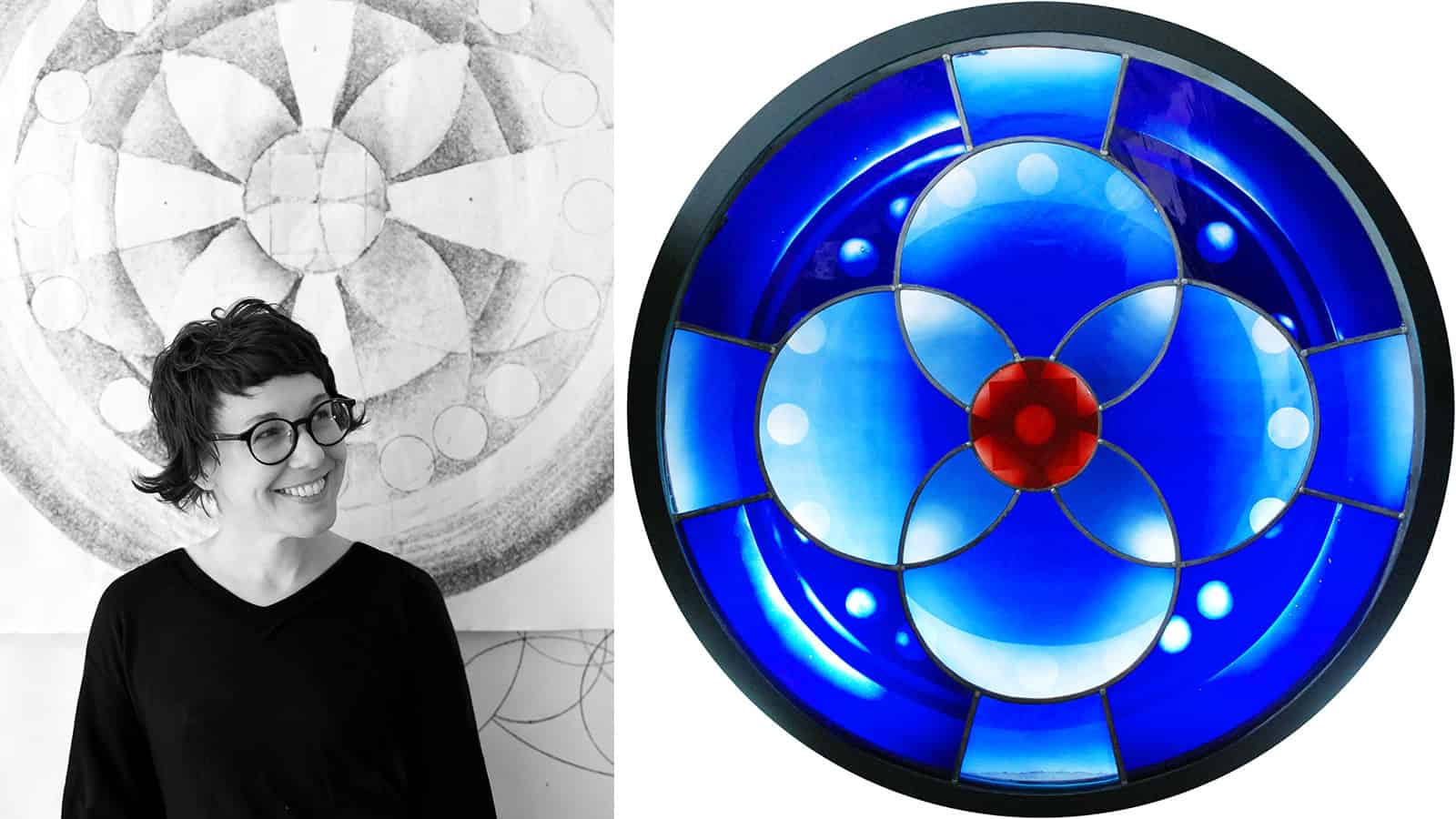
Artist Oksana Kondratyeva was inspired by the elegant geometry of this quantum computers and created a stunning glass artwork, “Per scientiam ad astra”, which resembles a medieval rose window. The artwork, made using hydrofluoric acid etching, is over a meter in diameter and features intricate designs that seem to change as one moves around it.
Rigetti, a leading quantum computing company, has designed a scalable quantum processor that could potentially lead to larger and more reliable quantum computers with many more qubits. The packaging for the quantum chip is a disc-shaped structure that holds the “brain” of the company’s quantum computer.
Kondratyeva’s work highlights the intersection of art and science, echoing the “two-cultures” dialogue introduced by C P Snow in 1959. With Rigetti’s quantum computers housed at the UK’s National Quantum Computing Centre, this artwork raises interesting questions about the convergence of certainty and uncertainty in our understanding of reality.
The attention to detail in Kondratyeva’s piece is remarkable. The acid-etched glass artwork, “Per scientiam ad astra,” is a masterpiece that not only showcases her technical skill but also captures the essence of quantum technology. The use of blue and red hues creates an otherworldly effect, evoking the mysterious and empowering qualities of quantum computing.
Just as qubits exist in a superposition of states, her glass art exists at the intersection of certainty and uncertainty. The acid-etching process, with its inherent unpredictability, mirrors the probabilistic nature of quantum systems.
The connection between art and science is profound here. Kondratyeva’s work demonstrates how artistic expression can visualize complex scientific concepts and tap into their underlying beauty. This crossover is reminiscent of C P Snow’s “two-cultures” dialogue, highlighting the need for greater understanding and collaboration between artists and scientists.
As we enter the International Year of Quantum Science and Technology in 2025, Kondratyeva’s artwork serves as a powerful symbol of the potential for art to inspire new perspectives on reality. Her piece raises intriguing questions about the nature of our universe and how quantum computing can broaden our understanding of it.
Ultimately, “Per scientiam ad astra” is more than just an artwork – it’s a testament to the human spirit’s ability to find beauty in the unknown and to push the boundaries of what we thought was possible.
External Link: Click Here For More