

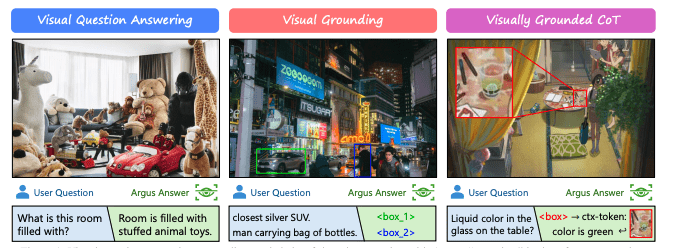
Argus, a novel multimodal large language model, improves performance in vision-centric tasks by employing object-centric grounding as visual chain-of-thought signals. Evaluations across multiple benchmarks confirm Argus’s enhanced capabilities in both multimodal reasoning and referring object grounding, demonstrating the value of explicit visual focus.
Multimodal large language models (MLLMs) are increasingly capable, yet often falter when reasoning demands precise visual attention – a critical limitation in scenarios requiring detailed analysis of images. Researchers are now addressing this through refined attention mechanisms that prioritise visual grounding during reasoning. A collaborative team, comprising Yunze Man and Liang-Yan Gui from the University of Illinois Urbana-Champaign, alongside De-An Huang, Guilin Liu, Shiwei Sheng, Shilong Liu, Zhiding Yu and Jan Kautz from NVIDIA, detail their approach in a paper entitled ‘Argus: Vision-Centric Reasoning with Grounded Chain-of-Thought’. Their work introduces a novel system employing object-centric grounding to guide visual attention, demonstrably improving performance on both multimodal reasoning and object-referencing tasks.
Argus: Enhancing Multimodal Reasoning with Visual Grounding
Argus, a novel multimodal large language model (MLLM), demonstrates improved performance on vision-centric reasoning tasks through the incorporation of visual Chain-of-Thought (CoT) mechanisms. The model utilises object-centric grounding – identifying and localising specific objects within an image – as visual CoT signals, enabling focused visual attention during multimodal reasoning. Evaluations across diverse benchmarks confirm Argus’s proficiency in both multimodal reasoning and referring object grounding.
The design of Argus underscores the importance of explicit visual region-of-interest engagement in MLLMs. By actively focusing on relevant image areas, the model achieves a deeper understanding of visual scenes and improves its ability to connect visual information with textual prompts. This highlights a shift towards developing multimodal intelligence from a distinctly visual-centric perspective, emphasising the crucial role of visual grounding in achieving robust and accurate reasoning capabilities.
Training incorporates a diverse range of datasets, including TextVQA, V-Star, and Shikra, specifically chosen to enhance visual perception, object grounding, and multimodal reasoning capabilities. Argus also benefits from training on datasets focused on visual grounding such as GR-RefCOCO and Visual Genome, equipping it to handle a wider range of visual scenarios and reasoning challenges than models trained on more limited datasets.
Quantitative and qualitative evaluations on benchmarks such as TextVQA and V-Star confirm Argus’s enhanced performance, demonstrating a significant improvement in both multimodal reasoning and referring object grounding tasks. The model consistently provides more accurate answers and successfully locates objects within images when utilising visual cues.
Despite these advances, the model’s capacity, currently at 8 billion parameters, represents a limitation, and future work will explore the potential of larger models to further enhance generalisability and reasoning capabilities. A key challenge remains the scarcity of large-scale, high-quality visual CoT data, necessitating efforts to create or acquire such resources.
Researchers highlight the critical role of dataset diversity in training robust and generalisable MLLMs. By explicitly grounding reasoning steps in identified objects and regions within images – visualised through bounding boxes – Argus avoids ambiguity and improves accuracy.
Expanding the scope of evaluation beyond visual question answering and grounding tasks is a priority, and the authors intend to assess Argus’s performance on open-world detection tasks, broadening its applicability to real-world scenarios. Further investigation into the interplay between model capacity, dataset complexity, and the effectiveness of visual CoT mechanisms will continue to refine the development of visually-centric MLLMs.
This mimics human reasoning processes by providing intermediate visual steps, analogous to explaining thought processes. The project represents a move towards building AI systems that not only see but truly understand the visual world.
👉 More information
🗞 Argus: Vision-Centric Reasoning with Grounded Chain-of-Thought
🧠 DOI: https://doi.org/10.48550/arXiv.2505.23766


