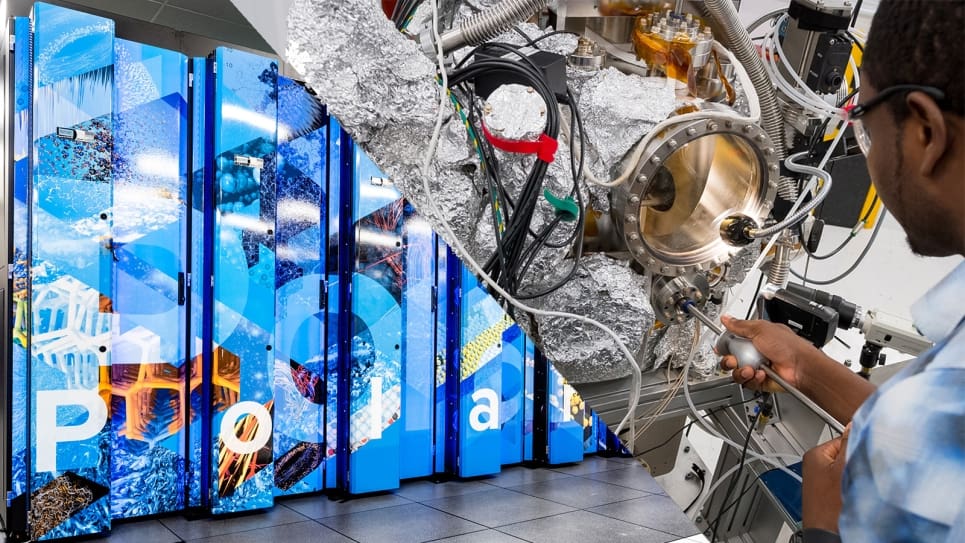
Argonne National Laboratory is revolutionizing X-ray science by seamlessly integrating its newly upgraded Advanced Photon Source (APS) with the nation’s most powerful supercomputers, beginning with Polaris. This major step allows researchers to analyze the massive influx of data – expected to increase up to 100 times over the next decade – in near real-time, guiding experiments as they unfold. “You can’t tell a material to stop cracking or a cell to stop dividing until the data are inspected and understood afterwards,” said Argonne group leader Nicholas Schwarz. “We need to capture quickly evolving phenomena and adjust the experiment in real time — not hours later.” This integration, part of the Department of Energy’s Integrated Research Infrastructure (IRI) vision, promises to accelerate scientific discovery by unifying research tools and facilities.
Argonne’s APS and ALCF Enable Real-Time Experimental Analysis
Argonne National Laboratory is forging a powerful link between its upgraded Advanced Photon Source (APS) and the ALCF supercomputer, fundamentally reshaping the pace of scientific discovery. Researchers have constructed an automated pipeline that streams data directly from APS beamlines to ALCF’s Polaris for analysis during live experiments, a capability spurred by a 500-times increase in X-ray beam brightness at the APS. This integration extends to other DOE supercomputers, including Perlmutter at Lawrence Berkeley and Frontier at Oak Ridge, all aimed at handling the escalating data volumes of next-generation X-ray science.
The APS, with over 30 years of experience in atomic-level material exploration, is now poised to generate up to 100 times more data over the next decade, necessitating real-time processing. Hannah Parraga, Ryan Chard, and Thomas Uram are key team members driving this transformation at the ALCF. ALCF is deploying integrated tools under the IRI framework, called Nexus, to cater to diverse experimental facilities, already providing seamless access to supercomputers for numerous APS beamlines. Central to this is Globus, a technology facilitating secure data transfer and distributed computing, demonstrated effectively in X-ray photon correlation spectroscopy (XPCS) experiments.
The team utilized Polaris and Globus for real-time processing across multiple beamlines, refining infrastructure and workflows for speed and reliability. Artificial intelligence will further accelerate analysis, identifying patterns beyond human capacity, benefiting fields from materials science to planetary science. Ultimately, this work aims to create “smart instruments” integrating high-performance computing and AI directly into the scientific process, with Aurora, Argonne’s exascale supercomputer, promising even greater analytical power.
Globus Data Transfer Automates X-ray Photon Correlation Spectroscopy
Argonne National Laboratory is pioneering a new approach to materials science by automating data transfer from the Advanced Photon Source (APS) to its Leadership Computing Facility (ALCF), specifically utilizing the Globus technology. This integration allows for near-real time analysis during live experiments, a critical advancement given the APS’s recent upgrade which increased the brightness of its X-ray beams by up to 500 times. A key application of this system is X-ray photon correlation spectroscopy (XPCS), a technique used to track material changes at the nanoscale.
Globus automates the flow of XPCS data between APS beamlines and supercomputers like Polaris, delivering results in near-real time—a significant leap forward in analytical speed. The team has been refining these workflows using Polaris and Globus tools across multiple beamlines, ensuring optimal performance.
You can’t tell a material to stop cracking or a cell to stop dividing until the data are inspected and understood afterwards,”
Nicholas Schwarz
Nexus Framework Integrates DOE Facilities for Scalable Workflows
This integration isn’t simply about increased computing power; it’s about building automated pipelines that stream data directly from APS beamlines for near real-time processing. “This comprehensive IRI framework and related services has already enabled seamless access to ALCF supercomputers for many APS beamlines,” said Thomas Uram, data services and workflows team lead at the ALCF.