

The Quantum computing industry continues to revolutionize rapidly, leveraging the principles of quantum mechanics, such as superposition and entanglement, to perform calculations at speeds exponentially faster than traditional computers, its potentials is massive, from basically having the potential to tackle extremely complex problems almost instantly vs traditional computers which could take years to solve, their practical applications can be beneficial in healthcare to drug discovery to cryptography and artificial intelligence.
Tech giants like IBM, NVIDIA, Microsoft, and Google have undoubtedly made substantial investments in quantum research and innovation, concentrating on areas such as hardware, software, and services. These advancements have led these companies to actively participate in the stock market, aiming to attract investors and amplify their market presence.
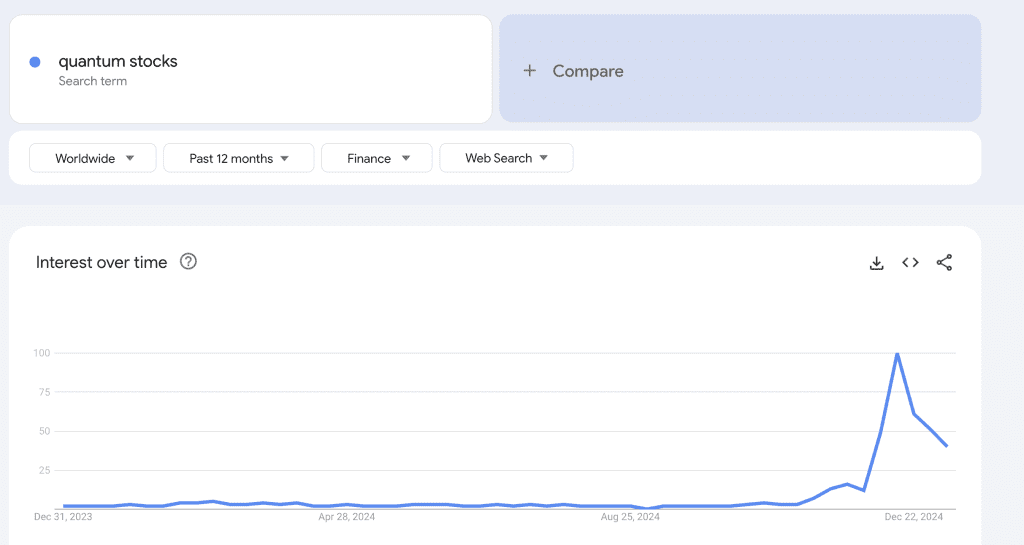
Generally, it is evident that quantum stocks has seen a notable surge in web searches, as highlighted by Google Trends, over the past 12 months, indicating a growing interest from both retail and institutional investors. Why the surge of interest in the last quarter of the year? Well, below are a list of technological advancements in the quantum industry from tech companies over the last year.
Quantum Computing and its Market Potential
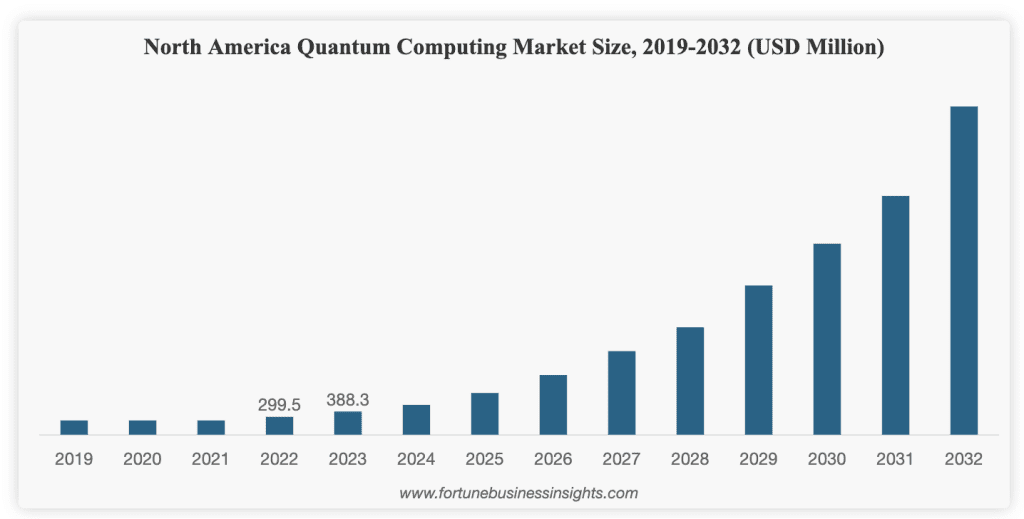
Before we go over the details of these advancement, we will be looking into the general market potential of quantum computing. Over the past few years, the quantum computing market has been steadily rising. In 2022, it was valued at around $974.1 million, climbed to $784 million in 2023, and is set to grow even more this year, reaching $1,160.1 million in 2024. Looking ahead, it’s projected to skyrocket to a whopping $12.6 billion by 2032, with an impressive annual growth rate of 34.8%.
This rapid growth is fueled by consistent investment and innovation in quantum computing technology., particularly on a per-segment basis —hardware, software, and services,—ll of which contribute to the growing appeal of quantum stocks. For example, tech giants like IBM, Google, Microsoft, Intel, and Rigetti Computing are at the forefront, rolling out cutting-edge quantum computing hardware and driving the market forward. New hardware launches have become increasingly frequent, with companies shipping more quantum systems each year.
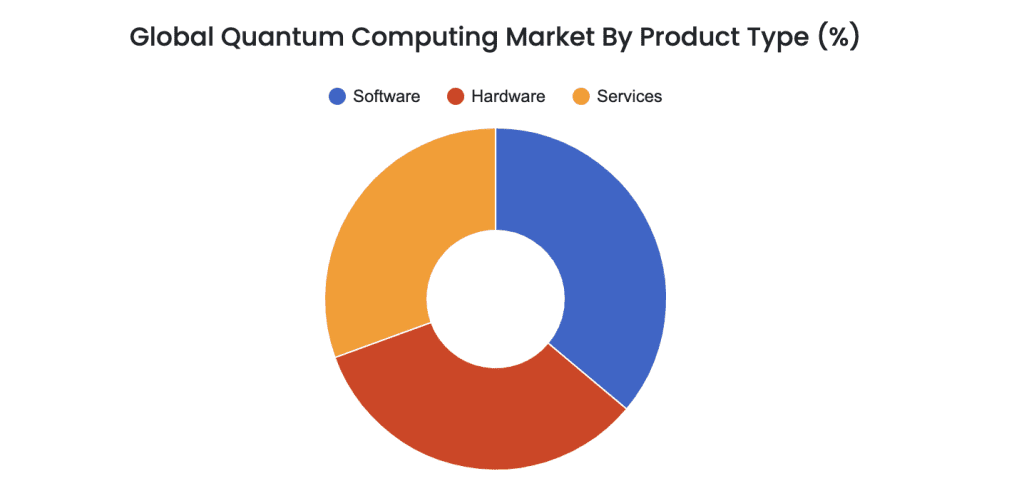
Additionally, on per-region market analysis, in 2023, North America led the quantum computing market, thanks to its early adoption of advanced technologies and competitive landscape, holding a 43.86% share: cutting-edge problem-solving capabilities, advancements in AI, and substantial global investments in the sector fuel this growth. From 2024 to 2032, the region is set for significant growth, driven by businesses eager to develop cutting-edge services and the widespread embrace of cloud computing.
Moreover, government support is one of the considered significant driving factors for the growth of quantum stocks, as respective government funding is allocated to quantum technologies, aiming to encourage businesses and industries to tap into their potential. These investments highlight how critical quantum tech is for staying competitive in industry, advancing scientific research, and strengthening security. By boosting domestic adoption of advanced quantum systems, governments are helping companies and investors remain ahead in defense and computing innovation areas.
Quantum Computing Companies and Its Quantum Stock Performance over the last year.
Rigetti Computing Inc. (NASDAQ: RGTI)
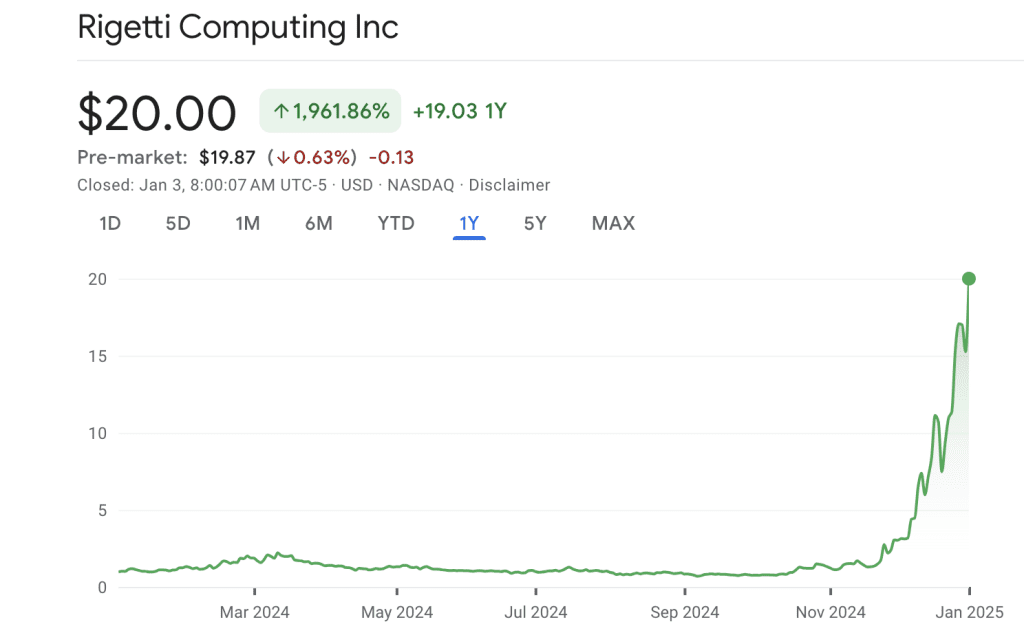
Rigetti Computing is a California-based company that develops integrated circuits for quantum computers. It has made significant technological progress, and its substantial stock growth has positioned it as a key contender in the quantum computing arena, attracting considerable attention from investors and analysts alike. Based on the trend shown, it did not have a good start. However, a surcharge started in December 2024, reaching a record high of $19.35 on December 27, 2024.
Rigetti recently unveiled its Ankaa-2 processor, which boasts an impressive 98% accuracy in quantum operations, meaning only a 2% error rate. The company has a solid plan for scaling this technology, and its Ankara architecture will pave the way for systems with over 336 qubits in the future.
According to a report, Rigetti’s stock has experienced a significant rise, initially jumping 70% to $2.95 per share after an everyday stock sale. Since then, the stock has continued to climb, reaching $6.50 per share as of December of this year. Over the past three months, Rigetti’s shares have surged by an impressive 784.7%, with a year-to-date increase of 559%.
NVIDIA (NASDAQ: NVDA)
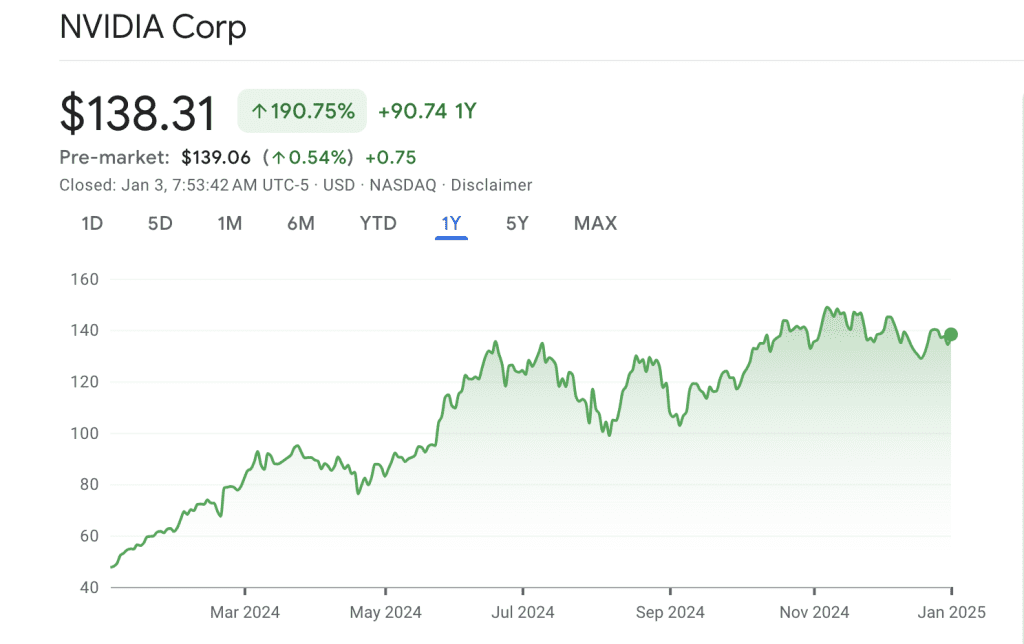
Nvidia is having an incredible 2024, with its stock up 172.8% this year. While growth has slowed a bit in the last three months to 25%, that’s still a pace most shareholders are thrilled about, especially with the S&P 500 up 26.5% as of December 10. Based on the trend, NVDA stock sharply increased in the first quarter, climbing steadily from around $50 to $100 by March 2024. After reaching $100, there was some consolidation with periodic volatility, with the quantum stock price fluctuating between $100-$120. Then, towards the year’s end, NVDA closed at $138.31, reflecting significant investor confidence and firm performance.
In May 2024, the company revealed that its CUDA-Q platform is now being integrated into high-performance computing systems at major national supercomputing centers in countries like Japan, Germany, and Poland, enhancing quantum processing capabilities within NVIDIA-powered systems.
Additionally, in November 2024, the company partnered with Google Quantum AI to speed up the design of next-gen quantum computing devices. Using Nvidia’s CUDA-Q platform and the power of 1,024 H100 Tensor Core GPUs at the Nvidia Eos supercomputer, Google engineers can run some of the world’s largest and fastest quantum device simulations at a much lower cost.
D-Wave (NYSE: QBTS)
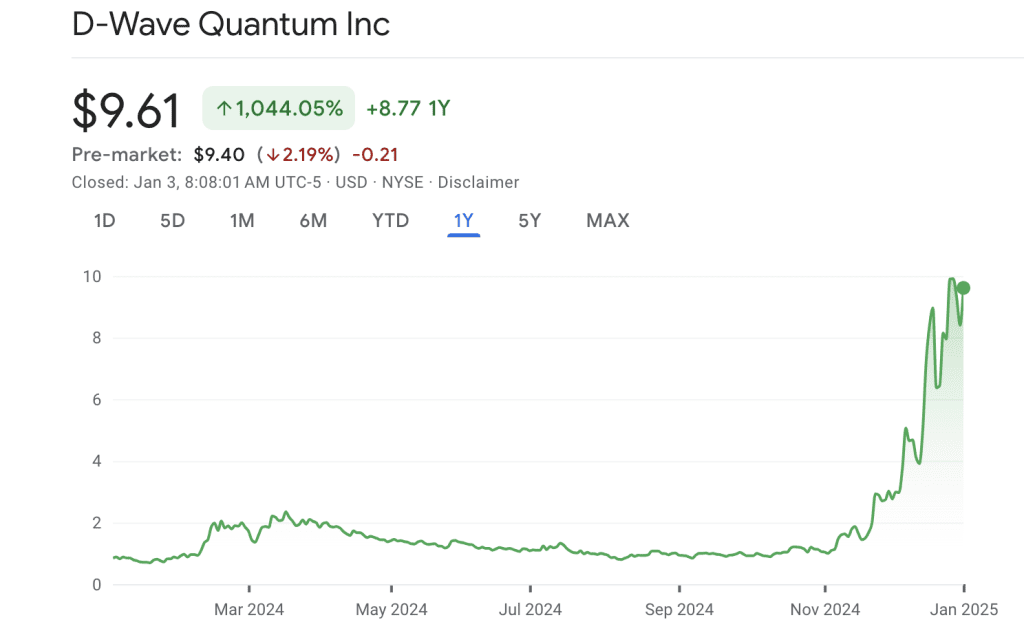
D-Wave is known for building advanced systems and providing related software services. Since launching its first 128-qubit system in 2011, the company has made huge strides, reaching over 5,000 qubits with the Advantage system introduced in 2020. According to the quantum trend, QBTS stock price increased by 1,044.05%, rising by $8.77 over the past year. This marks a significant surge in value and investor confidence in the company, with the quantum stock starting the year trading at a value even below $1 and closing at $9.61 at the end of the period.
In early 2024, D-Wave announced it had developed a prototype of its next-generation system, Advantage2. This prototype features 1,200+ qubits and over 10,000 couplers—double what its earlier prototype offered. This new system promises significant performance improvements compared to the original Advantage platform.
D-Wave Quantum Inc. reported a 41% year-over-year increase in Quantum Computing as a Service (QCaaS) revenue for Q3 2024, reaching $1.6 million. The company expanded its customer base to 132, including 27 Forbes Global 2000 companies.
IBM (NYSE: IBM)
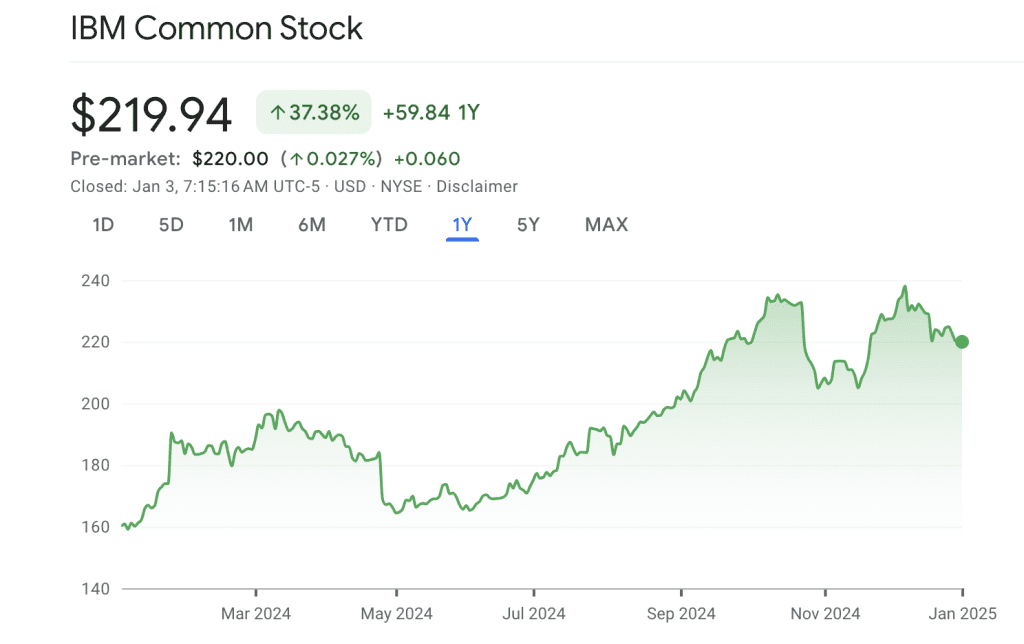
IBM is a well-known American tech giant that has been at the forefront of quantum computing for years. Its IBM Quantum System One was among the first major steps into this cutting-edge field. In 2023, IBM shifted its focus from just increasing qubits to improving the quality of gate operations, aiming to enhance overall computing efficiency. IBM’s stock price increased by 37.38%, a gain of $59.84 over the past year. The stock began the year near $160 and quickly climbed to around $180 by March 2024. However, as volatile as it could be, the stock experienced a slight decline from April to July 2024, dropping below $170 at its lowest and gaining its most substantial growth during Q4, breaking above $220 in November 2024 and closing at $219.94.
That same year, IBM announced a breakthrough in quantum utility, publishing its findings in Nature. By October 2024, the company expanded its reach by opening its first European quantum data center in Germany. It enabled utility-grade quantum services for European clients and strengthened its global presence in the quantum market.
Looking ahead, IBM plans to showcase quantum-centric supercomputing by 2025, scale its systems, and cut costs through 2027. By 2029, the company will deliver a fully error-corrected quantum computer. According to its quantum roadmap, IBM has already hit its 2023 milestones and is on track with its 2024 goals.
Moreover, in terms of its quantum stock, IBM’s stock has risen by 45.8% in 2024, offering investors a solid 2.9% dividend yield. Analysts are generally optimistic, with Evercore ISI maintaining a “buy” rating and a $240 price target, indicating limited upside from the current trading price of approximately $232 per share.
Microsoft Corp. (MSFT)
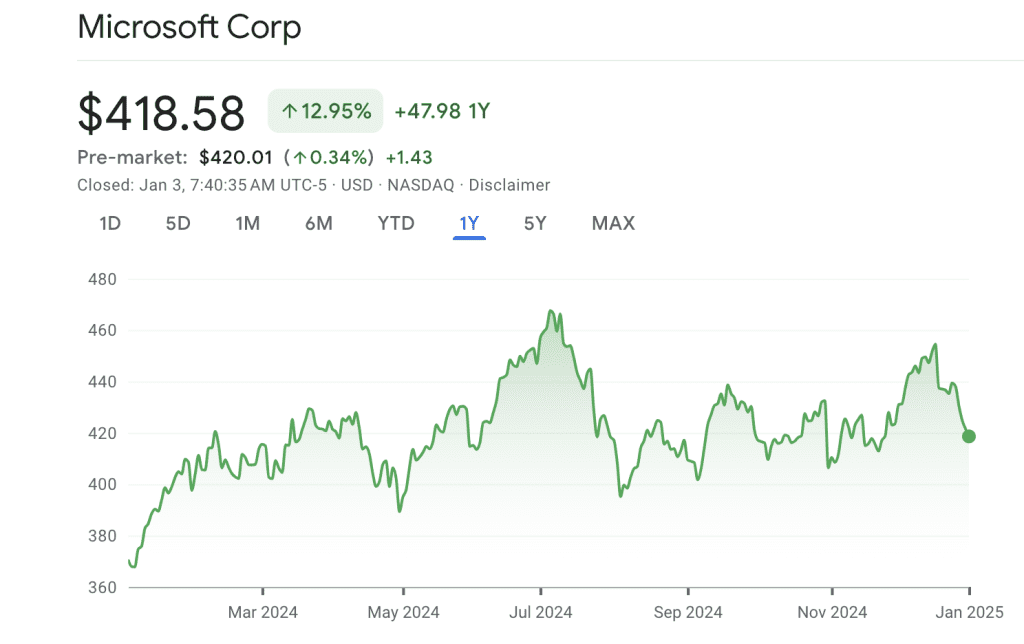
Microsoft reported fourth-quarter revenue of $64.7 billion, a 15% increase compared to the previous year, surpassing analysts’ expectations from Visible Alpha. The company’s net income reached $22 billion, or $2.95 per share, up from $20.08 billion, or $2.69 per share, a year ago, exceeding projections. Starting the year near $370, the stock steadily grew through Q1, reaching approximately $420 by March 2024. It also had a few setbacks during Q2, fluctuating between $400 and $440. It closed at $418.58, reflecting modest but steady growth. Microsoft’s stock price increased by 12.95%, gaining $47.98 over the past year.
In February of this year, Microsoft announced that DARPA had renewed its funding for Azure Quantum. This funding allows them to continue working on a utility-scale quantum computer using topological qubits. The project’s impressive recent progress has been significant. Microsoft will now focus on building a prototype. This prototype will be a fault-tolerant quantum computer based on this advanced technology. The platform will soon offer priority access to reliable quantum hardware. This will help researchers overcome the slow computing speeds. These slow speeds have traditionally held back progress in chemistry, physics, and life sciences.
In November, Microsoft announced a partnership with Atom Computing. They plan to build a cutting-edge quantum supercomputer. It will have 1,000 physical qubits and is set to launch in 2025. This collaboration aims to accelerate Microsoft’s efforts. They want to bring their powerful quantum technologies out of the lab. Their goal is to use them in real-world commercial applications.
Alphabet Inc. (GOOGL)
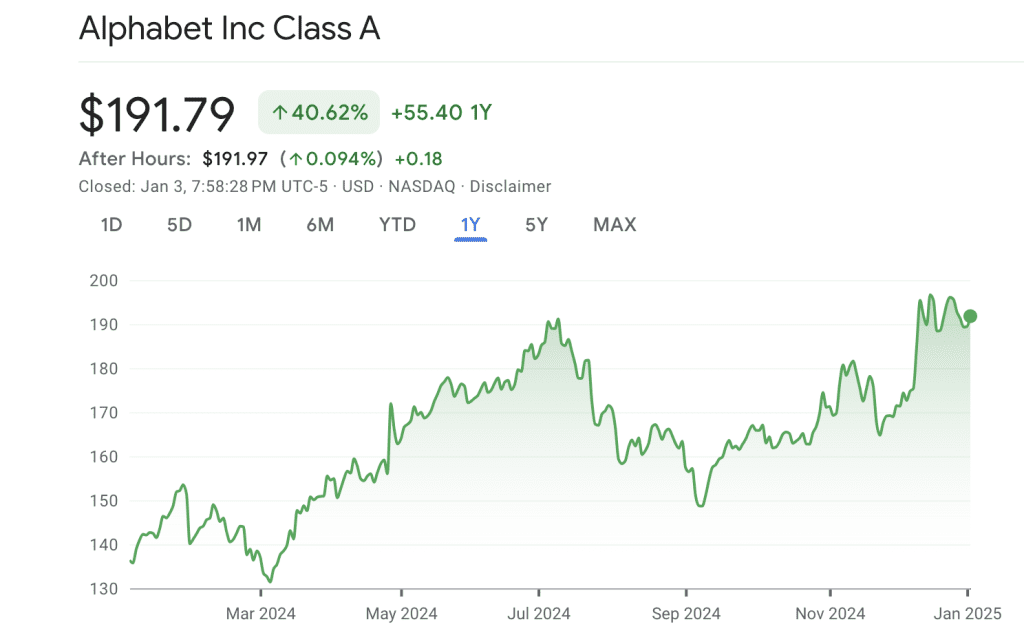
Google, under Alphabet Inc., is one of the leaders in the quantum computing space. The company’s Quantum AI division has been instrumental in advancing quantum supremacy since its landmark achievement in 2019, where its Sycamore processor completed a computation in 200 seconds that would take classical supercomputers thousands of years.
The chart shows a strong upward trend over the past year, with Alphabet Inc. Class A stock (GOOGL) increasing by 40.62% or $55.40 year-over-year. Starting around $130 in early 2024, the stock experienced consistent growth, with notable peaks in July 2024 and November 2024, where it climbed above $190. Although there were some corrections, especially in September 2024, the stock rebounded quickly and achieved near-record highs by the end of 2024.
One of the most significant recent drivers for Google’s quantum stock performance is the unveiling of its “Willow” quantum computing chip. The Willow chip, announced in December 2024, represents a substantial advancement in quantum technology, capable of performing computations in minutes that would take classical supercomputers trillions of years.
Future Outlook for Quantum Stocks
The future of quantum computing is no longer just theoretical—we’re steadily approaching the era of quantum advantage. This is where quantum computers can outperform traditional ones in solving specific, practical tasks. As a result, investments in research and innovation are skyrocketing, with governments and private sectors pouring billions into development.
For instance, China has allocated $10 billion to its National Laboratory for Quantum Information Sciences, while the U.S. and the EU are heavily funding ambitious programs to maintain their competitive edge. And Canada has also joined the quantum race with the launching of its National Quantum Strategy, committing around USD 260 million in investment to bolster its position in the quantum race. So, talk about commitment to innovations, right?
That said, the journey forward isn’t without its challenges, from stabilizing qubits and scaling systems to tackling enormous development costs, these obstacles are slowing the path to widespread commercialization. Thus, quantum stocks still remain highly volatile, reflecting the field’s infancy and the hurdles the industry still faces. Yet, it is still also worth noting that the potential it brings to different industry is already quite evident—as it’s poised to transform industries like healthcare, finance, cybersecurity, and supply chain management by solving problems that classical computers simply can’t handle.