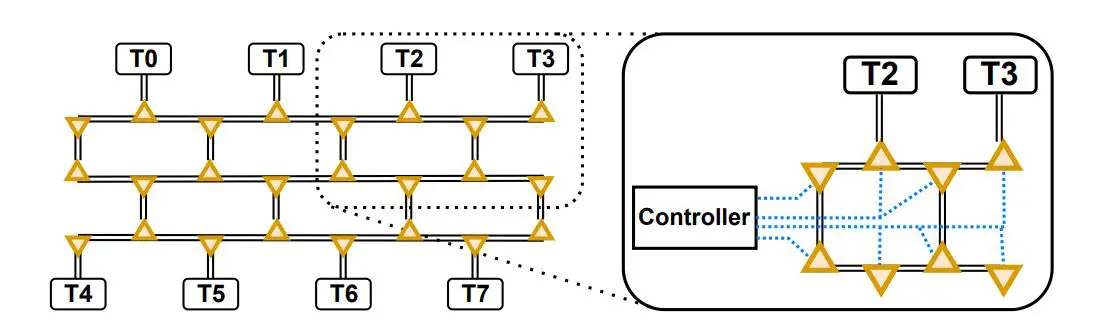
Large-scale computing architectures increasingly rely on efficient communication between processing tiles, but managing data flow in these systems presents significant challenges due to sparse and unpredictable traffic patterns. Phu Khanh Huynh, Francky Catthoor, and Anup Das, from Drexel University and the National Technical University of Athens, address this problem with a novel control system for a segmented ladder bus, a promising interconnect architecture known for its simplicity and energy efficiency. Their research introduces a design methodology that optimises the control plane, minimising its size and power consumption while ensuring it scales effectively with larger networks. By streamlining the control process, the team demonstrates a substantial reduction in the control plane’s area compared to the data plane, paving the way for more efficient and scalable large-scale computing systems.
Scenario-Aware Control for Segmented Ladder Buses
Scientists engineered a novel control plane for segmented ladder bus architectures, a communication infrastructure increasingly used in large-scale neuromorphic computing systems. These systems, designed to mimic the brain, rely on sparse, asynchronous communication patterns where neurons transmit information through brief electrical spikes, creating bursts of activity interspersed with periods of inactivity. The team addressed the need for an interconnect that efficiently handles these bursts while minimizing power consumption during idle times, focusing on the dynamic segmented bus as a promising solution. They recognized that the effectiveness of this bus hinges on a streamlined control mechanism capable of scaling with network size.
The research pioneered a scenario-aware control plane specifically tailored for the segmented ladder bus, a first-of-its-kind design intended to minimize control overhead and optimize energy and area utilization. The team’s approach analyzes application traffic patterns to adapt the control plane, reducing the number of active control scenarios and consequently minimizing memory storage requirements. This optimization significantly reduces the control plane’s area footprint relative to the data plane, making it suitable for deployment in large-scale neuromorphic systems. To validate their design, scientists implemented essential components of the control plane on a field-programmable gate array (FPGA) and conducted a combination of hardware-based and software-based simulations.
These experiments assessed the impact of the scenario-aware optimization on area utilization and scalability. Results demonstrated that the team’s control plane design achieves substantial reductions in resource overhead while maintaining reliable spike transmission. The study successfully demonstrates a scalable and efficient control mechanism for dynamic segmented buses, paving the way for more energy-efficient and larger-scale neuromorphic computing architectures.
Scenario-Aware Control Optimizes Neuromorphic Communication
Scientists have developed a novel control plane for segmented ladder bus architectures, a communication system designed for large-scale neuromorphic computing. This work addresses the challenge of efficiently managing communication in spiking neural networks, which exhibit sparse and dynamic traffic patterns. The segmented ladder bus, characterized by parallel bus lanes connecting rows of processing tiles, offers advantages in energy efficiency and scalability, but requires a streamlined control mechanism to fully realize its potential. The team designed a scenario-aware control plane that minimizes overhead by adapting to frequently occurring communication patterns within the network.
By analyzing application traffic, the control plane reduces the number of active control scenarios, thereby minimizing memory storage requirements and the overall area footprint of the control plane. Experiments demonstrate that this optimized control plane significantly reduces resource overhead while maintaining reliable spike transmission across the network. Implementation and evaluation involved a combination of FPGA implementation and software simulation. Results show the control plane achieves a substantial reduction in area footprint compared to the data plane, demonstrating its suitability for large-scale neuromorphic deployments. This breakthrough delivers a more efficient and scalable communication infrastructure for future neuromorphic computing systems.
Scalable Control for Neuromorphic Interconnects
Researchers have developed a new control methodology for a segmented ladder bus, a dynamic interconnect designed for large-scale neuromorphic systems. This work addresses the need for efficient communication in these systems, which are characterized by sparse and localized neural activity. The team’s approach leverages compile-time traffic analysis to minimize the number of switching scenarios required by the control plane, thereby reducing both control memory and hardware overhead. Evaluation through FPGA implementation and software simulation demonstrates that the resulting control plane remains lightweight, consuming less than 10% of total network resources.
Furthermore, analysis reveals that control complexity grows more slowly than network connectivity, indicating good scalability. The methodology effectively reduces the area footprint of the control plane compared to the data plane, while maintaining performance as network size increases. This research provides an efficient and scalable solution for neuromorphic interconnects, paving the way for larger and more complex neuromorphic computing systems.
🗞 Scenario-Aware Control of Segmented Ladder Bus: Design and FPGA Implementation
🧠 ArXiv: https://arxiv.org/abs/2511.15987