Metal halide perovskites are revolutionising optoelectronics, delivering performance comparable to, or exceeding, established materials, but their production currently relies on toxic solvents and complex processing. Zhaoyi Du, Jiewen Wei, and Ding Ding, alongside colleagues, now demonstrate a significant advance by developing a water-based method for creating highly efficient CsPbBr3 perovskite nanocrystals under normal atmospheric conditions and at room temperature. This innovative approach avoids harmful chemicals and simplifies manufacturing, yielding nanocrystals with a photoluminescence yield exceeding 60 percent. Furthermore, devices incorporating these nanocrystals exhibit exceptional light detection capabilities, achieving a specific detectivity of 1. 2x 10^11 Jones, and paving the way for sustainable and environmentally friendly optoelectronic technologies.
Green Synthesis Stabilizes Cesium Lead Bromide Nanocrystals
This research details a new, environmentally friendly method for creating highly stable cesium lead bromide perovskite nanocrystals, addressing issues of toxicity and instability common in traditional synthesis. The team employed a mixture of malic acid, beta-alanine, and water as a solvent, replacing harmful organic chemicals, and further stabilized the nanocrystals with L-ascorbic acid and oleic acid to prevent degradation and improve long-term performance. Thorough characterization confirmed the formation, size, shape, and optical properties of the synthesized nanocrystals. The resulting nanocrystals demonstrate significantly improved stability against moisture, oxygen, and light compared to those created using conventional methods, showing promising performance in optoelectronic applications, particularly as potential candidates for photodetectors. Researchers propose that the solvent acts as both a solvent and coordinating agent, while the additives passivate surface defects and prevent aggregation, representing a significant advancement in perovskite nanocrystal synthesis and offering a pathway towards more sustainable, stable, and high-performing materials for next-generation optoelectronic devices.
Water-Based Solvent Enables Perovskite Nanocrystal Synthesis
Scientists have developed a new water-based solvent system capable of dissolving lead halide compounds at high concentrations at room temperature, overcoming their inherent low solubility in water and enabling a new synthetic route for creating size-controlled cesium lead bromide perovskite nanocrystals. This method eliminates the need for toxic organic solvents traditionally used in perovskite production, addressing significant environmental and health risks associated with scaling up manufacturing. This approach involves dissolving lead halide precursors in the specially formulated water-based solvent, followed by the addition of cesium bromide, immediately triggering nanocrystal nucleation and growth. Scientists carefully controlled reaction parameters to achieve precise size control over the resulting nanocrystals, which exhibit a photoluminescence quantum yield exceeding 60 percent. Fabricated photoconductors achieved a specific detectivity of 1. 2x 10^11 Jones, underscoring the high quality and functionality of the water-synthesized nanocrystals and paving the way for environmentally friendly and sustainable optoelectronic technologies.
Water-Based Synthesis of High-Efficiency Perovskite Nanocrystals
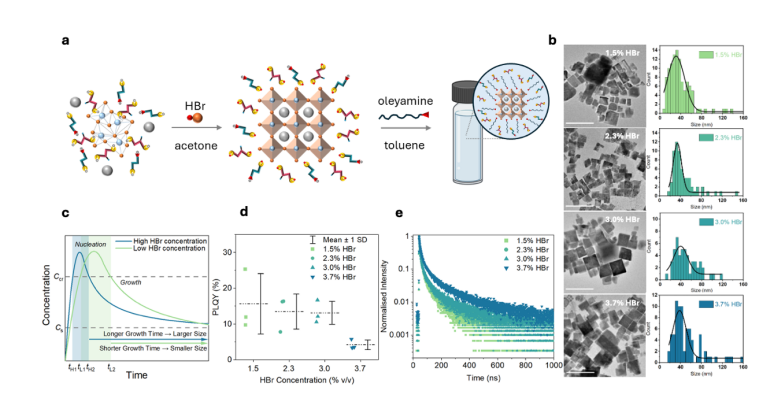
Scientists have achieved a breakthrough in the synthesis of cesium lead bromide perovskite nanocrystals, developing a water-based solvent system and ambient air process for production at room temperature. This innovative approach overcomes the reliance on toxic solvents traditionally used in perovskite manufacturing, offering a sustainable and scalable pathway for optoelectronic applications. Experiments reveal that the resulting nanocrystals exhibit a photoluminescence quantum yield exceeding 60 percent, demonstrating high efficiency in light emission. The research team investigated the roles of betaine, methylamine, lead bromide, and hydrobromic acid in controlling nanocrystal size and properties, successfully synthesizing size-controlled nanocrystals ranging from less than 5 nanometers to 100 nanometers.
Measurements of solution conductivity demonstrate that the combination of betaine and methylamine creates a conductive environment crucial for precursor dissolution and nanocrystal formation. To demonstrate potential, the team fabricated photoconductors, achieving a specific detectivity of 1. 2x 10^11 Jones, delivering a green, scalable, and low-cost method for precise control over nanocrystal size and composition.
Water-Based Synthesis of Bright Perovskite Nanocrystals
This research demonstrates a new method for creating highly efficient cesium lead bromide perovskite nanocrystals, achieving a significant advance in sustainable optoelectronic materials. Scientists developed a water-based solvent system, utilizing malic acid and beta-alanine, to synthesize these nanocrystals directly in ambient air and at room temperature, avoiding the need for toxic solvents and high-temperature processing. Detailed analysis revealed specific interactions between the solvent components and precursor materials, providing insight into the nanocrystal growth process and enabling control over their size and uniformity. The resulting nanocrystals exhibit strong luminescence, with quantum yields exceeding 60 percent, and demonstrate tunable size depending on the synthesis conditions.
To showcase their potential, the team fabricated photodetectors from these nanocrystals, achieving a specific detectivity of 1. 2x 10^11 Jones, indicating a high level of sensitivity to light. This work establishes a simple, sustainable, and scalable route for producing high-performance perovskite nanocrystals, paving the way for environmentally friendly optoelectronic devices.
🗞 Aqueous Preparation of CsPbBr3 Perovskite Nanocrystals Under Ambient Conditio
🧠 ArXiv: https://arxiv.org/abs/2510.18366