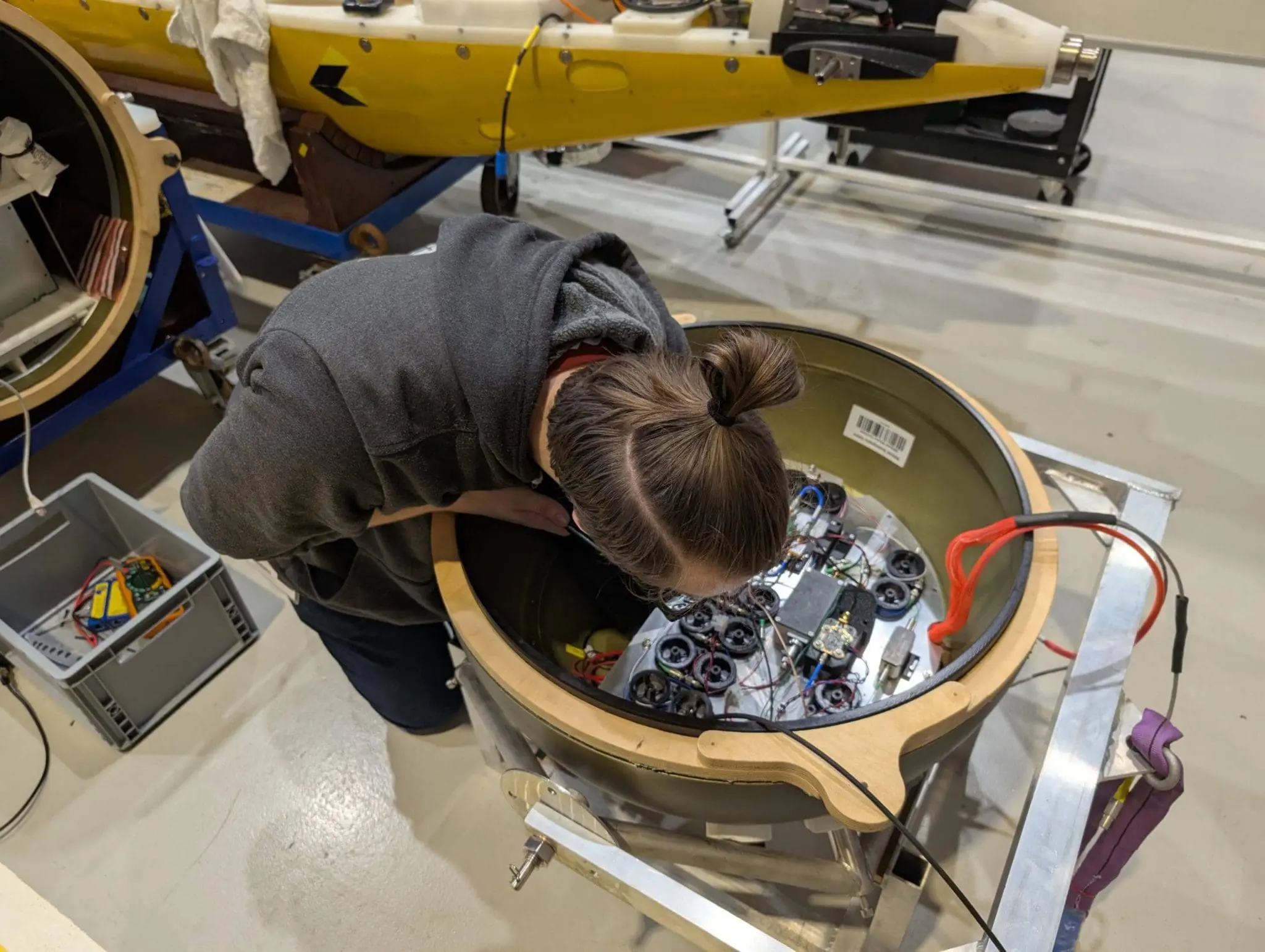
Aquark Technologies, a Southampton-based startup specializing in quantum-enabling technologies, has announced the successful trapping of cold atoms underwater for the first time, utilizing the National Oceanography Centre’s (NOC) autonomous submersible vehicle, Boaty McBoatface.
This achievement was accomplished during trials conducted in NOC’s indoor test tank, where Aquark’s AQuest system demonstrated the ability to continuously trap cold atoms under dynamic conditions, collecting data on performance metrics across varying temperatures and pressures. The collaboration highlights advancements in quantum sensing applications, including navigation, medical diagnostics, and environmental monitoring, by overcoming challenges associated with isolating systems underwater for laser cooling.
Southampton-based startup Aquark Technologies, which specialises in reducing the size, weight, power consumption, and cost of quantum-enabling technologies, successfully and continuously trapped cold atoms in dynamic conditions underwater for the first time. The Company trialled its ultra-cold atom source in NOC’s massive indoor test tank.
The result? A boatload (pun intended) of data was collected about the system’s behaviour and robustness in these challenging conditions, including performance metrics at different temperatures and pressures. The insights gathered will support improvements to the reliability of Aquark’s cold atom systems, which could be used in applications like advanced navigation, medical diagnostics, and environmental monitoring.
What makes the trial remarkable is that laser
What makes the trial remarkable is that laser cooling atoms is only possible when a system is completely isolated from most external disturbances. This means forming ultra-cold atom clouds poses a big engineering challenge, even on dry land. Aquark Technologies and NOC overcame these challenges with ease.
This extreme sensitivity makes cold atoms the perfect choice for quantum sensing applications since noise can be selectively reintroduced, allowing for an unprecedented level of precision for measurement, surpassing the limitations of classical sensors.
Andrei Dragomir, Co-Founder & CEO, Aquark Technologies, said: “Seeing our platform work alongside NOC’s Autosub – known as Boaty McBoatface – was a real win for both science and fun. It was fantastic to demonstrate the compatibility of our platform with the ALR’s pressure vessel, and the resounding success of this trial has opened new doors for research enabled by quantum technologies.
In the future, we may be able to measure the density of minerals under the sea floor using gravity measurements or perform high-sensitivity magnetic field measurements, giving scientists new ways of seeing previously hidden things. We may even uncover some hidden treasures!”
Villius Atkočius, Quantum Systems Engineer,AquarkTechnologies, said: “This is
Villius Atkočius, Quantum Systems Engineer, Aquark Technologies, said: “This is the first time a cold atom trap has been tested underwater, and we have achieved it with our unique Super Molasses Trap (SMT). The underwater world is less understood than space, so the potential for this is huge. Gravity sensing platforms like Aquark’s SMT are more reliable than traditional magnetic field sensing when working for long periods underwater or near the polar regions. With this trial with the NOC, we have shown the platform works, and we expect real-life applications to follow quickly after.”
Dr Alex Phillips, Head of Marine Autonomous and Robotics Systems at NOC said, “Quantum sensing has the potential to make a substantial contribution to underwater navigation and seabed imaging. These initial tests illustrate that quantum technologies are now close to making the transition out of the laboratory and into underwater vehicles like Autosub Long Range”.
External Link: Click Here For More