

Recent advances in laser technology now generate intense, ultra-short pulses capable of accelerating ions to energies previously unattainable with conventional accelerators. These compact, laser-driven ion sources promise significant benefits for applications including cancer therapy, isotope production, and materials science. Achieving the necessary beam quality and stability for these applications presents a considerable challenge, stemming from the inherent instability of the acceleration process and the complex interaction between the laser pulse and the target material. Therefore, a thorough understanding of the underlying physics governing laser-driven ion acceleration is crucial for optimising beam characteristics and realising the full potential of this technology. This research focuses on developing a comprehensive model that accurately describes the laser-target interaction and predicts the characteristics of the accelerated ion beam, identifying optimal conditions for achieving high-quality, stable ion beams suitable for practical applications.
Laser Wakefield Acceleration and Electron Beam Control
This collection of references details research into laser wakefield acceleration (LWFA), beam physics, and techniques for characterizing and controlling electron beams produced in these accelerators. Studies address fundamental LWFA theory, laying the groundwork for understanding plasma waves, electron trapping, and acceleration mechanisms, as well as beam loading and multi-stage acceleration techniques to improve energy gain and beam quality. Research also focuses on injection and trapping mechanisms, exploring methods for injecting electrons into the accelerating plasma wave, and manipulating the plasma density profile to optimise acceleration and beam quality. Beyond acceleration, the research details beam characterization and diagnostics, including single-shot reconstruction of beam properties like energy, charge, and emittance, utilizing spectroscopy, diffraction, and emittance measurement techniques. Furthermore, the research covers beam control and manipulation, including feedback control systems to stabilize laser pulses and optimize plasma conditions, as well as chirp control to manipulate the electron beam’s energy spread. Advanced concepts such as beam-driven plasma wakefield acceleration, high-brightness beams, all-optical acceleration, and coherent control are also investigated, utilizing particle-in-cell (PIC) simulations.
Electron Beam Mapping Reveals Wakefield Structure
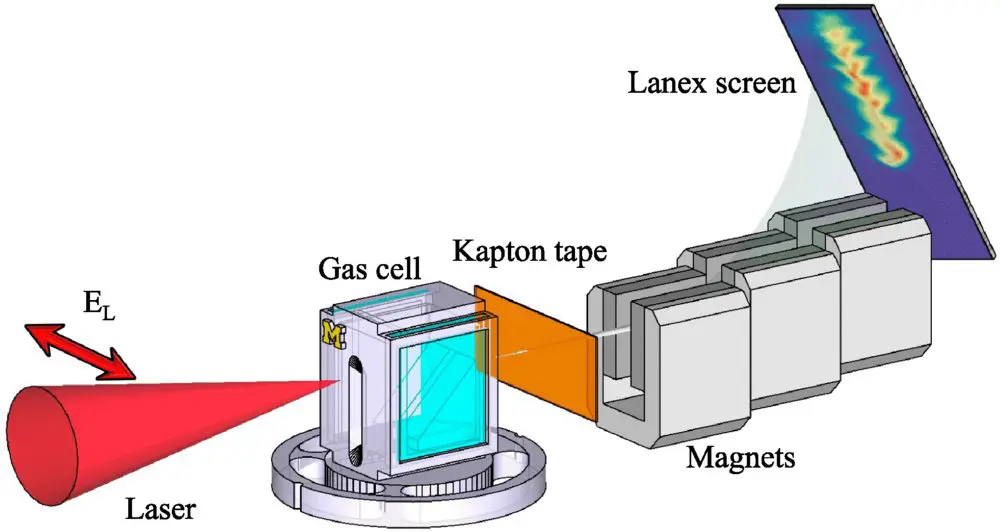
Researchers have developed a technique for fully mapping ultrashort electron beams, a crucial step towards creating compact next-generation x-ray free-electron lasers. This breakthrough addresses a significant challenge in laser wakefield acceleration, where characterizing the electron beam properties has been exceptionally difficult. Experiments revealed a distinctive herringbone structure in the electron spectra, directly linked to the interplay between electron motion within the laser-driven wakefield and the oscillating laser fields. By establishing a theoretical model and applying a novel reconstruction method, scientists demonstrated quantitative agreement between experimental results and theoretical predictions, confirming the accuracy of the model and highlighting the potential to extract detailed information about the electron beam.
The research demonstrates that the longitudinal momentum of electrons is intricately linked to their transverse displacement and momentum, governed by a relationship influenced by betatron oscillations within the wakefield. Furthermore, the team showed that the transverse motion of electrons follows the behavior of a damped, forced harmonic oscillator, providing a clear understanding of how electrons respond to the combined forces of the laser and the wakefield. By accurately modeling these interactions, scientists can now reconstruct the complete phase space distribution of the electron beam, paving the way for optimized laser designs and improved x-ray source performance.
Single-shot Electron Beam Phase Space Reconstruction
This research presents a new method for fully reconstructing the longitudinal phase space of electron beams produced by laser wakefield acceleration, a promising technique for creating compact particle accelerators. By modelling the coupled motion of electrons within the accelerating plasma and the oscillating laser fields, the team successfully reconstructed key beam parameters including energy distribution, spatial distribution, and pulse duration, with high resolution. The technique directly reveals the slice energy spread of the electron beam, a crucial characteristic for many scientific applications. The method demonstrated single-shot reconstruction capabilities, offering a significant advancement for diagnosing high-quality electron beams. While the current work focuses on laser wakefield acceleration, the theoretical model and reconstruction approach are broadly applicable to electron beams from traditional accelerators, potentially improving diagnostics across the entire field.
🗞 Single-Shot Reconstruction of Electron Beam Longitudinal Phase Space in a Laser Wakefield Accelerator
🧠 DOI: http://link.aps.org/doi/10.1103/sxqf-l6mp


