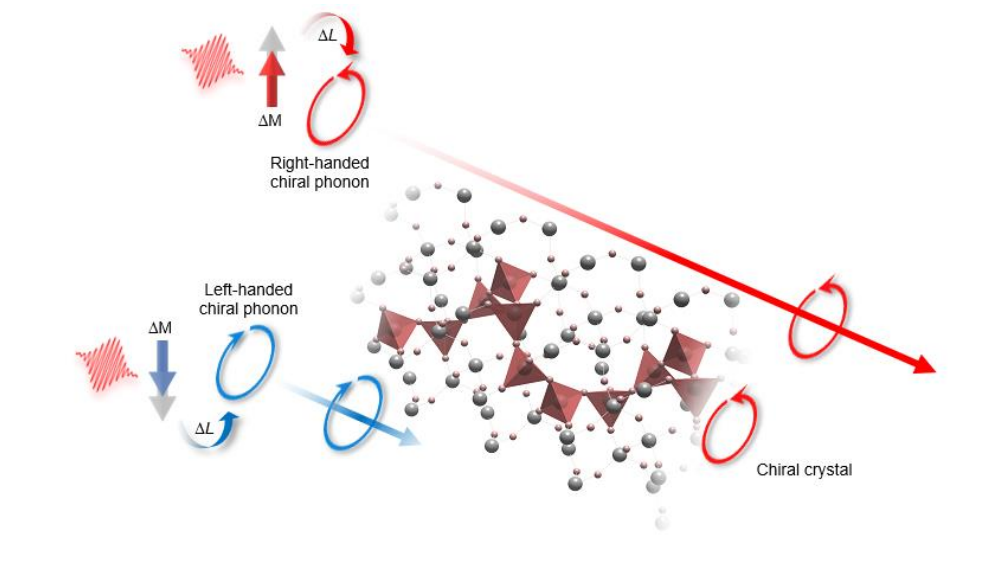
Controlling heat flow at the nanoscale presents a significant challenge for modern electronics, and researchers are actively exploring innovative materials and methods to address this issue. In Hyeok Choi, Daeheon Kim, Yeon Jong Jin, and colleagues at various institutions demonstrate a new approach to thermal management using a unique combination of materials. They fabricate a nanoscale thermal switch that selectively conducts heat based on its chirality, a property related to its ‘handedness’, and controlled by an external magnetic field. The team’s experiments reveal that the thermal conductivity of a chiral silicon dioxide material changes dramatically depending on the magnetization direction of an adjacent ferromagnetic material, achieving a thermal on/off ratio exceeding one. This work represents the first experimental demonstration of a chirality-selective thermal switch, paving the way for more efficient heat dissipation in future nanoscale devices.
Chiral-lattice degrees of freedom offer novel chirality-selective functionalities for thermotronic applications. Chiral phonons, which carry both heat and angular momentum, emerge when chiral symmetry is broken within the material’s phonon bands, a breaking occurring through intrinsic crystal structure or angular momentum transfer from photons or spins. This controllability of lattice dynamics enables new approaches to manipulating heat flow and angular momentum within materials, potentially leading to advanced thermotronic devices.
Chiral Phonons Enhance Spin Seebeck Effect
Scientists have discovered that chiral phonons in oxide heterostructures can induce and enhance the Spin Seebeck Effect (SSE). The SSE converts a temperature gradient into a spin current, and this research demonstrates that the chirality of the phonons plays a crucial role in this process, enabling more efficient transfer of angular momentum between the spin system and the phonons. The team observed, for the first time, real-time angular momentum transfer from spins to chiral acoustic phonons, a key mechanism for manipulating spin currents using phonon-based techniques. The research utilizes oxide heterostructures, known for their complex properties and potential for hosting novel phenomena.
The team employed time-resolved measurements to observe the dynamics of angular momentum transfer and fabricated heterostructures with specific properties to host chiral phonons. Spectroscopic techniques characterized the phonon modes and their chirality, and computational methods, such as density functional theory, modeled the phonon modes and their interaction with spins. This research could lead to the development of new spintronic devices that utilize chiral phonons to control spin currents and improved thermal management technologies, potentially enabling energy harvesting from temperature gradients.
Magnetization Controls Chirality-Selective Thermal Switching
Scientists have demonstrated a nanoscale chirality-selective thermal switch using a heterostructure composed of ferromagnetic materials and insulating chiral silicon dioxide. The work reveals that external magnetic fields can control thermal transport properties within this structure, opening new avenues for heat management in nanoscale devices. Experiments, based on magneto-optic thermometry, show that the thermal conductivity of the silicon dioxide is demonstrably dependent on both the magnetization direction of the ferromagnetic layers and the structural chirality of the silicon dioxide itself, a finding supported by first-principles molecular dynamic simulations. Researchers observed a magnetization-dependent thermal on/off ratio of 1.
07 at room temperature, increasing to approximately 1. 2 as the temperature decreases to 50 Kelvin, attributed to reduced phonon-phonon scattering within the silicon dioxide at lower temperatures. They observed a 7% difference in the thermal conductivity of the silicon dioxide by reversing the magnetization in the ferromagnetic multilayer, confirming the chirality-selective heat transfer. Molecular dynamics simulations indicate that the conservation of angular momentum in chiral phonons plays a crucial role in heat propagation from the ferromagnetic layer into the silicon dioxide, resulting in distinct temperature profiles dependent on the phonon chirality. These findings demonstrate that chiral degrees of freedom in phonons strongly influence thermal transport, offering a new approach to realizing chirality-selective nano-thermal switches through heterostructuring with ferromagnets.
Chirality Controls Heat at Nanoscale
This research demonstrates the successful creation of a nanoscale chirality-selective thermal switch, achieved through a heterostructure combining ferromagnetic materials and chiral silicon dioxide. The team experimentally confirms that thermal conductivity within the silicon dioxide is demonstrably influenced by both the magnetization direction of the ferromagnetic layer and the inherent structural chirality of the silicon dioxide itself. This control over thermal transport is achieved by leveraging chiral phonons, which carry both heat and angular momentum, and their interaction within the heterostructure. The researchers observed a thermal on/off ratio of 1.
07 at room temperature, increasing to 1. 2 at 50 Kelvin, attributed to reduced phonon-phonon scattering within the chiral silicon dioxide at lower temperatures. First-principles calculations support these findings, providing detailed insight into the angular momentum transfer processes occurring at the interface between the ferromagnetic and chiral materials. This work represents the first experimental demonstration of this type of switch, offering a potential solution to heat dissipation challenges in increasingly miniaturized electronic devices and providing a foundational blueprint for developing prototype nanoscale thermal control devices with broad applicability in advanced electronics.
🗞 Demagnetization-Driven Nanoscale Chirality-Selective Thermal Switch
🧠 ArXiv: https://arxiv.org/abs/2509.24205