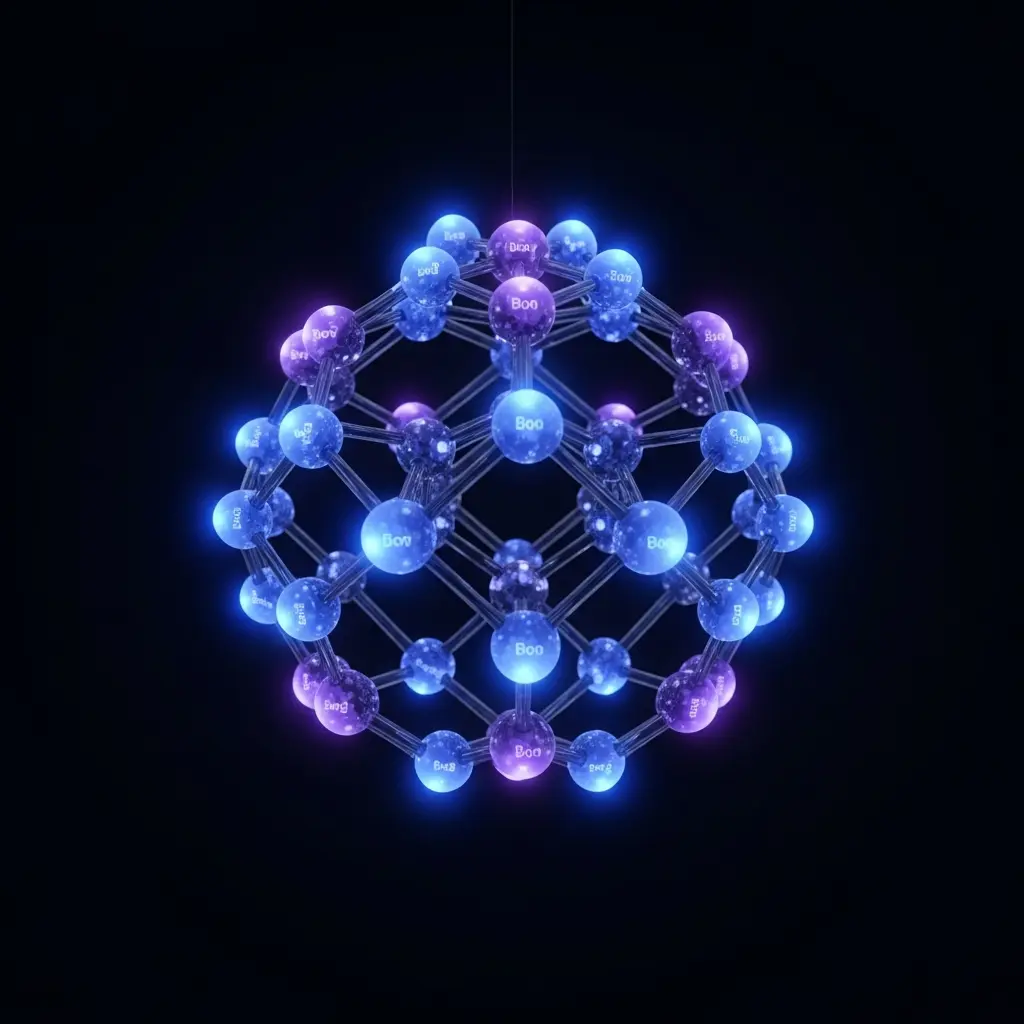
Boron cages represent a fascinating frontier in materials science, offering potential for applications ranging from lightweight structural materials to advanced optoelectronics, and a new investigation delves into their fundamental properties. Kashinath T. Chavan, from the Indian Institute of Technology Bombay, Ihsan Boustani of Bergische Universität Wuppertal, and Alok Shukla, also from IIT Bombay, systematically explore the geometry, electronic structure, and optical properties of these cage-like boron clusters, ranging in size from 20 to 122 atoms. Their calculations, performed using advanced density-functional theory, reveal that specific cage sizes, notably those containing 32 and 92 atoms, exhibit exceptional stability. Importantly, the team’s analysis of light absorption demonstrates that these boron cages could function effectively in optoelectronic devices, potentially harnessing visible light for technological applications.
Through density-functional theory calculations, scientists determined the dynamic and thermodynamic stability of these cage-like structures by analyzing vibrational frequencies and binding energies per atom. The findings reveal that the 32-atom and 92-atom cages exhibit the greatest stability among smaller and larger clusters, respectively, with binding energies increasing initially up to a cluster size of 42 atoms before plateauing. The team also explored the optical properties of these clusters using time-dependent density-functional theory, discovering that their absorption spectra fall within the visible light spectrum. This suggests potential applications in optoelectronic devices, and the inherent cage structure offers opportunities for encapsulating atoms or molecules, potentially tailoring the clusters’ properties for specific applications in optoelectronics and spintronics.
Boron Cluster Stability and Isomeric Structures
Scientists have systematically investigated the structural, electronic, and optical properties of cage-like boron clusters containing between 20 and 122 atoms, employing density-functional theory. Through geometry optimization and vibrational frequency analysis, researchers determined the stable configurations of these clusters, revealing that most retain a cage-like geometry, with the exception of the B42 cluster which exhibits distortion. The team identified that the 32- and 92-atom cages are the most thermodynamically stable among the smaller and larger structures studied, as determined by calculating binding energies per atom. Detailed analysis of the B20 cage revealed two isomers, one with D5h symmetry and the other a dodecahedral structure, exhibiting similar binding energies. Calculations of binding energies per atom demonstrate that the stability of these clusters is directly related to their atomic arrangement and electronic structure. Furthermore, the team computed the optical absorption spectra of these boron cages using time-dependent density-functional theory, revealing potential applications in optoelectronic devices within the visible range of the spectrum.
Boron Cluster Stability and Optical Properties
Scientists have systematically investigated the structural and electronic properties of boron clusters, ranging in size from 20 to 122 atoms, using density-functional theory. The research team employed vibrational frequency analysis to confirm the dynamic stability of each cluster, and calculated binding energies per atom to assess thermodynamic stability, revealing that the 32- and 92-atom cages are the most stable among the smaller and larger structures examined. To explore potential optoelectronic applications, the team utilized time-dependent density-functional theory to determine the absorption spectra of these cages, suggesting their suitability for devices operating in the visible range. The research provides a comprehensive understanding of boron cluster properties and lays the groundwork for future materials design.
🗞 Geometry, electronic structure, and optical properties of boron cages: A first-principles DFT study
🧠 ArXiv: https://arxiv.org/abs/2512.20114