
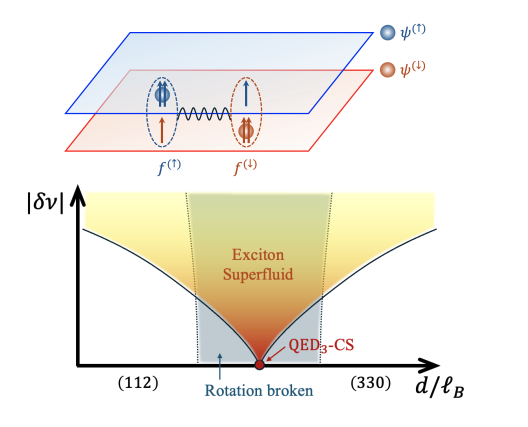
The exotic behaviour of particles with fractional statistics, known as anyons, promises revolutionary advances in quantum computing, but realising and controlling these particles remains a significant challenge. Zhaoyu Han of Harvard University, alongside Taige Wang and Zhihuan Dong from the University of California, Berkeley, and their colleagues, now demonstrate a pathway towards achieving this control by exploring the potential for ‘anyonic exciton superfluidity’ in specifically layered materials. Their work reveals that carefully constructed bilayers, combining two quantum Hall states, can host excitons, bound pairs of electrons, that behave as neutral anyons, flowing without resistance in a novel superfluid state. This discovery is significant because it not only provides a new platform for studying anyonic behaviour, but also predicts specific, measurable properties of this superfluidity, including an unexpectedly strong resistance to disruption, offering a clear route for experimental verification and potentially paving the way for robust quantum technologies.
Composite Fermion Pairing and Novel States
Researchers have constructed a novel quantum Hall-like state from composite fermions, quasiparticles formed when electrons bind to magnetic flux quanta. This state arises through a specific pairing mechanism and exhibits unique properties, potentially displaying exotic topological order. The team details a theoretical framework, considering the effects of disorder, and predicts how the system’s properties change as it transitions into this new state, focusing on the interactions and arrangement of these composite fermions. The foundation of this work lies in composite fermions, which behave as fermions even in strong magnetic fields.
The pairing of these composite fermions is crucial, leading to an effective theory that describes the system’s behavior and aims to create a state with non-trivial topological order, meaning its properties are robust against local disturbances. The influence of disorder is also considered, as it can affect the stability of the state. The team’s analysis reveals that disorder can localize the composite fermions, but the transition into the new state occurs through a process called a plateau transition, similar to those observed in conventional quantum Hall systems. The spin conductivity, a key measurable property, is calculated to characterize this transition and the new state’s properties, predicting a novel quantum Hall-like state that is robust against disorder and offers a pathway to identify and study this exotic state of matter.
Anyonic Exciton Superfluidity in Quantum Hall Systems
Researchers have discovered a novel state of matter, an anyonic exciton superfluid, within bilayer quantum Hall systems. This discovery centers on the behavior of neutral particles, anyons, formed when electrons occupy two closely spaced layers and experience a density imbalance. Unlike conventional materials, anyons exhibit fractionalized statistics, and the team demonstrates that introducing these anyons into the quantum Hall fluid creates a superfluid, a state of matter with zero viscosity, allowing it to flow without resistance. The research focuses on transitions between different quantum Hall states, specifically within the Jain sequence, a series of fractions representing electron densities.
By carefully tuning the separation between the layers and the density imbalance, researchers observed transitions indicative of a fundamental change in the system’s properties, described by a theoretical framework called Chern-Simons QED, which predicts the emergence of Dirac dispersion for the anyons, significantly influencing their behavior and interactions. A striking finding is the unexpectedly large superfluid stiffness observed near these transitions. This stiffness, a measure of the superfluid’s resistance to flow disturbances, is significantly enhanced when the anyons are ‘cheap’ and ‘light’, suggesting the superfluid state is energetically favored near the transition points, offering a pathway to stabilize and control this exotic state of matter. This discovery builds upon previous observations of Coulomb drag and conductance features, providing a comprehensive framework to explain these experimental findings and opens new avenues for exploring novel technologies, including fault-tolerant quantum computers and materials with unprecedented properties.
Anyon Superfluidity in Bilayer Quantum Hall Systems
This research demonstrates the possibility of ‘anyonic exciton superfluidity’ in bilayer quantum Hall systems, a charge-neutral counterpart to anyon superconductivity. The team shows that when two layers of electrons each exhibit the fractional quantum Hall effect, introducing a small density of excitons, bound pairs of electrons, can lead to a superfluid state composed of these anyons, predicted to be particularly robust near specific filling fractions and layer separations, exhibiting an unusually large superfluid stiffness and a unique energy scaling. The findings suggest that bilayer quantum Hall systems offer a controllable platform for studying anyon superfluidity and exploring novel topological phases of matter. The theoretical framework developed predicts specific properties of this superfluid, including the pseudospin and angular momentum of the excitons within it, and proposes the possibility of realizing “spin nematic” order through doping higher Jain fractions. Researchers are investigating the transitions between different states to determine if they are continuous, and their calculations align with existing experimental data, providing concrete predictions for future measurements, such as identifying critical points in conductance measurements. Future work will focus on numerically confirming the continuous nature of these transitions and further exploring the potential for realizing exotic topological orders within these systems, providing a pathway to understanding and manipulating anyonic exciton superfluids, potentially leading to new materials and technologies based on the unique properties of these exotic states of matter.
👉 More information
🗞 Anyon superfluidity of excitons in quantum Hall bilayers
🧠 ArXiv: https://arxiv.org/abs/2508.14894