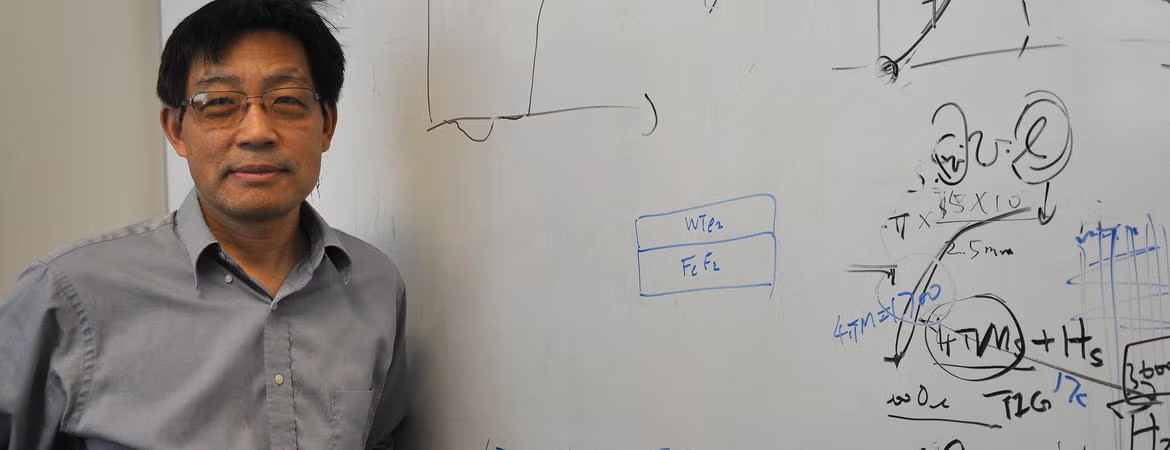
UC Riverside has received a $4 million award for leading a three-year project exploring antiferromagnetic spintronics for advanced memory and computing. The team collaborates with UC San Diego, UC Davis, UCLA, and Lawrence Livermore National Laboratory to develop ultrafast, high-density alternatives to current ferromagnetic technologies, leveraging quantum phenomena like exchange interaction and spin superfluidity. The research focuses on antiferromagnets’ potential in-memory storage and computing applications, including magnetic neural networks, with implications for next-generation microelectronics and domestic semiconductor production under the CHIPS Act.
UC Riverside Receives Funding For Antiferromagnetic Spintronics Project
UC Riverside has been awarded nearly $4 million from the UC National Laboratory Fees Research Program to advance research into antiferromagnetic spintronics, a cutting-edge technology with potential applications in memory and computing. This three-year project seeks to harness the unique properties of antiferromagnetic materials to develop faster and more compact alternatives to current ferromagnetic technologies.
Antiferromagnetic spintronics operates by exploiting the intrinsic angular momentum of electrons, known as spin. Unlike ferromagnetic materials, where electron spins align in the same direction, antiferromagnetic materials exhibit alternating spin directions. This property results in no net magnetic moment, enabling higher density memory storage as neighboring bits do not interfere with each other. Additionally, the absence of a net magnetic moment allows for faster memory writing due to quicker spin dynamics driven by exchange interaction.
The project involves researchers from UC Riverside and other institutions, leveraging advanced characterization techniques and computational modeling to design novel antiferromagnetic materials. These materials are expected to overcome current limitations in data storage and processing speed while reducing energy consumption.
Potential Applications In Computing And Neural Networks
Beyond memory applications, antiferromagnetic materials hold promise for advanced computing architectures such as magnetic neural networks. Certain types of antiferromagnets, like easy-plane antiferromagnets, can efficiently propagate spin pulses over long distances with minimal energy loss. This capability is facilitated by spin superfluidity, a quantum mechanical phenomenon where spin states move through the material with little dissipation.
These properties could enable ultra-low-power computing and enhanced processing capabilities for artificial intelligence applications in magnetic neural networks. Researchers are exploring how antiferromagnetic materials can be integrated into neuromorphic devices to mimic biological neural networks more effectively than traditional silicon-based systems.
Challenges And Future Prospects Of The Research Project
Despite the potential of antiferromagnetic spintronics, several challenges remain. These include identifying suitable materials with stable antiferromagnetic properties at room temperature and developing scalable fabrication techniques for device integration. Additionally, understanding the fundamental mechanisms governing spin dynamics in antiferromagnetic systems requires further research.
The UC Riverside project addresses these challenges through a multidisciplinary approach combining material science, physics, and engineering. By overcoming these barriers, the researchers aim to unlock the full potential of antiferromagnetic spintronics for next-generation memory and computing technologies. Success could lead to transformative advancements in data storage, processing speed, and energy efficiency across various industries.
The project represents a significant step forward in leveraging quantum mechanical properties for practical applications, with implications for fields ranging from artificial intelligence to green energy solutions. As the research progresses, it is expected to contribute valuable insights into the behavior of antiferromagnetic materials and their real-world applications.
More information
External Link: Click Here For More