

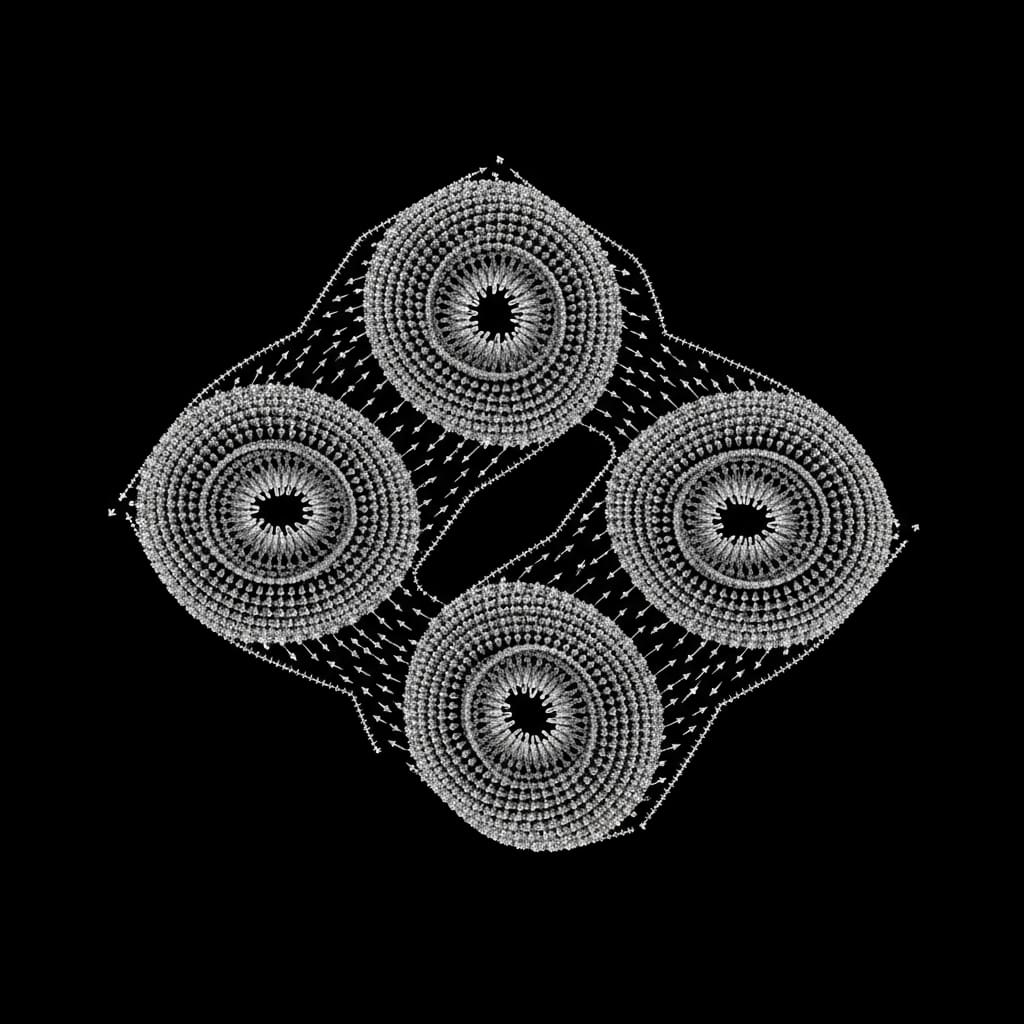
Magnetic skyrmions hold considerable promise for future data storage technologies, and researchers are increasingly focused on antiferromagnetic versions due to their enhanced stability. Inés Corte, Federico Holik, and Lorena Rebón, all from the Instituto de Física La Plata (CONICET-UNLP) and Universidad Nacional de La Plata, alongside Flavia A Gómez Albarracín from the Instituto de Física de Líquidos y Sistemas Biológicos (CONICET-UNLP), have now investigated these elusive quasiparticles within the antiferromagnetic spin-1/2 Heisenberg model on a triangular lattice. Their work, utilising the density matrix renormalization group algorithm, identifies and characterises a stable three-sublattice antiferromagnetic skyrmion texture across a broad range of magnetic fields , a significant step towards realising robust and efficient magnetic memory devices. This research addresses a crucial gap in the field, providing vital insights into the behaviour of antiferromagnetic skyrmions and paving the way for their potential application in next-generation technologies.
Quantum Skyrmions Stabilised in Antiferromagnetic System offer novel
Scientists have demonstrated the stabilization of quantum antiferromagnetic skyrmion textures within a two-dimensional spin-1/2 Heisenberg model on a Triangular lattice. This breakthrough, achieved using the density matrix renormalization group (DMRG) algorithm, unveils a pathway towards novel data storage applications by exploring the quantum properties of these swirling magnetic textures. The research team meticulously investigated the phases of the antiferromagnetic system, incorporating Dzyaloshinskii-Moriya interactions, crucial for skyrmion formation, and applied an external magnetic field to induce and characterise the emergence of these quantum states. Crucially, the study focuses on antiferromagnetic skyrmions, which exhibit a significant advantage over their ferromagnetic counterparts by eliminating transverse deflection, a critical feature for reliable data storage.
Experiments show that three-sublattice antiferromagnetic skyrmion textures are remarkably stable across a wide range of magnetic fields, indicating their potential robustness for practical applications. The researchers employed DMRG, a powerful computational technique originally developed for one-dimensional systems but successfully adapted for two-dimensional lattices, to compute the ground states of the model Hamiltonian. This involved detailed analysis of the magnetization profile, spin structure factor, and Quantum entanglement of the resulting ground states, providing a comprehensive characterization of the observed phases and confirming the presence of these unique quantum skyrmions. The work establishes a clear connection between the model Hamiltonian and the emergence of antiferromagnetic skyrmions in a classical spin scenario, paving the way for understanding their quantum behaviour.
The study reveals that the system transitions through distinct magnetic phases as the magnetic field is varied. At lower fields, interpenetrated helices emerge, forming an antiferromagnetic helical pattern, which then evolves into the skyrmion lattice as the field increases. Researchers carefully calculated the magnetization and magnetic susceptibility to map out these phase transitions and identify the conditions conducive to skyrmion formation. Furthermore, the team analysed the chirality, a measure of the swirling nature of the spin texture, and computed the structure factor to provide detailed insights into the spin arrangement and confirm the topological nature of the observed skyrmions.
This research establishes a significant advancement in the field of quantum magnetism, demonstrating the feasibility of stabilizing quantum antiferromagnetic skyrmions in a well-defined model system. The team also investigated the influence of boundary shape and lattice size on the skyrmion texture, ensuring the robustness of their findings. Moreover, the use of entanglement measures provides compelling evidence that these skyrmion states are genuinely quantum, exhibiting non-classical correlations between spins. This work opens exciting possibilities for developing next-generation memory devices and exploring the fundamental physics of topological magnetism, potentially leading to breakthroughs in spintronics and quantum computing.
AF Skyrmion Phases via DMRG Simulation are explored
Scientists investigated the potential for antiferromagnetic (AF) skyrmions as candidates for future data storage applications. The study pioneered a detailed exploration of the phases of the AF spin-1/2 Heisenberg model on a triangular lattice, employing the density matrix renormalization group (DMRG) algorithm to characterise ground states and detect the emergence of AF skyrmions. Researchers constructed a Hamiltonian, H = X⟨r,r′⟩ [J Sr · Sr′ +Dr′,r ·(Sr × Sr′)]− X r Bz· Sr, to model the system, where J represents the antiferromagnetic exchange coupling, Dr′,r denotes the Dzyaloshinskii-Moriya interaction, and Bz is the external magnetic field, all parameters were carefully defined to facilitate analysis. The team fixed J = 1 to establish a consistent energy scale throughout the work, allowing for meaningful comparisons between different magnetic field strengths and system configurations.
Experiments employed the DMRG method, originally developed for one-dimensional quantum systems, but proven effective for simulating two-dimensional lattices, to compute the ground states of the triangular lattice, a technique recently used to successfully model quantum ferromagnetic skyrmions. The approach enables the investigation of quantum properties of AF skyrmions, focusing on signatures of these textures upon application of an external magnetic field and assessing the influence of quantum entanglement. Scientists utilised the ITensorMPS library, a Julia-based implementation of ITensor, to perform the DMRG calculations, ensuring a robust and efficient computational framework for analysing the complex interactions within the model. To characterise the resulting phases, the study calculated the magnetization profile, spin structure factor, and entanglement of the ground states, these measurements provided crucial insights into the magnetic ordering and quantum correlations present in the system.
Researchers analysed the chirality, computed using Eq. (4), to identify the topological nature of the skyrmion textures, specifically examining triangular plaquettes formed by sites i, j, and k belonging to different sublattices as defined in Fig 0.1. The. The research, utilising the density matrix renormalization group (DMRG) algorithm, explores the phases of the spin-1/2 Heisenberg model with Dzyaloshinskii-Moriya interactions on a triangular lattice, revealing crucial insights into these quasiparticles potentially useful for future memory and devices. Experiments revealed that the topological charge, NSk, quantifying the texture wrapping around a sphere, yields a value of |NSk| = 1 for skyrmions, demonstrating their robust and non-trivial topology. The team measured the magnetization profile, spin structure factor, and quantum entanglement of the resulting ground states to characterise the phases and confirm the emergence of these quantum antiferromagnetic skyrmions.
Results demonstrate that these skyrmion textures are stabilised by antiferromagnetic interactions and a carefully tuned external magnetic field, offering a pathway to control their formation and properties. Data shows a clear signal for these textures, indicating their potential for data storage applications where transverse deflection is undesirable. Measurements confirm the existence of these textures even with quantum effects playing a significant role, particularly at nanometer scales where classical spin descriptions may fail. Scientists recorded that the Hamiltonian used in the DMRG calculations, H, incorporates antiferromagnetic exchange couplings, J, and in-plane Dzyaloshinskii-Moriya interactions, D, alongside an external magnetic field, B.
The study fixed J = 1, establishing the energy scale for the entire analysis, and meticulously calculated the chirality to identify the skyrmion textures. Tests prove that the calculated magnetic susceptibility and magnetization provide further evidence for the emergence of these unique quantum states. Furthermore, the research explored the influence of boundary shape and lattice size on the stability of the antiferromagnetic skyrmion phase, ensuring the robustness of the findings. Measurements of quantum entanglement between spins demonstrate that these ferromagnetic skyrmion states exhibit entanglement, confirming their genuinely quantum nature. The breakthrough delivers a deeper understanding of quantum antiferromagnetic skyrmions and their potential for advanced technological applications, particularly in the realm of high-density data storage and spintronic devices. This work opens exciting avenues for exploring novel quantum materials and manipulating spin textures at the nanoscale.
Quantum Entanglement Stabilises Antiferromagnetic Skyrmions at Finite Temperatures
Scientists have identified and characterised a stable antiferromagnetic skyrmion phase within a spin-1/2 Heisenberg model on a triangular lattice. Using the density matrix renormalization group (DMRG) algorithm, researchers explored the behaviour of this model under varying magnetic fields and Dzyaloshinskii-Moriya interactions, revealing the emergence of three-sublattice antiferromagnetic skyrmions. These skyrmions, formed by interpenetrating sublattices, are stabilised across a significant range of magnetic fields, exhibiting textures similar to their classical counterparts but with demonstrably quantum mechanical properties. The key finding is the confirmation of quantum entanglement within these antiferromagnetic skyrmions, evidenced by the analysis of entanglement entropy and pairwise spin concurrence.
This entanglement distinguishes the skyrmion phase from other magnetic states, such as low-field helices and high-field polarised states, and confirms the non-classical nature of these quasiparticles. While acknowledging the presence of finite size effects due to computational constraints, the authors demonstrated the robustness of the AF skyrmion phase across different system sizes and DMI strengths. Future research should investigate the resilience of these quantum skyrmions to external disturbances and explore their dynamic behaviour, potentially paving the way for technological applications due to the absence of the skyrmion Hall effect in certain conditions.
👉 More information
🗞 Quantum skyrmions in the antiferromagnetic triangular lattice
🧠 ArXiv: https://arxiv.org/abs/2601.18737
