

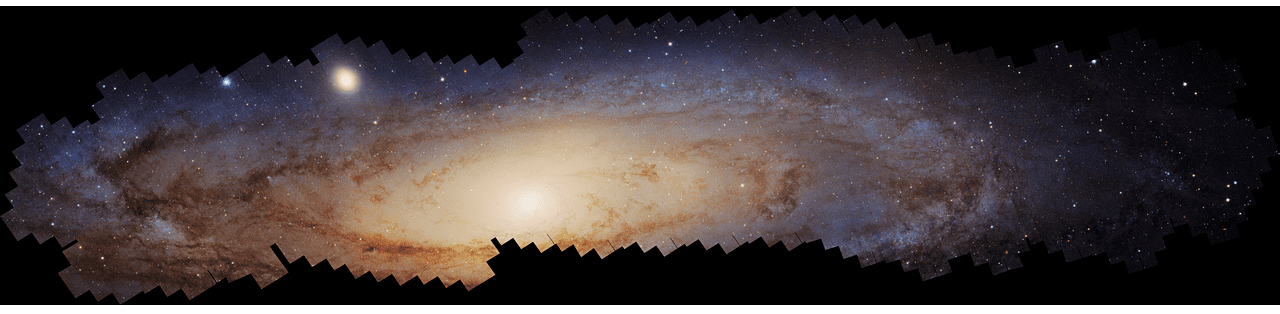
The Andromeda galaxy, our nearest galactic neighbor, has been unveiled in unprecedented detail through a panoramic view captured by the Hubble Space Telescope, showcasing hundreds of millions of stars across its vast expanse. This meticulously crafted photomosaic, spanning over 10 years and comprising 2.5 billion pixels, offers a holistic perspective on the galaxy’s structure and evolution, revealing subtle asymmetries between its northern and southern halves.
As astronomers continue to study this neighboring stellar island, located 2.5 million light years away from Earth, they are gaining valuable insights into its complex history, including mergers with smaller satellite galaxies, which have shaped its distinctive features and set it apart from our own Milky Way galaxy. With the ability to resolve over 200 million stars, the Hubble Space Telescope has provided a unique window into the Andromeda galaxy’s past, allowing researchers to piece together its evolutionary narrative and better understand the intricate dynamics of galactic formation and interaction.
Introduction to the Andromeda Galaxy
The Andromeda galaxy, located approximately 2.5 million light years away from Earth, is the closest prominent galactic neighbor to the Milky Way. This spiral galaxy can be seen with the naked eye on clear autumn nights as a faint oval object roughly the size of the moon. The Andromeda galaxy has been a subject of interest for astronomers due to its proximity and similarity in structure to the Milky Way, making it an ideal candidate for studying the evolution and formation of galaxies.
The Hubble Space Telescope has played a crucial role in understanding the Andromeda galaxy, with its sharp imaging capabilities allowing researchers to resolve over 200 million stars within the galaxy. This is a significant achievement, considering that the total population of the Andromeda galaxy is estimated to be around 1 trillion stars, with many less massive stars falling below Hubble’s sensitivity limit. The ability to study the Andromeda galaxy in such detail has provided valuable insights into its evolutionary history and structure.
The importance of studying the Andromeda galaxy cannot be overstated, as it serves as a proxy for understanding the Milky Way’s own evolution and structure. Since Earth is embedded within the Milky Way, it is challenging to obtain a holistic view of our own galaxy. The Andromeda galaxy, on the other hand, can be observed in its entirety, allowing astronomers to gather detailed information about its disk, bulge, and halo.
Photographic Survey of the Andromeda Galaxy
The photographic survey of the Andromeda galaxy was a monumental task that spanned over a decade. The project involved capturing images of the galaxy using the Hubble Space Telescope, which required over 1,000 orbits around Earth. The resulting mosaic is composed of approximately 600 separate fields of view and contains at least 2.5 billion pixels. This level of detail has never been achieved before in the study of a large spiral galaxy.
The survey was carried out under two Hubble programs: the Panchromatic Hubble Andromeda Treasury program and the Panchromatic Hubble Andromeda Southern Treasury program. The first program focused on imaging the northern half of the Andromeda galaxy, while the second program targeted the southern half. The combination of these two programs has provided a comprehensive view of the entire disk of the Andromeda galaxy, which is seen almost edge-on from Earth.
The photographic survey has revealed intriguing asymmetries between the northern and southern halves of the Andromeda galaxy. The southern region, in particular, is structurally unique and more sensitive to the galaxy’s merger history than the northern disk. This information will be crucial in understanding the evolutionary history of the Andromeda galaxy and how it has interacted with other galaxies over billions of years.
Insights into the Evolutionary History of the Andromeda Galaxy
The detailed measurements from the Hubble survey programs have provided valuable insights into the age, heavy-element abundance, and stellar masses within the Andromeda galaxy. This information will enable astronomers to distinguish between competing scenarios for the galaxy’s merger history and disk evolution. The data suggest that the Andromeda galaxy has a more active recent star formation and interaction history than the Milky Way, with a higher population of younger stars and unusual features like coherent streams of stars.
The study of the Andromeda galaxy’s evolutionary history is essential for understanding the formation and evolution of galaxies in general. By comparing the properties of the Andromeda galaxy to those of the Milky Way, researchers can gain insights into the factors that influence the development of galaxies over billions of years. The findings from this research will also have implications for our understanding of the universe on larger scales, including the distribution of matter and energy within the cosmos.
Conclusion and Future Research Directions
The photographic survey of the Andromeda galaxy has set a new benchmark for precision studies of large spiral galaxies. The level of detail achieved in this study is unprecedented, and the findings have significant implications for our understanding of galaxy evolution and formation. Further research will be necessary to fully interpret the data and to develop more sophisticated models of galaxy evolution.
The study of the Andromeda galaxy will continue to be an active area of research, with future studies focusing on the analysis of the data obtained from the Hubble survey programs. Additionally, new observations using next-generation telescopes, such as the James Webb Space Telescope, will provide even higher resolution images and spectroscopic data, allowing researchers to probe the properties of the Andromeda galaxy in greater detail. The continued study of the Andromeda galaxy will ultimately enhance our understanding of the universe and its many mysteries.
Implications for Galaxy Evolution and Formation
The findings from the study of the Andromeda galaxy have significant implications for our understanding of galaxy evolution and formation. The discovery of asymmetries between the northern and southern halves of the galaxy suggests that the Andromeda galaxy has undergone a complex merger history, with interactions between galaxies playing a crucial role in shaping its structure and evolution.
The study of the Andromeda galaxy also highlights the importance of considering the role of environment in galaxy evolution. The galaxy’s location within the Local Group, which includes the Milky Way and several smaller galaxies, may have influenced its development over billions of years. Further research will be necessary to fully understand the interplay between galaxies and their environments, but it is clear that the study of the Andromeda galaxy has provided valuable insights into the complex processes that shape the evolution of galaxies.
The research on the Andromeda galaxy has been funded by NASA and the Simons Foundation, with a full list of co-authors listed in the accompanying paper. The study demonstrates the power of collaborative research and the importance of continued investment in astronomical research to advance our understanding of the universe.
External Link: Click Here For More


