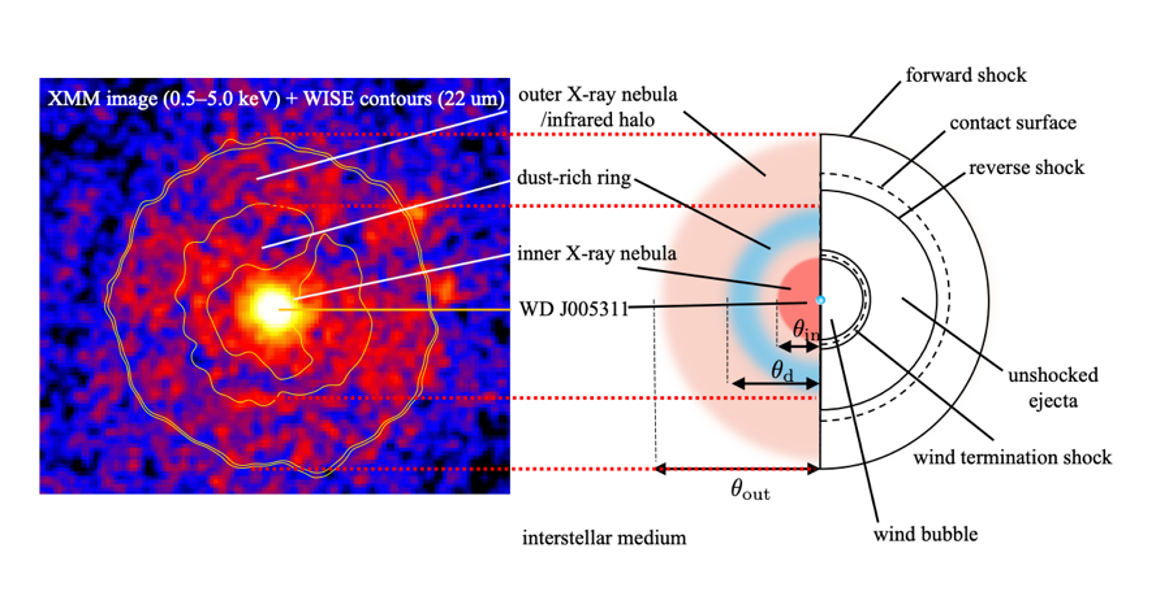
A team of researchers has successfully recreated the structure of a rare type of supernova remnant, known as SNR 1181, which was recorded in historical documents in Japan and elsewhere in Asia in 1181. Led by doctoral student Takatoshi Ko from the University of Tokyo, the team used computer modeling and observational analysis to explain the mysterious properties of this remnant, including its double shock formation.
This finding improves our understanding of the diversity of supernova explosions and highlights the benefits of interdisciplinary research, combining history with modern astronomy to enable new discoveries about our galaxy. The team used X-ray data from the Subaru Telescope in Hawaii and is now preparing to further observe SNR 1181 using the Very Large Array radio telescope in New Mexico.
Unveiling the Mysteries of Supernova SN 1181
In 1181, a rare type of supernova, known as Type Iax, was recorded in historical documents from Japan, China, and Korea. This “guest star” was visible to the naked eye for approximately 180 days before gradually dimming out of sight. The remnant of this explosion, labeled SNR 1181, remained a mystery until its location was pinpointed in 2021 in a nebula towards the constellation Cassiopeia.
Through computer modeling and observational analysis, researchers have recreated the structure of SNR 1181. The team analyzed the latest X-ray data to construct a theoretical model that explains the observed features of this supernova remnant. The main challenge was understanding why the merger of two white dwarfs left behind a single, bright, and fast-rotating white dwarf instead of exploding and disappearing.
The researchers found that the spinning white dwarf did not create a stellar wind immediately after its formation. Instead, they discovered that the wind may have started blowing only very recently, within the past 20-30 years. This suggests that the white dwarf has started to burn again, possibly due to matter thrown out by the explosion falling back to its surface, increasing its density and temperature over a threshold to restart burning.
The ability to determine the age of supernova remnants or the brightness at the time of their explosion through archaeological perspectives is a rare and invaluable asset to modern astronomy. This research highlights the immense potential for combining diverse fields to uncover new dimensions of astronomical phenomena. The team is now preparing to further observe SNR 1181 using the Very Large Array (VLA) radio telescope and the 8.2 meter-class Subaru Telescope.
Type Iax supernovae are a rare class of explosions that result from the merger of two white dwarfs. They are distinct from other types of supernovae, such as Type Ia, which are thought to arise from the explosion of a single white dwarf. The study of SNR 1181 provides valuable insights into the properties and behavior of these enigmatic events.
The discovery that the wind may have started blowing only recently suggests that white dwarfs can experience periods of rejuvenation, where they start burning again due to accretion of matter. This has significant implications for our understanding of the evolution and behavior of these extreme objects.
Further observations of SNR 1181 using advanced telescopes will provide additional insights into the properties and behavior of this enigmatic supernova remnant. The study of Type Iax supernovae and their remnants offers a unique window into the extreme physics of white dwarf mergers, providing valuable opportunities for advancing our understanding of these complex events.
External Link: Click Here For More