

The faint light emitted by galaxies within the cosmic web remains a challenging area of study, but new research offers a significant step forward in interpreting data from this elusive region. Hyunbae Park from the University of Tsukuba, Hyunmi Song from Chungnam National University, Chris Byrohl from the University of Heidelberg, Aaron Smith from The University of Texas at Dallas, Yajima Hidenobu from the University of Tsukuba, and Zarija Lukić have developed a new analytic model that accurately predicts how light from these galaxies scatters through the post-reionization intergalactic medium. This model simplifies complex radiative transfer calculations, offering a computationally efficient alternative to detailed simulations, and allows researchers to accurately predict the large-scale behaviour of scattered light. By focusing on the physics of how light escapes resonance and scatters across vast distances, the team achieves impressive accuracy in predicting the intensity of this faint signal, paving the way for more effective analysis of future observations and a deeper understanding of the universe’s underlying structure.
Lyα intensity mapping is emerging as a powerful new technique for studying faint galaxies within the cosmic web, structures that remain difficult to observe with traditional methods. However, interpreting observations of this faint light is complicated by the way Lyα photons interact with the surrounding gas. Researchers have now developed a fast and accurate analytic prescription for modelling Lyα emission from the cosmic web, offering a significant improvement over computationally intensive methods. This prescription incorporates a novel treatment of multiple scattering, allowing for precise predictions of the observed Lyα intensity.
Lyman-alpha Scattering in Early Galaxies
Scientists are investigating the Lyman-alpha emission from galaxies in the early universe to understand how galaxies form and evolve. Lyman-alpha emission, a specific wavelength of light, serves as a key indicator of star formation. However, the path of this light is complex, as photons scatter within galaxies and the surrounding intergalactic medium. The team aims to understand how these scattering processes affect observed properties of Lyman-alpha emitters and to develop more accurate models for interpreting observations. They are particularly interested in the relationship between a galaxy’s intrinsic properties, such as its star formation rate and dust content, and the observed Lyman-alpha luminosity and the characteristics of the emitted light.
The research utilizes sophisticated computer simulations to model the propagation of Lyman-alpha photons through galaxies and the intergalactic medium. These simulations incorporate realistic models of galaxies, including parameters like star formation rate, dust content, gas density, and velocity. The team also incorporates models of the intergalactic medium, accounting for the density and temperature of the gas. By systematically varying the parameters of these models, they explore a wide range of possible galaxy and intergalactic medium conditions. Comparing the results of these simulations with actual observations of Lyman-alpha emitters allows them to test the validity of their models and refine our understanding of these distant galaxies.
Lyα Radiative Transfer Simplifies at High Ionization
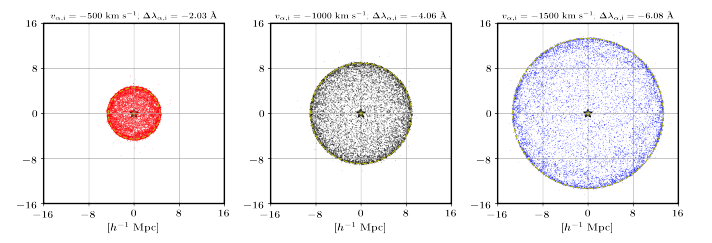
Researchers have discovered that modelling the scattering of Lyα light becomes significantly simpler in a highly ionized intergalactic medium. This means that after the universe became largely transparent to this light, the behavior of photons emitted at slightly higher frequencies than the Lyα line changes in a predictable way as they travel across vast cosmic distances. The team found that these photons quickly move out of resonance as they redshift, simplifying their scattering behavior on megaparsec scales. They observed that these photons scatter off a thin, nearly spherical surface, with the radius determined by the distance to resonance.
Based on this behavior, the team derived equations that predict both the amount of scattered light and its observed brightness. These equations rely only on the initial spectrum of the light source, the density of neutral hydrogen, and the movement of matter. When tested against detailed computer simulations, the model achieves remarkable accuracy, predicting the overall brightness of the scattered light with less than 5% error beyond a distance of one megaparsec from the source. This new prescription offers a significant advancement in forward-modeling Lyα intensity maps from cosmological simulations, enabling more efficient analysis of future observations.
Lyman-alpha Mapping Model Predicts Light Distribution
Scientists have developed a new analytic model for predicting the distribution of light emitted from hydrogen gas in the universe, known as Lyman-alpha intensity mapping. This model accurately simulates how this light scatters across vast cosmic distances, offering a computationally efficient alternative to complex simulations. By focusing on the physics of light scattering in the post-reionization universe, where the universe is largely transparent to this light, the team developed equations that predict the intensity of the scattered light based on the density of hydrogen gas and the movement of matter. Validation against detailed simulations demonstrates the model achieves better than 5% accuracy in predicting the overall brightness of the scattered light beyond a few megaparsecs from the source. This achievement enables rapid generation of realistic simulations of Lyman-alpha emission, facilitating exploration of the relationship between the distribution of matter and the observed light. Future work will focus on applying this model to larger-scale simulations and investigating how the scattered light can be used to map the distribution of dark matter, potentially reconstructing the intensity map directly from the underlying matter distribution.
🗞 Analytic Model for Scattered Ly Emission in the Post-reionization Intergalactic Medium
🧠 ArXiv: https://arxiv.org/abs/2509.11268


