Optical turbulence significantly degrades free-space optical communication, introducing fluctuations that distort signals and limit performance, and researchers are now gaining deeper insight into how this turbulence affects the fundamental statistics of light. Shouvik Sadhukhan and C. S. Narayanamurthy, from the Indian Institute of Space Science and Technology, demonstrate a method for reconstructing optical fields distorted by turbulence and then analysing the resulting photon statistics. Their work reveals how turbulence shifts the statistical behaviour of light between predictable patterns, and importantly, how carefully placed materials can partially correct for these distortions, bringing the signal closer to an ideal state. This achievement establishes a quantitative connection between turbulence and the statistical properties of light, offering a pathway to improved designs for robust free-space optical communication systems.
Light, Geometry, and Statistical Pattern Recognition
This compilation of research papers explores the intersection of optics, machine learning, information geometry, and signal processing. Researchers investigate statistical comparison and similarity measures, particularly using Gaussian Mixture Models (GMMs) and the Kullback-Leibler (KL) divergence, essential for pattern recognition, data clustering, and anomaly detection. The collection focuses on efficient and accurate methods for calculating similarity between GMMs, addressing the computational demands of high-dimensional data. The inclusion of Information Geometry indicates the application of differential geometry to statistical inference and data analysis, providing a mathematically rigorous approach to comparing probability distributions.
This framework utilizes Riemannian metrics to define similarity measures, with applications in optics and photonics for turbulence compensation, scintillation correction, and the study of light-matter interactions, potentially leading to improved sensor development. This work represents a comprehensive investigation into statistical inference, information geometry, and their applications to optics, photonics, and machine learning, addressing challenging problems in data analysis and signal processing. The combined approach aims to develop robust algorithms for image or signal processing in challenging environments and create machine learning algorithms for analyzing optical data.
Turbulence Reconstruction via Wigner Function Tomography
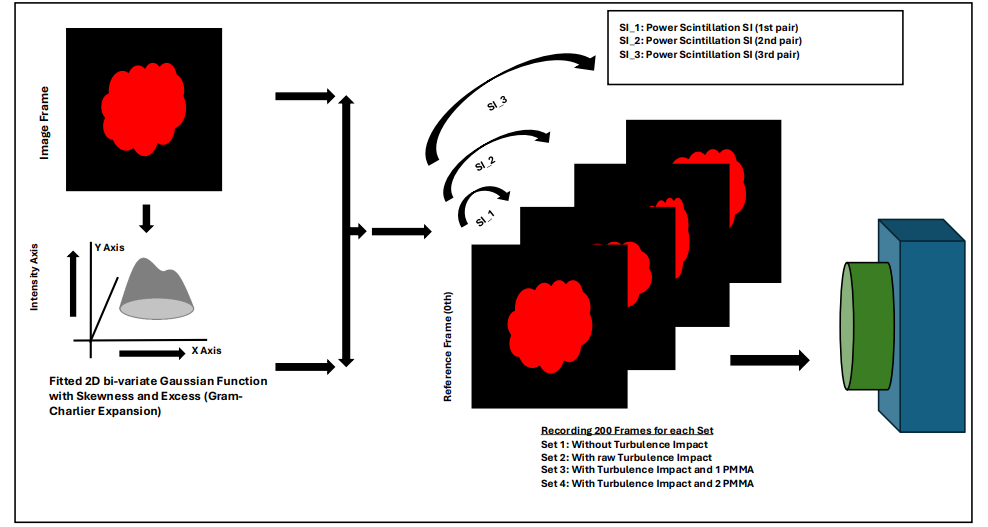
Scientists developed a novel method to analyze the influence of optical turbulence on light fields by combining nonlinear reconstruction with a phase-space formalism. The study employed a partial differential equation to reconstruct the complex optical field distorted by turbulence, enabling recovery of embedded field information. Recovered fields were then projected onto a Gaussian local oscillator, generating quadrature ensembles used for Wigner function tomography, a technique originally developed for quantum state reconstruction. This innovative approach allowed researchers to obtain photon-number distributions by overlapping the reconstructed Wigner functions with Fock-state kernels, facilitating direct evaluation of statistical moments and the Fano factor, a key metric for characterizing photon statistics.
Comparative analysis across four experimental configurations, uncorrected turbulence, turbulence with single and dual polymethyl methacrylate (PMMA) slabs, and a free-space reference, revealed modifications in noise and photon statistics resulting from the partial compensation provided by the PMMA elements. Notably, the evolution of the Fano factor traced a clear transition among Poissonian, super-Poissonian, and near-sub-Poissonian regimes, quantitatively capturing the degree of turbulence mitigation achieved by the PMMA elements. This work pioneered the application of a quantum-statistical framework to turbulence-affected beams, establishing that collective dipole synchronization manifests in reduced intensity variance and modified photon-number distributions. The method rigorously quantifies passive turbulence compensation by bridging classical wave optics, quantum phase-space representations, and information theory.
Turbulence Reversal Reveals Light’s Quantum Statistics
This research demonstrates a framework for quantifying the impact of optical turbulence on light propagation through detailed analysis of field statistics and reconstructed optical fields. Scientists employed a nonlinear reconstruction method, utilizing a partial differential equation, to retrieve the complex optical field distorted by turbulence, effectively reversing the effects of atmospheric disruption. The recovered fields were then projected onto a Gaussian local oscillator, enabling Wigner function tomography, which maps the quantum state of light. Experiments were conducted across four distinct configurations: uncorrected turbulence, turbulence with single and dual poly(methyl methacrylate) (PMMA) slabs, and a free-space reference.
Measurements reveal that the PMMA slabs partially compensate for turbulence, modifying both the noise characteristics and photon statistics of the reconstructed fields. Notably, the Fano factor, a key indicator of light’s statistical properties, traced a clear evolution, transitioning among Poissonian, super-Poissonian, and near-sub-Poissonian regimes. This evolution quantitatively captures the degree of turbulence mitigation achieved by the PMMA elements, demonstrating a measurable improvement in beam quality. The team’s analysis establishes a quantitative link between turbulence-induced distortions and the statistical behavior of reconstructed optical fields, providing a powerful tool for characterizing and correcting atmospheric disturbances. Measurements confirm that the introduction of PMMA slabs alters the statistical properties of the light, moving it closer to an ideal, sub-Poissonian state.
Turbulence Mitigation Via Synchronized Optical Oscillation
This research demonstrates a new approach to mitigating the effects of optical turbulence, a significant challenge in free-space optical communication. By passing light through specifically configured dielectric materials, the team successfully induced synchronized oscillation modes that suppress the rapid phase fluctuations caused by turbulence. The method involves reconstructing the optical field distorted by turbulence using a nonlinear reconstruction technique, followed by analysis of the resulting statistical properties of the light. Quantitative measurements, including the Fano factor, reveal a systematic transition from highly turbulent, super-Poissonian light statistics towards near-Poissonian behavior with the use of multiple dielectric elements, and even occasional instances of sub-Poissonian light, indicating partial phase locking.
The study establishes a clear link between the physical configuration of the dielectric materials and the statistical stabilization of the propagated light. Information-theoretic and geometric analyses confirm these findings, showing substantial reductions in statistical divergence and geodesic distance as the interaction length within the materials increases. These experimental results align closely with a theoretical model based on coupled anharmonic Lorentz oscillators, demonstrating that reduced perturbation forces correspond to near-complete synchronization of dipole modes. While complete compensation remains a goal, the achieved mitigation represents a significant step towards practical passive optical turbulence compensation.
🗞 Turbulence Induced Photon Statistics with Classical Beam propagation in Free Space Optical Communications
🧠 ArXiv: https://arxiv.org/abs/2510.21225