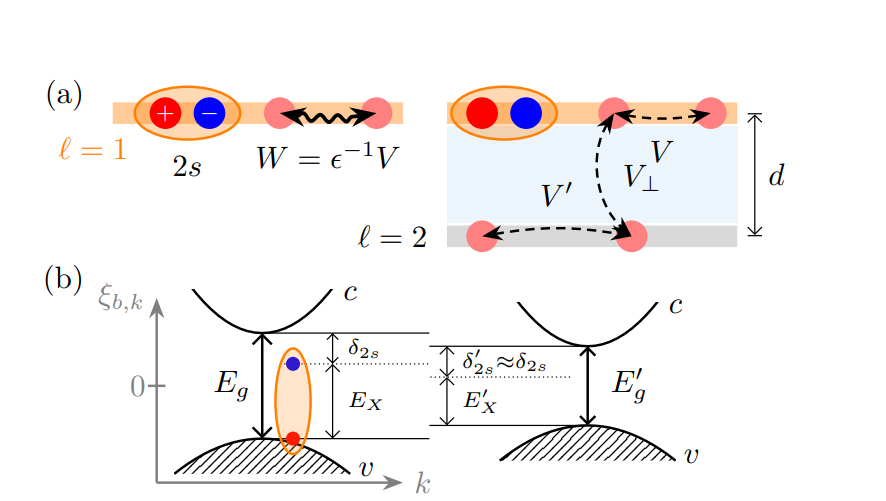
The ability to detect and understand the behaviour of electrons in distant materials represents a significant advance in materials science, and a team led by Tobias M. R. Wolf and Tian Xie from the University of California at Santa Barbara, alongside Allan H. MacDonald from the University of Texas at Austin, now demonstrates a novel method for achieving this. They investigate how excitons, bound pairs of electrons and holes in two-dimensional materials, respond to the presence of distant, strongly interacting electron fluids. This research establishes a theoretical framework for interpreting experiments where excitonic resonance frequencies shift due to long-range interactions, offering a new way to probe and understand the properties of remote electron correlations in layered materials, and paving the way for future applications in nanoscale sensing and electronic devices.
Excitons Probe Remote Electron Correlations
Many two-dimensional materials, including molybdenum disulphide, molybdenum diselenide, tungsten disulphide, and tungsten diselenide, possess direct bandgaps and exhibit strong excitonic effects, making them promising for optoelectronic devices and fundamental studies of material properties. Researchers investigate using excitons as sensitive probes of electron correlations in van der Waals heterostructures, demonstrating that the energy of an exciton in a two-dimensional semiconductor is significantly affected by the dielectric environment created by nearby correlated layers, even when separated by a considerable distance. Calculations reveal that exciton binding energy and oscillator strength are modified by correlated layers, providing a direct measure of their electronic properties. This change in exciton energy scales non-linearly with the strength of electron correlation, allowing for precise determination of this parameter. This exciton-based sensing approach proves robust against variations in layer thickness and stacking order, establishing a new method for characterizing remote electron correlations in two-dimensional heterostructures and offering a pathway towards novel optoelectronic devices and a deeper understanding of emergent phenomena in correlated materials. Researchers predict this method can probe the electronic phase diagram of correlated layers with unprecedented spatial resolution and sensitivity.
Excitonic Sensing of Remote Electronic States
Monolayer transition-metal dichalcogenides exhibit strong excitonic effects due to their reduced dimensionality and enhanced interactions between electrons and holes, emerging as platforms for exploring novel optoelectronic phenomena and developing advanced devices. Researchers investigate the influence of remote two-dimensional electron fluids on excitonic resonances in van der Waals heterostructures, constructing a theoretical framework to describe the dynamics of excitons coupled to remote electron fluids. This approach allows for the calculation of frequency shifts and line broadening effects induced by interactions between electrons, incorporating the dielectric function of the electron fluid, which depends on its carrier density and screening properties. Experiments involve fabricating van der Waals heterostructures consisting of tungsten diselenide and graphene bilayers or multilayers, characterised using optical spectroscopy to measure excitonic resonance frequencies and line shapes.
The carrier density in the graphene layers is controlled using electrostatic gating, allowing for tuning of the interaction with the tungsten diselenide excitons. Analysing the frequency shifts as a function of graphene carrier density extracts information about the screening properties and electronic structure of the electron fluid. Results demonstrate a clear correlation between graphene carrier density and the excitonic resonance frequency in tungsten diselenide, confirming long-range interactions consistent with theoretical predictions, validating the proposed model. This approach provides a sensitive probe of the electronic properties of remote two-dimensional materials, offering new opportunities for exploring correlated electron physics and developing novel optoelectronic devices.
Graphene Modulates WSe2 Bandgap Without Spacer
Researchers investigated the electronic coupling between graphene and tungsten diselenide, focusing on Bernal-stacked bilayer graphene and trilayer graphene. The goal is to understand how the electronic properties of graphene influence the bandgap of tungsten diselenide when they are in close proximity without a spacer layer, relevant for creating exciton sensors where changes in graphene’s electronic structure can be detected by changes in tungsten diselenide’s optical properties. The research relies on calculations of the non-interacting susceptibility, used in a Random Phase Approximation calculation to determine the screened Coulomb interaction and ultimately the bandgap shift in tungsten diselenide. A magnetic field is applied to the graphene, leading to the formation of Landau levels, with their filling varied to tune the electronic properties of the graphene.
Calculations use a uniform mesh and Lorentzian broadening to model the system. Researchers analysed the band structure and non-interacting susceptibility for trilayer graphene, demonstrating how different electronic configurations affect its screening properties. Line cuts of the static and dynamic susceptibility along specific directions provide detailed information about the frequency dependence of the susceptibility. Calculations focused on cases where Landau levels are empty or fully occupied, revealing how this affects the static response and dynamic screening. Quantitative data on the bandgap shift in tungsten diselenide due to proximity to trilayer graphene in different electronic states is presented.
The filling of Landau levels in graphene significantly affects its screening properties and, consequently, the bandgap of tungsten diselenide. Odd Landau level filling leads to enhanced screening and a larger bandgap shift in tungsten diselenide. Low-energy particle-hole excitations are crucial for driving the filling-factor dependence of the tungsten diselenide bandgap. These findings demonstrate the potential of using graphene-tungsten diselenide heterostructures as exciton sensors, where changes in the graphene’s electronic structure can be detected by changes in the tungsten diselenide’s optical properties.
Dynamic Screening Corrects Bandgap Shifts in 2D Materials
Researchers present a theoretical framework to understand how the bandgap of a two-dimensional semiconductor changes when placed near another two-dimensional material with strong electronic interactions. They developed equations to calculate the impact of these interactions on the semiconductor’s electronic structure, specifically focusing on corrections to the conduction and valence bands. Numerical evaluations, applied to bilayer and trilayer graphene examples, demonstrate that accounting for dynamic screening effects significantly reduces the predicted bandgap shifts compared to simpler approximations. The magnitude of the bandgap shift is strongly influenced by low-frequency collective electronic behaviors in the adjacent material, particularly those with momentum less than the interlayer distance.
The theory successfully explains experimental observations of an “even-odd” effect related to the number of layers in the interacting material. Future work could extend this model by incorporating the finite thickness of multilayer stacks and proximity-induced spin-orbit coupling, potentially revealing additional optical signatures. The authors suggest applications of this framework to investigate other complex phenomena in two-dimensional materials, including flavor ferromagnetism, the fractional quantum Hall effect, and superconductivity, offering a pathway to probe these states through combined transport and optical sensing studies.
🗞 Exciton-based sensing of remote electron correlations in 2D heterostructures
🧠 ArXiv: https://arxiv.org/abs/2510.21522