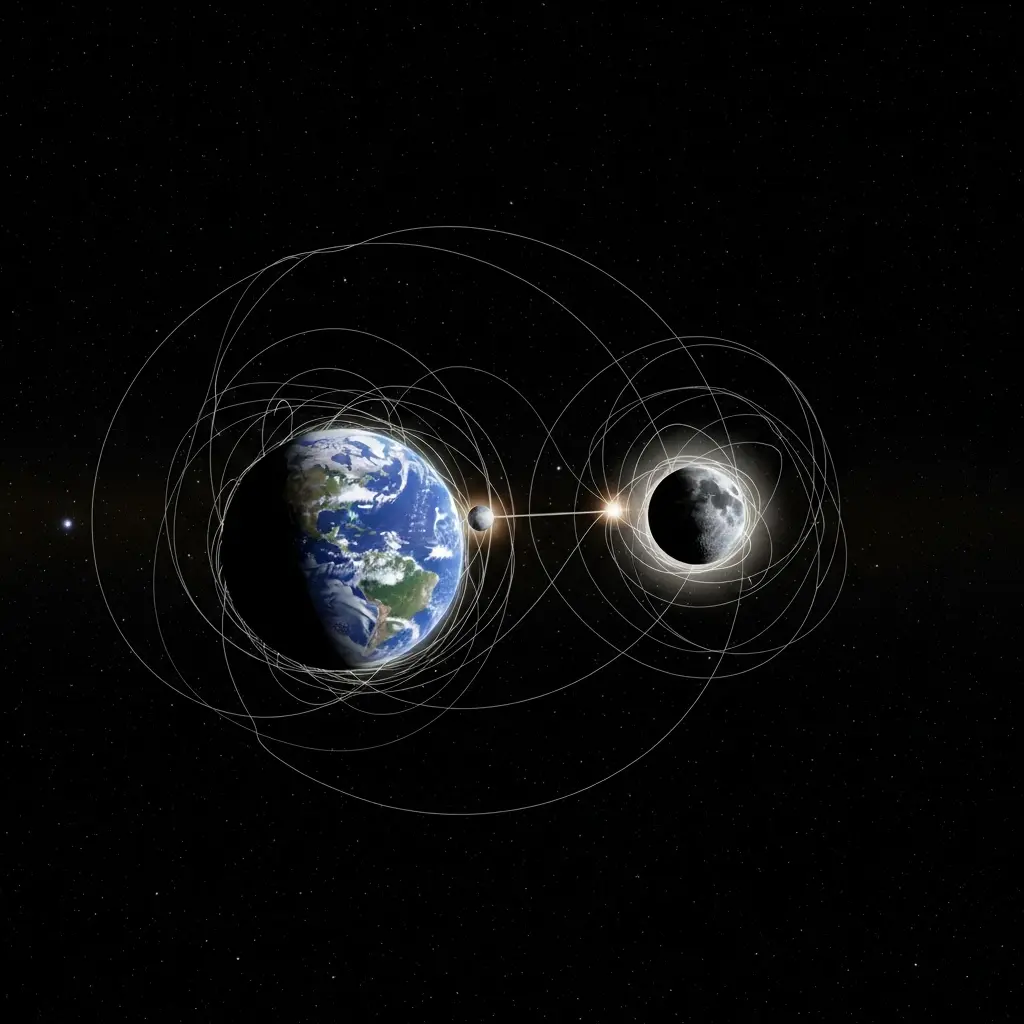
Scientists are tackling the complex challenge of accurately predicting the possible trajectories of low-thrust spacecraft, crucial for increasingly ambitious missions to Earth and beyond. Jinaykumar Patel and Kamesh Subbarao, both from The University of Texas at Arlington, alongside et al., present a novel method utilising ‘set-based reachability analysis’ to map these potential paths in both simple two-body scenarios and the intricate cislunar environment. This research is significant because it offers a scalable framework for ensuring safe trajectory generation and station-keeping , vital for missions involving Halo orbits around L1 and L2, and the increasingly popular Near Rectilinear Halo Orbits , and allows for direct comparison with established control techniques like Model Predictive Control and LQR.
The resulting reachable sets are used for safe trajectory generation and tracking. The proposed approach provides a scalable framework for analysing spacecraft behaviour under complex dynamics and control constraints. The growing interest in cislunar space is driven by plans for sustained lunar exploration. Scientists increasingly demand robust techniques for spacecraft trajectory planning and control, particularly with the advent of lunar gateways and expanded human activities beyond Earth’s orbit.
As missions in this domain involve complex nonlinear dynamics and significant uncertainties, effective methods to guarantee safe and reliable spacecraft operations are crucial. Reachability analysis, computing the set of all possible states a spacecraft can attain from given initial conditions, is an essential tool for addressing these mission-critical challenges. It provides crucial information for collision avoidance, obstacle avoidance, safe path planning, and robust guidance, navigation, and control under uncertainty. Specifically, in cislunar space, precise reachability analysis can significantly enhance mission safety and efficiency.
Several computational approaches exist for reachability analysis, each with strengths and limitations. Sampling-based approaches often require extensive trajectory propagation to yield accurate boundary approximations and can be computationally demanding when employing realistic ephemeris models. Recent work has introduced a set-based reachability approach that leverages state-transition tensors to efficiently propagate reachable sets under multi-body gravitational dynamics. However, due to gravitational perturbations, navigational uncertainties, and actuator constraints, maintaining a spacecraft on NRHOs requires continuous station-keeping. A variety of station-keeping strategies have been explored, including control methods based on dynamical systems theory, linear-quadratic regulators (LQR), sliding mode control, and model predictive control (MPC) approaches. This paper addresses a set propagation methodology, building upon previous research in hypersonic atmospheric re-entry reachability analysis.
Reachability analysis can be leveraged for path planning or generating a safe reference trajectory that ensures collision avoidance and respects spacecraft thrust limitations. These reference solutions then serve as the foundation for subsequent station-keeping approaches, such as MPC, which can robustly track the trajectory while accommodating actuator constraints and uncertainties. We extend earlier work to the domain of low-thrust spacecraft reachable set computations for both two-body and cislunar dynamics. In addition to the baseline reachable set methodology, we develop a novel approach that formulates the dynamics in a state-dependent coefficient (SDC) form, enabling structured matrix-based reachable set propagation while retaining០ compatibility with the original method.
Zonotope Reachability for Safe Space Trajectories
Scientists achieved significant advancements in spacecraft trajectory analysis using zonotope-based reachability analysis, demonstrating its efficacy in both two-body and cislunar environments. The research team successfully generated reachable sets under complex dynamics, employing set-based methods and Taylor expansions to approximate nonlinear systems. A state-dependent coefficient (SDC) parameterization was implemented to represent nonlinear dynamics in a pseudo-linear form, facilitating efficient matrix-based propagation of reachable sets for safe trajectory generation and tracking. Experiments focused on Earth-to-Mars transfer scenarios, revealing that a minimum flight duration exceeding 200 days is required to achieve positional reachability, a crucial first step in evaluating rendezvous feasibility.
The team measured computation times for varying time-of-flight durations, recording 3.443 seconds for a 200-day transfer and 5.103 seconds for a 300-day transfer, all simulations performed on a computer with 16 GB of RAM and a 2.10GHz Intel Core i7 processor. Initial conditions were precisely defined, with the spacecraft’s initial position vector at r = [−140699693; −51614428; 980]⊤km and velocity vector at v = [9774596; −2807828; 4337725E-4]⊤km/s, departing on 10 April 2007. Further investigations extended to circular restricted three-body problem (CR3BP) dynamics, specifically around the L2 Halo orbit of the Earth-Moon system. All quantities were expressed in nondimensional units, utilizing characteristic length l∗ = 3844 × 10⁵km, characteristic mass m∗ = 60458 × 10²⁴kg, and characteristic time t∗ = 375,200 seconds to normalize the system.
Reachability analysis was performed for a low-thrust spacecraft with Tmax = 0.1 N, Isp = 3000s, and initial mass m0 = 1000kg, starting from the initial state x0 = [1.1720; 0; −0.0862; 0; −0.1880; 0]⊤. The team compared the performance of model predictive control (MPC) and linear quadratic regulator (LQR) controllers for reference tracking, demonstrating that MPC achieved lower tracking error, recorded at 17.2308, and reduced total control effort, measured at 1.385, at a modest increase in computational cost, with total computation time of 305.9837 seconds. These results demonstrate a scalable framework for analyzing spacecraft behaviour under complex dynamics and control constraints, paving the way for more robust and efficient space missions. Scientists have developed and validated two practical methods for computing reachable sets for nonlinear systems, specifically applied to low-thrust spacecraft trajectory analysis.
The first method utilises a direct, high-order Taylor approximation of the spacecraft’s dynamics, while the second employs a state-dependent coefficient (SDC) parameterisation to tightly bound nonlinearities and control set growth. These techniques were successfully tested on an Earth-to-Mars transfer under two-body dynamics and a cislunar L2 Halo orbit within the circular restricted three-body problem (CR3BP), with the SDC method demonstrating superior accuracy and numerical stability. The resulting reachable sets were integrated with a model-predictive controller, achieving fuel-efficient, event-triggered station-keeping for the cislunar orbit, demonstrating a scalable framework for analysing spacecraft behaviour under complex conditions. The authors acknowledge that results were obtained using an idealised CR3BP model, meaning per-orbit delta-V and controller activation counts may vary when more accurate ephemerides and perturbations are included. Future research will focus on extending the SDC framework to near-rectilinear Halo orbits, incorporating high-fidelity disturbance models like solar radiation pressure and lunar gravity perturbations.
👉 More information
🗞 Set-Based Reachability for Low-Thrust Spacecraft in Two-Body and Cislunar Dynamical Systems
🧠 ArXiv: https://arxiv.org/abs/2601.17155