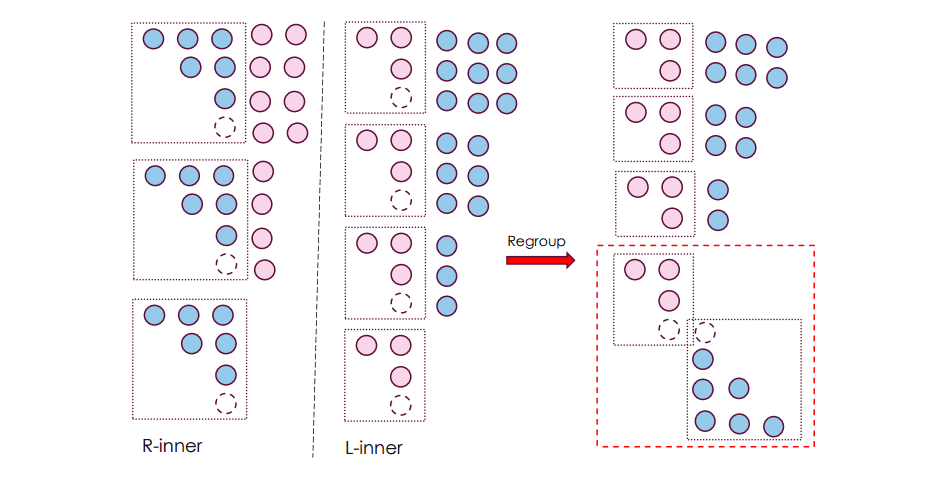
The challenge of escaping local minima represents a fundamental obstacle in quantum annealing, limiting its ability to solve complex optimisation problems. Vicky Choi from Gladiolus Veritatis Consulting Co and colleagues now present a detailed structural analysis of this limitation in stoquastic transverse-field quantum annealing. Their work focuses on a specific class of Maximum Independent Set instances, revealing the origin of an exponentially small energy gap that hinders the system’s progress towards the optimal solution. By reducing the problem to an effective two-block Hamiltonian and reformulating the eigenvalue problem, the researchers demonstrate how this bottleneck arises from competition between degenerate local minima and the global minimum, offering crucial insight into the limitations of this quantum approach and paving the way for the development of more effective algorithms.
The analysis begins by reducing the complex dynamics to an effective two-block Hamiltonian, constructed from decoupled subsystems representing the local and global minima, a reduction justified through structural decomposition of the problem. The work argues that these anti-crossings fundamentally limit the potential for quantum speedup in adiabatic quantum computation. Key achievements include a structured analysis of specific problem instances, the use of a non-orthogonal basis to accurately capture tunneling behavior, and highlighting the importance of driver graph design. The research demonstrates that simply introducing non-stoquasticity is insufficient to overcome the tunneling bottleneck; a well-designed driver graph is essential. The team derives an exponential runtime bound for the adiabatic evolution, demonstrating the limitations of the algorithm. The research provides a structural explanation for the anti-crossing phenomenon, arising from competition between energies associated with local and global minima, and analytically derives the associated exponentially small gap separating these energy levels. This analysis proceeds by reducing the complex dynamics to an effective two-block Hamiltonian, constructed from decoupled subsystems representing the local and global minima, a reduction justified through structural decomposition of the problem. The team reformulated the eigenvalue problem as a generalized eigenvalue problem using a non-orthogonal basis constructed from the bare eigenstates of these subsystems, enabling a clean perturbative treatment of the anti-crossing structure independent of the transverse field. Measurements confirm that the size of the anti-crossing gap is directly related to the coupling strength, with stronger coupling leading to a larger gap and weaker coupling resulting in a narrower one. Researchers successfully explained the anti-crossing phenomenon, where the energies of local minima compete with the global minimum, using a novel structural approach. This method allows for a clear perturbative treatment of the energy landscape, independent of the strength of the transverse field, and ultimately yields an analytical derivation of the exponentially small gap that limits performance. The team demonstrated that the complex dynamics of the system can be effectively reduced to a simplified two-block Hamiltonian, constructed from the bare subsystems associated with the local minima and the global minimum.
This reduction builds upon a decomposition framework previously developed by the researchers, refined to justify the analysis of disjoint cases and apply an L-inner decomposition to derive the effective Hamiltonian. The analysis provides a deeper understanding of the factors limiting the efficiency of stoquastic quantum annealing for these problem instances. Future research could explore the applicability of this structural approach to a wider range of problem instances and investigate the impact of different approximations on the derived results. The team also suggests that further work could explore how appropriately designed non-stoquastic drivers can overcome the tunneling-induced bottleneck identified in this study.
👉 More information
🗞 Limitation of Stoquastic Quantum Annealing: A Structural Perspective
🧠 ArXiv: https://arxiv.org/abs/2509.16265