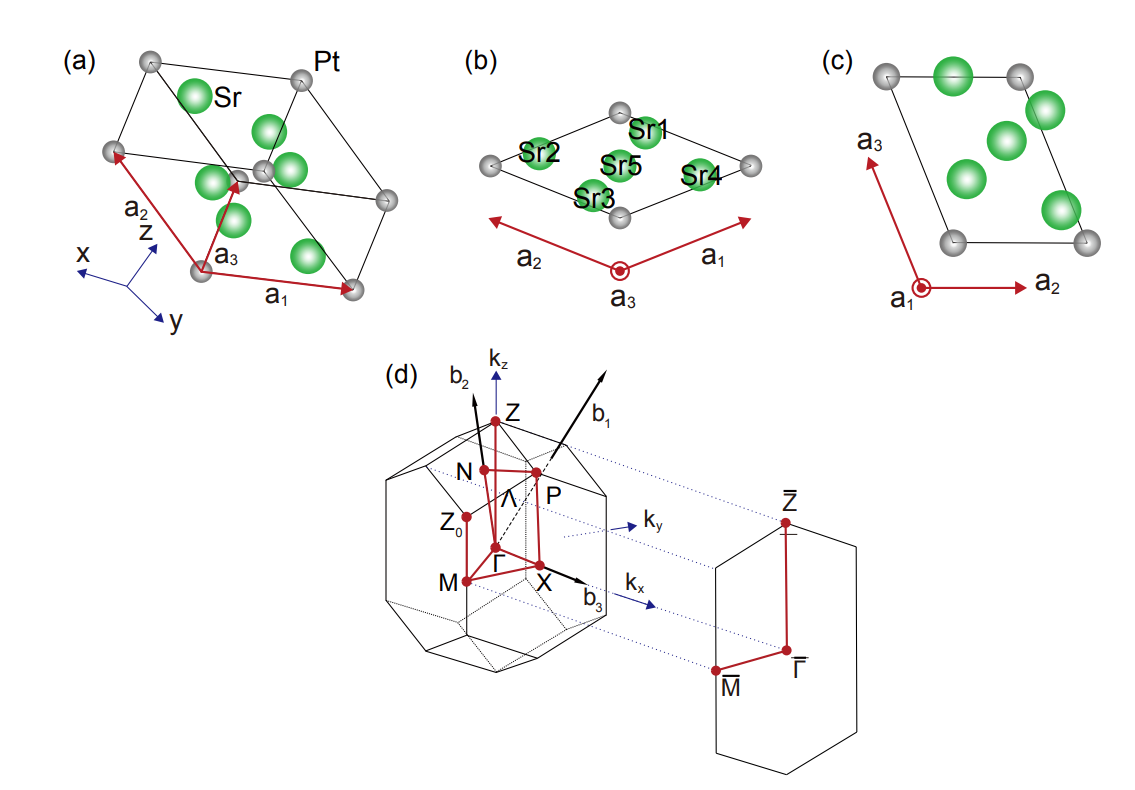
The search for materials exhibiting exotic electronic properties drives innovation in modern physics, and recent work focuses on compounds with unique topological states of matter. Inkyou Lee, Churlhi Lyi, and Youngkuk Kim, from the Department of Physics at Sungkyunkwan University, investigate the intriguing material PtSr5, identified through artificial intelligence-guided design as a promising candidate for hosting such states. Their calculations reveal that PtSr5 possesses a normal Dirac semimetal phase, a state where electrons behave as massless particles, but with a topologically trivial character. Significantly, the team demonstrates that applying a magnetic field transforms this material, inducing a topological phase transition to a Weyl semimetal, and showcasing a pathway to control and tune these properties for potential applications in advanced electronics.
Calcium Platinum Strontium Topological Material Discovery
Scientists have discovered a new material, Ca 3 Pt 2 Sr 2 , exhibiting properties characteristic of a topological material. Employing advanced computational methods, the research team predicted and analyzed the material’s behavior, focusing on its unique electronic structure and robust electronic properties. This discovery expands the range of known topological materials and contributes to the ongoing search for materials with tailored electronic characteristics. The investigation relied on first-principles calculations, a powerful technique using quantum mechanics to predict a material’s properties without experimental data.
These calculations determined the material’s electronic structure, confirmed its non-trivial topological state, and predicted the existence of protected surface states, a hallmark of topological materials. The calculations demonstrate that Ca 3 Pt 2 Sr 2 possesses unique surface states robust against imperfections. These findings open possibilities for utilizing this material in advanced electronic devices, potentially leading to innovations in spintronics, quantum computing, and low-power electronics.
PtSr5 Electronic Structure via Density Functional Theory
Researchers have investigated the electronic structure of PtSr 5 , a recently discovered tetragonal intermetallic compound, using sophisticated computational techniques. Employing density functional theory, they explored the material’s electronic properties and behavior, considering the effects of electron interactions and relativistic effects to accurately model its electronic structure. This detailed analysis provides a fundamental understanding of PtSr 5 ’s electronic characteristics. To comprehensively analyze the material’s electronic behavior, the team performed calculations with and without considering spin-orbit coupling.
They utilized a plane-wave energy cutoff and a carefully chosen grid of points to ensure the accuracy of the calculations, enabling them to investigate the material’s topological properties and understand its potential for hosting unique electronic states. The team analyzed the material’s topological invariants and investigated the formation of surface states. These calculations established the tunability of PtSr 5 ’s electronic properties and confirmed its classification as a Dirac semimetal, a material with unique electronic characteristics and potential for advanced applications.
PtSr5 Exhibits Unique Dirac Semimetal Phase
The discovery of PtSr 5 reveals a unique Dirac semimetal phase with intriguing electronic properties. Guided by artificial intelligence-driven materials design, researchers identified this body-centered tetragonal compound as a promising candidate for hosting Dirac points, special points in its electronic structure. Detailed calculations demonstrate that PtSr 5 exhibits a compensated semimetal phase, resulting in characteristic Dirac points within its band structure. While many Dirac semimetals exhibit band inversion, PtSr 5 ’s Dirac crossings occur within its Brillouin zone, suggesting a topologically trivial phase.
Further analysis confirms this, revealing that all topological invariants are indeed trivial. However, the material’s behavior is tunable; applying an external magnetic field drives a transition to a Weyl semimetal phase, a different type of topological phase. This transition is evidenced by changes in the computed surface states, demonstrating the potential for external control of the material’s topological properties. The stability of the PtSr 5 structure is also confirmed through calculations, indicating its resistance to decomposition. These findings establish PtSr 5 as a promising platform for exploring tunable topological phases and advancing the development of novel electronic devices.
PtSr5 Transitions Between Semimetal Phases
Researchers have detailed the discovery and characterization of PtSr 5 , establishing it as a Dirac semimetal with topologically trivial characteristics. Through first-principles calculations, they demonstrated that PtSr 5 possesses a Dirac semimetal phase, confirmed by analysis of its electronic band structure and resulting symmetry indicators. Importantly, this research also demonstrates the potential for tuning the topological properties of PtSr 5 through external stimuli. Applying a magnetic field induces a phase transition, driving the material from its initial Dirac semimetal state into a Weyl semimetal phase.
This transition is evidenced by the emergence of Weyl points and the formation of corresponding surface Fermi arcs, confirming the change in topological state. The authors acknowledge that the strength of the magnetic field used in their calculations was chosen for clarity and that the same physical mechanism can occur at lower fields, as demonstrated in other materials. This research highlights the effectiveness of artificial intelligence in guiding materials discovery and demonstrates the tunability of topological phases in PtSr 5 , opening avenues for further exploration of its potential applications.
🗞 Normal Dirac Semimetal Phase and Zeeman-Induced Topological Fermi Arc in PtSr5
🧠 ArXiv: https://arxiv.org/abs/2510.22649