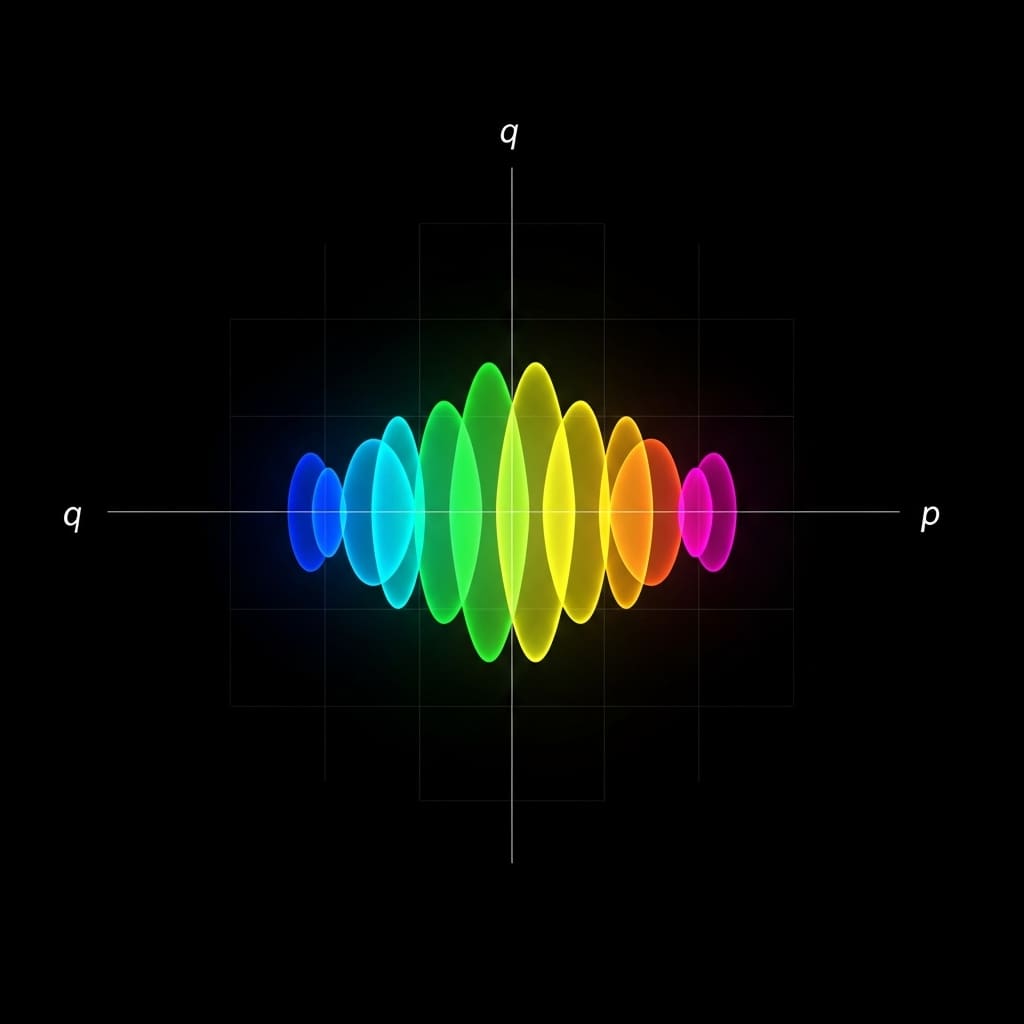
The fundamental interaction between charged particles and light traditionally focuses on momentum, yet increasingly sophisticated experiments demand a deeper understanding of how radiation evolves in both space and time. D. V. Karlovets, A. A. Shchepkin, and A. D. Chaikovskaia, alongside colleagues D. V. Grosman, D. A. Kargina, and U. G. Rybak, have developed a new method to describe photon emission using phase space and the Wigner function, offering a more complete picture of these processes. This approach reveals previously unseen effects in phenomena like Cherenkov radiation, including a measurable spreading time for photons and a shift in their arrival time, all occurring on the incredibly short timescales of attoseconds and femtoseconds. By linking macroscopic radiation patterns to the atomic characteristics of the emitting particle, the team demonstrates a pathway towards “snapshots” of the emitter’s wave function and opens possibilities for advanced tomographic methods within particle physics.
Chaikovskaia, alongside colleagues, have developed a new method to describe photon emission using phase space and the Wigner function, offering a more complete picture of these processes. This approach reveals previously unseen effects in phenomena like Cherenkov radiation, including a measurable spreading time for photons and a shift in their arrival time, all occurring on the incredibly short timescales of attoseconds and femtoseconds. By linking macroscopic radiation patterns to the atomic characteristics of the emitting particle, the team demonstrates a pathway towards “snapshots” of the emitter’s wave function and opens possibilities for advanced tomographic methods within particle physics.
Wigner Function Describes Photon Emission Dynamics
Scientists pioneered a novel method for describing photon emission using the Wigner function in phase space, moving beyond traditional momentum-space approaches. This technique addresses a limitation of existing theory, which often overlooks crucial spatial and temporal phenomena like radiation formation and wave packet spreading, increasingly important in experiments employing attosecond spectroscopy. The research team developed a theoretical framework that explicitly incorporates the spatial structure of both the emitting electron packet and the measurement procedure, enabling the treatment of both standard and generalized measurements of the emitted photons. By focusing on the phase-space description, the work overcomes limitations of conventional methods that obscure essential features of photon emission, such as finite formation length and spatial coherence.
Applying this method to Cherenkov radiation, the scientists predicted several effects absent in classical electrodynamics, including a negative photon spreading time near the Cherenkov angle, a flash duration determined by the electron packet size, and a quantum shift in photon arrival time. These effects, occurring on timescales ranging from attoseconds to femtoseconds, reveal the atomic origins of macroscopic phenomena and demonstrate the influence of the electron wave packet’s spatial coherence on the emitted radiation. Notably, the near-field distribution of the photon field closely mirrors the shape of the electron packet, effectively creating “snapshots” of the emitter’s wave function, a capability unavailable in far-field theories.
Cherenkov Radiation Reveals Negative Photon Formation Length
Scientists have developed a new method for describing how charged particles emit light, moving beyond traditional approaches that focus on momentum and instead examining the process in both space and time. This work introduces a phase-space approach, utilizing the Wigner function, to model single-photon emission and accurately capture effects absent in classical electrodynamics. Experiments involving Cherenkov radiation demonstrate several novel phenomena predicted by this new formalism. The team measured a negative spreading time, and therefore a negative formation length, for photons emitted near the Cherenkov angle, a result that challenges classical understanding of wave propagation.
Measurements confirm a finite duration for the emitted light flash, directly linked to the size of the electron packet initiating the radiation, and a quantum shift in photon arrival time, which can be both positive and negative. These effects, occurring on timescales ranging from attoseconds to femtoseconds, reveal the atomic origins of what are typically considered macroscopic phenomena, demonstrating how the structured electron packet influences light emission. Remarkably, the spatial distribution of the emitted photons closely resembles the shape of the electron wave packet itself, effectively creating a snapshot of the emitting particle’s wave function.
Quantum Radiation Beyond Momentum Description
This research presents a new method for describing the emission of photons, moving beyond traditional approaches that focus on momentum to incorporate spatial and temporal aspects of the process. Scientists developed a quantum phase-space description using the Wigner function, allowing them to model photon emission from an electron wave packet, specifically examining Cherenkov radiation as an illustrative example. This technique explicitly accounts for the finite size and coherence of the electron, as well as the details of how the emitted photons are measured.
The results reveal several effects not predicted by classical theory, including a negative spreading time for photons, a finite duration for the emitted radiation pulse, and a quantum shift in photon arrival time. Importantly, the spatial distribution of the emitted photons closely mirrors the shape of the electron wave packet, effectively creating a snapshot of the emitting particle’s structure. Extending the model to materials with varying light-bending properties demonstrates that dispersion significantly alters these effects, potentially increasing the range of negative spreading times and making temporal shifts measurable on femtosecond to nanosecond timescales. This work establishes a more complete understanding of light-matter interactions at the quantum level, with implications for attosecond spectroscopy and metrology, and offers a framework for investigating the fundamental limits of radiation emission.
👉 More information
🗞 Phase-space description of photon emission
🧠 ArXiv: https://arxiv.org/abs/2512.21783