

Inter-satellite free-space optical (FSO) communication offers the potential for high-bandwidth data transfer in space, but its reliability is significantly affected by even slight misalignment between the transmitting and receiving satellites. Minje Kim from Korea Advanced Institute of Science and Technology, Hongjae Nam from Purdue University, and Beomsoo Ko, along with their colleagues, investigate this critical issue and present a new analytical model to accurately predict the impact of beam misalignment on these links. Their work moves beyond relying on perfect orbital knowledge and complex hardware, instead focusing on quantifying the effects of unavoidable jitter and displacement based on realistic orbital dynamics. The team develops a method to efficiently calculate the probability of communication failure, offering a practical tool for designing robust inter-satellite FSO systems and paving the way for more dependable space-based communication networks.
Atmospheric Turbulence and Satellite Optical Links
This extensive collection of research focuses on free-space optical (FSO) communication, particularly its application to satellite communications. Researchers investigate methods for accurately modeling the FSO channel, considering atmospheric turbulence and employing techniques like spatial diversity to improve link reliability and optimize power allocation. Some studies explore combining FSO with radio frequency communication to create more robust hybrid systems. References to constellations like Starlink and Kuiper demonstrate research focused on the practical challenges and opportunities of FSO in large-scale low Earth orbit systems, including considerations for satellite collision avoidance. The collection encompasses theoretical modeling, analytical analysis, numerical simulation, experimental studies, and system design, all contributing to a comprehensive understanding of FSO technology and its potential for space-based communication.
Satellite Pointing Error Model for Free-Space Optics
Scientists have developed a comprehensive model to characterize pointing errors in inter-satellite free-space optical (FSO) communication. The team established an exact closed-form cumulative distribution function (CDF) for the FSO link channel, providing a precise mathematical description of signal behavior. To improve computational efficiency, researchers introduced a truncation-based algorithm, enabling rapid and accurate evaluation of outage probabilities, a critical metric for assessing link reliability. The work quantifies misalignment induced by satellite orbital motion, a factor often neglected in previous studies.
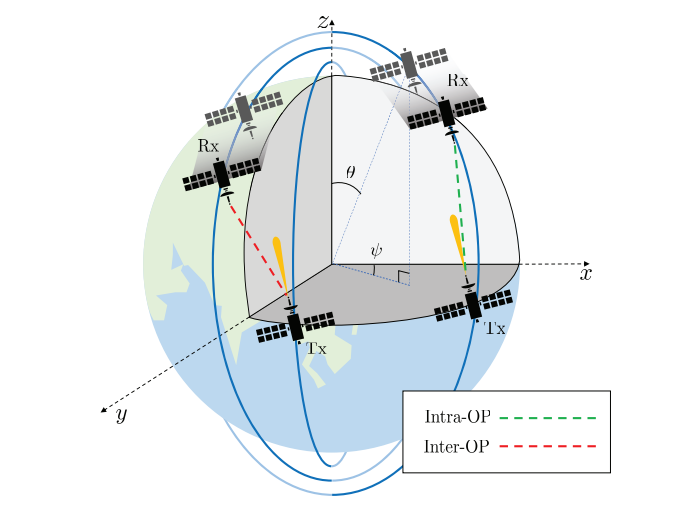
Scientists employed a receiver-centric spherical coordinate framework to analyze orbital dynamics and relative orbital plane orientations, enabling precise determination of signal arrival time and estimation of receiver displacement. Validated against Monte Carlo simulations, the model demonstrates a close match, confirming its utility for practical system design. This delivers a robust analytical framework for assessing and optimizing inter-satellite FSO communication systems, paving the way for high-bandwidth, low-latency space-based networks.
FSO Link Reliability Under Beam Misalignment
Scientists have developed a new model for analyzing free-space optical (FSO) communication links between satellites, addressing the critical challenge of beam misalignment. The team derived a closed-form expression for the cumulative distribution function (CDF) of the FSO channel, accounting for both jitter and misalignment-induced pointing errors. To enable practical computation, researchers introduced a truncated CDF formulation combined with a bisection algorithm, ensuring efficient and accurate results with minimal computational overhead. The model quantifies displacement based on orbital dynamics, providing a comprehensive assessment of system performance under realistic conditions. Experiments demonstrate a close match between the proposed model and Monte Carlo simulations, validating its accuracy and usefulness for designing future inter-satellite FSO systems.
Predicting Outage Probability in Satellite Links
This research presents a new model to accurately predict the performance of free-space optical communication links between satellites, a technology poised to become crucial for future space-based data networks. The team developed a mathematical framework to quantify the impact of beam misalignment on signal quality. By deriving a closed-form expression for the probability of signal outage, the researchers provide a practical tool for designing robust inter-satellite links, accounting for both random jitter and predictable orbital dynamics. The key achievement lies in the development of a truncated cumulative distribution function, coupled with an efficient bisection algorithm, which allows for accurate and computationally manageable estimation of outage probabilities.
🗞 Analysis of Beam Misalignment Effect in Inter-Satellite FSO Links
🧠 ArXiv: https://arxiv.org/abs/2511.02189


