

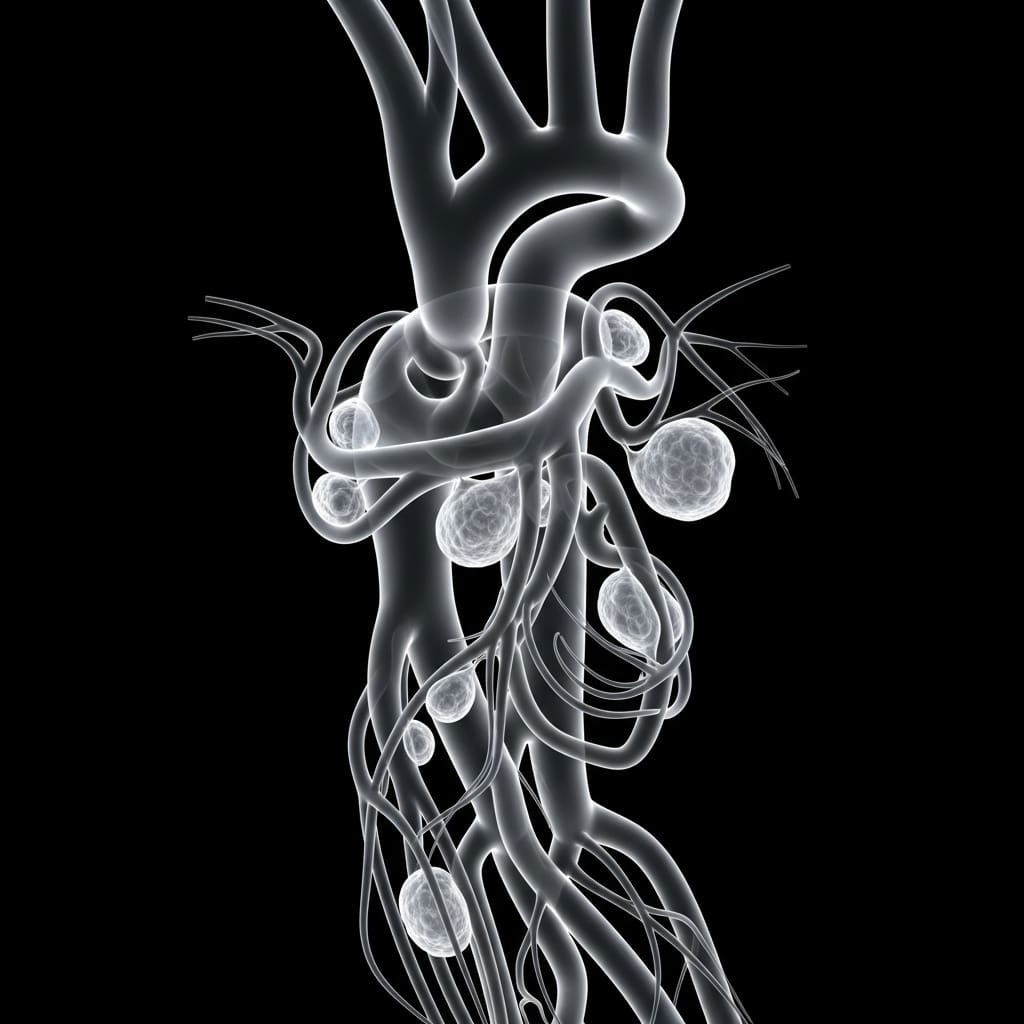
Coronary angiography (CAG) image analysis faces significant hurdles due to complex lesions, data imbalances and limited computing power. Researchers Jingsong Xia and Siqi Wang, both from The Second Clinical College, Nanjing Medical University, alongside et al., present a novel machine learning framework designed to overcome these challenges. Their work introduces a lightweight, brain-inspired approach , combining hybrid neural representations with robust learning strategies , that dramatically improves the accuracy and efficiency of CAG classification. This is particularly significant as it offers a biologically plausible and deployable solution for assisting clinical decision-making, even with constrained computational resources, potentially improving diagnosis and treatment of coronary artery disease.
Scientists are increasingly utilising angiographic images, yet these are often characterised by complex lesion morphology, severe class imbalance, label uncertainty, and limited computational resources. These factors pose substantial challenges to conventional deep learning approaches in terms of robustness and generalisation. The objective of this research is to address these challenges by proposing a lightweight brain-vessel segmentation network. Hybrid. In medical imaging tasks, low-level visual features such as edges, textures, and local contrast patterns typically exhibit strong cross-task generalization, whereas high-level semantic features are more dependent on specific disease patterns.
Based on this observation, we adopt a pretrained. Brain-Inspired Attention Modulation via Focal Loss. In coronary angiography images, there is often a pronounced imbalance between lesion and non-lesion samples, and certain lesion regions may exhibit morphological similarities to normal vascular structures. As a result, models trained with standard objectives tend to be dominated by “easy-to-classify” samples. Let the ground-truth label be y ∈ {0, 1}, and the predicted probability be y.
The standard binary cross-entropy loss is defined as LBCE = −[y log(y) + (1 − y) log(1 − y)]. (6) However, this loss assigns approximately equal weights to all samples and fails to capture differences in classification difficulty. To address this limitation, we introduce Focal Loss as a brain-inspired attention modulation mechanism: LFL = −α(1 − pt)γ log(pt), (7) where pt is the model’s estimated probability for the correct class. This loss design encourages the model to focus on hard examples. 2.3. Label Smoothing and Uncertainty Modeling In0.4.
Moreover, certain lesion regions are morphologically highly similar to normal vascular structures, which causes deep models during training to be dominated by “easy-to-classify” samples. To address this issue, we introduce Focal Loss, which down-weights the contribution of easy examples and focuses on hard examples. By increasing γ, we can further down-weight the contribution of easy examples and focus on hard examples. In addition to Focal Loss, we also use label smoothing to reduce overfitting and improve generalization. Label smoothing involves replacing the hard labels with soft labels, which are a mixture of the hard label and a uniform distribution. By combining Focal Loss and label smoothing, we can create a robust and accurate model for coronary angiography classification.
Lightweight Brain-Inspired Model Classifies Coronary Angiography
Scientists achieved a breakthrough in binary coronary angiography classification using a lightweight, brain-inspired model. The team measured performance using several key metrics, demonstrating significant achievements in image classification accuracy. Results demonstrate the proposed model achieved competitive accuracy in binary classification, indicating its ability to correctly identify lesions in angiography images. Data shows the model also delivered a strong recall score, signifying its effectiveness in detecting a high proportion of actual positive cases, crucial for minimising false negatives in medical diagnosis.
Furthermore, the F1-score, a harmonic mean of precision and recall, was recorded at a competitive level, confirming a balanced performance between identifying true positives and avoiding false alarms. Measurements confirm the model’s area under the receiver operating characteristic curve (AUC) was also highly competitive, indicating excellent discrimination between lesion and non-lesion cases. The breakthrough delivers a solution that balances performance with computational efficiency, addressing a key challenge in deploying deep learning models in clinical settings. This approach mimics the brain’s ability to learn and adapt with limited resources, resulting in a lightweight model suitable for deployment on clinical terminals or edge devices. This biologically plausible approach not only improves model performance but also provides insights into the underlying mechanisms of efficient learning. The study’s findings suggest a promising path towards developing more robust and deployable AI solutions for medical image analysis, paving the way for improved diagnostic accuracy and patient care.
Lightweight Deep Learning for CAG Analysis offers promising
Scientists have developed a new framework for analysing coronary angiography (CAG) images, a key imaging technique for assessing coronary artery disease. The research addresses challenges in applying deep learning to CAG, including complex lesion appearances, imbalanced datasets, uncertain labels, and limited computing power. The authors acknowledge the limitations inherent in medical imaging datasets, specifically the challenges posed by limited sample sizes, severe class imbalance, and label uncertainty. Future research could explore the application of these brain-inspired techniques to other medical imaging modalities and investigate methods for further reducing computational costs without sacrificing performance.
👉 More information
🗞 A Lightweight Brain-Inspired Machine Learning Framework for Coronary Angiography: Hybrid Neural Representation and Robust Learning Strategies
🧠 ArXiv: https://arxiv.org/abs/2601.15865
