

Improving traffic safety at busy intersections remains a critical challenge, and researchers are now moving beyond traditional, delayed crash data to proactively assess risk. Shounak Ray Chaudhuri, Arash Jahangiri, and Christopher Paolini, from San Diego State University, present a new computer vision framework that continuously monitors intersections using multiple cameras and calculates Post-Encroachment Time, a measure of how closely vehicles follow each other. This innovative system processes images in real-time, accurately pinpointing potential hazards with centimetre-level precision and creating dynamic heatmaps of high-risk areas. By moving beyond static analysis and leveraging decentralized, vision-based technology, this research demonstrates a replicable methodology for scalable, high-resolution intersection safety evaluation and paves the way for intelligent transportation systems that actively mitigate risk.
Vehicle Tracking and Near-Collision Risk Assessment
This research details a system for evaluating traffic safety using computer vision, employing a deep learning model to accurately identify and track vehicles in video footage. The system calculates Post-Encroachment Time, or PET, representing the time a vehicle has to avoid a collision after another vehicle enters its path, as a key indicator of risk. Lower PET values suggest a higher probability of a collision, allowing the system to identify near misses and potentially dangerous situations. By generating data on PET distributions, the system identifies locations with consistently low PET values, indicating a need for safety improvements, and moves beyond reactive crash analysis to a proactive approach.
Real-time Traffic Assessment via Camera Synchronization
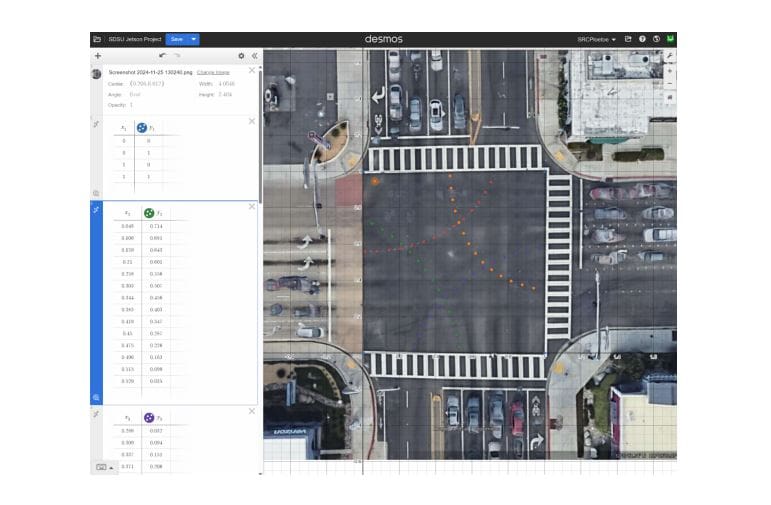
Researchers developed a novel computer vision framework for real-time traffic safety assessment, demonstrated at an intersection in California. The study harnessed data from four synchronized cameras, providing continuous visual coverage, and processed each frame on specialized computing devices. Vehicle detection employed a state-of-the-art segmentation algorithm, identifying vehicles within each camera’s field of view. Detected vehicle shapes were then transformed into a unified bird’s-eye map using precisely calculated transformations, effectively combining overlapping camera views and improving the accuracy of vehicle localization. This framework achieves high-resolution, sub-second precision in identifying high-risk areas and facilitates long-term monitoring and analysis of traffic patterns.
Real-time Hazard Mapping with Multi-Camera Vision
Scientists have developed a multi-camera computer vision framework for real-time traffic safety assessment, demonstrated at a busy intersection in California. The work utilizes four synchronized cameras to continuously monitor vehicle movements, processing each frame on specialized computing devices with a state-of-the-art segmentation algorithm for precise vehicle detection. Detected vehicles are transformed into a unified bird’s-eye map using transformations, aligning views from overlapping cameras and enabling accurate vehicle localization. A key achievement is a novel pixel-level Post-Encroachment Time algorithm, which measures vehicle position without relying on fixed cells, allowing for hazard visualization with high accuracy and enabling the identification of close-encounter events with greater precision.
Real-time Intersection Safety via Computer Vision
This research presents a novel computer vision framework for real-time intersection safety assessment, moving beyond traditional crash-based studies. The team developed a multi-camera system, deployed at a California intersection, that continuously monitors vehicle movements and computes Post-Encroachment Time, a key metric for identifying hazardous situations. By processing camera feeds on specialized computing devices, the system achieves high-resolution, sub-second precision in identifying high-risk areas and accurately measures vehicle positions at a high granularity. While limitations exist regarding camera coverage and the need for manual configuration, future work will focus on improving camera indexing strategies and reducing the need for manual calibration to further enhance the system’s accuracy, scalability, and ease of implementation.
👉 More information
🗞 Enhancing Road Safety Through Multi-Camera Image Segmentation with Post-Encroachment Time Analysis
🧠 ArXiv: https://arxiv.org/abs/2511.12018


