Understanding the nature of gravity at extremely small scales remains a fundamental challenge in theoretical physics, and recent work by Luca Griguolo of the University of Parma and INFN, alongside Jacopo Papalini from Ghent University, and Lorenzo Russo and Domenico Seminara from the University of Florence and INFN, offers a novel approach to this problem. The team investigates dilaton gravity, a theory exploring how gravity behaves when considering a minimum possible length scale, and develops a new mathematical framework for analysing it. Their research successfully connects different methods of calculation, including examining the evolution of closed universes and the behaviour of boundaries in spacetime, to produce a consistent picture of gravity at these tiny distances. This achievement not only provides an exact formula for calculating key quantities in these theories, but also reveals potential pathways towards a more complete understanding of how gravity interacts with quantum mechanics, offering crucial insights into the search for a unified theory of everything.
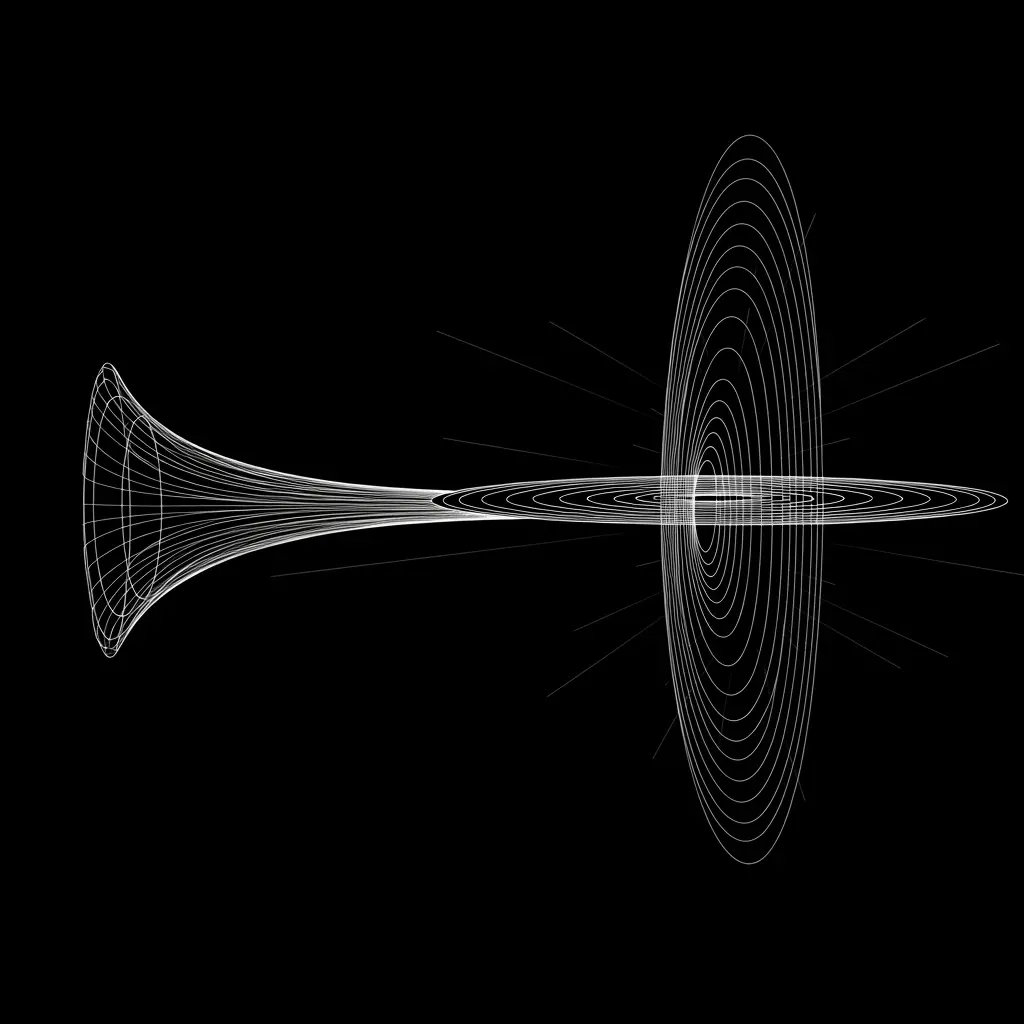
The research investigates the closed-channel bulk path integral and the path integral over boundary curves. Initially, the team studies the radial evolution of a closed universe and derives the trumpet wavefunction as a transition amplitude between a geodesic boundary and a finite Dirichlet boundary. This analysis recovers the Hartle-Hawking wavefunction without imposing asymptotic boundary conditions, enabling the trumpet to connect with a cap wavefunction to reconstruct a smooth disk. Subsequently, the researchers derive an exact Riccati equation for the extrinsic curvature of a finite-cutoff boundary curve within the Euclidean Poincaré disk, and a WKB expansion of this equation yields all perturbative corrections in the cutoff parameter.
JT Gravity, SYK Models, and Complexity Studies
A substantial body of work explores Jackiw-Teitelboim (JT) gravity, double-scaled SYK models, and T-bar deformations, investigating connections between quantum gravity, quantum chaos, and complexity. Research focuses on exact quantization of JT gravity using matrix integral techniques, and the role of topological defects like wormholes in its geometry. Studies also examine JT gravity with a finite cutoff, introducing a natural length scale for controlled analysis, and the effects of modifications to the JT action via T-bar deformations. The double-scaled SYK model, a quantum mechanical model exhibiting black hole-like properties, is investigated for its holographic duality with JT gravity.
Researchers extract geometric information from the SYK model and utilize it as a platform to study quantum complexity, particularly Krylov complexity, which relates to entanglement growth. Analyses of chord dynamics within the SYK geometry provide insights into information propagation and complexity. T-bar deformations, modifications of 2D quantum field theories, are studied through exact solutions, renormalization group flows, and thermodynamic properties. A significant theme is the use of holographic techniques to study quantum complexity, including Krylov complexity and the Schwarzian theory, which describes the boundary dynamics of holographic spacetime.
Investigations connect wormhole geometry to the growth of complexity. Foundational papers establish the groundwork for JT gravity and the SYK model, while further research delves into quantization, defects, and holographic connections. Studies of T-bar deformations and holographic complexity build upon these foundations, exploring connections to other areas of theoretical physics. This rapidly evolving field continues to generate new insights into the interplay between gravity, quantum mechanics, and complexity.
Finite Cutoff Dilaton Gravity Wavefunction Reconstruction
Scientists have made a significant advance in understanding two-dimensional dilaton gravity models with a finite cutoff, a boundary at a finite distance within spacetime. This work employs both a bulk path integral and a boundary path integral to achieve consistent results. The team computed the “trumpet wavefunction”, representing universe evolution, successfully reconstructing a smooth disk partition function without traditional boundary condition assumptions, and recovering the Hartle-Hawking wavefunction. The research reveals an exact Riccati equation governing the extrinsic curvature of finite-cutoff boundary curves within the Euclidean Poincaré disk, enabling systematic expansion in the cutoff parameter.
A WKB expansion of this equation yields perturbative corrections and captures nonperturbative effects, providing a comprehensive understanding of boundary dynamics. Calculations of the quadratic boundary action and the one-loop partition function agree with both the bulk approach and the expected effective action for the deformation of the Schwarzian theory. Further research extends these findings to general dilaton gravity with arbitrary potentials, proposing an exact expression for their finite cutoff partition functions. Investigations into ultraviolet completeness introduce a canonical quantization approach, opening avenues for exploring higher topologies and boundary-to-boundary correlators. These advancements provide a controlled method for improving the UV behavior of bulk theories and realizing integrable deformations of the boundary model, potentially mirroring the finite state density observed in the SYK model.
Trumpet Wavefunction Reconstructs Universe Geometry
This research presents a novel approach to understanding two-dimensional gravity within Jackiw-Teitelboim (JT) gravity, examining it from both a bulk path integral perspective and through boundary curve geometry. The team successfully derived the “trumpet wavefunction”, a mathematical description of universe evolution, which recovers the Hartle-Hawking wavefunction without specific boundary condition assumptions, enabling reconstruction of a complete universe. This clarifies the relationship between different mathematical formulations of quantum gravity and provides a robust foundation for calculations. Researchers obtained an exact equation governing the shape of finite-cutoff boundary curves in the Euclidean Poincaré disk, allowing calculation of the quadratic boundary action and the one-loop partition function.
These calculations agree with existing results from the bulk approach and the Schwarzian theory, and extend to more general dilaton gravity theories, suggesting broader applicability. By drawing parallels with sine dilaton gravity and the double-scaled SYK model, the team proposes an exact expression for partition functions in these complex systems, potentially offering insights into ultraviolet completeness. While acknowledging limitations in extending these results to higher dimensions, the authors suggest future research explore the canonical quantization approach within the finite cutoff framework, potentially revealing deeper connections between geometry and quantum mechanics. This work represents a significant step towards understanding the fundamental principles governing gravity at the quantum level.
🗞 A new perspective on dilaton gravity at finite cutoff
🧠 ArXiv: https://arxiv.org/abs/2512.21774