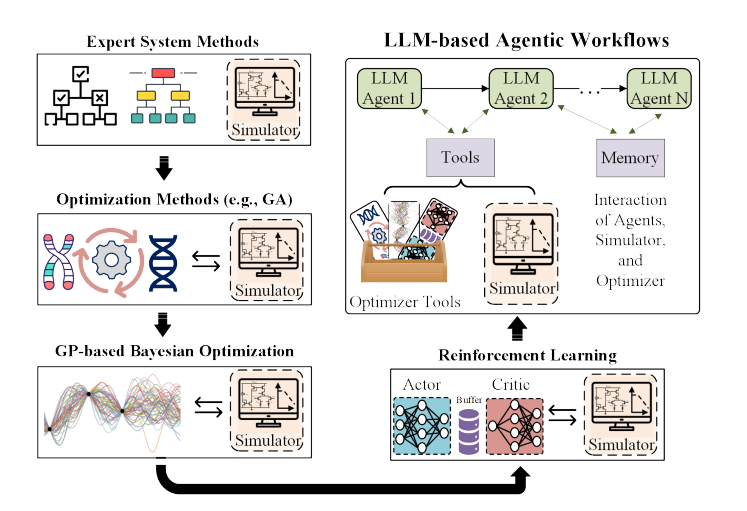
Analog circuits form the essential link between electronics and the physical world, yet their design remains a complex and time-consuming process prone to errors. Mohsen Ahmadzadeh, Kaichang Chen, and Georges Gielen from KU Leuven present a new framework, AnaFlow, that tackles these challenges by employing an agentic artificial intelligence system for efficient and explainable analog circuit sizing. This innovative approach moves beyond traditional methods by utilising multiple, specialised AI agents that collaborate to understand design goals and iteratively refine circuit parameters, providing human-interpretable reasoning throughout the process. The system significantly reduces the need for extensive simulations, achieving greater efficiency, and offers a transparent design exploration tool that promises a new paradigm in analog electronic design automation where AI agents act as intelligent assistants.
AI Automates Analog Circuit Design Challenges
Artificial Intelligence, specifically Large Language Models and Reinforcement Learning, is transforming analog and mixed-signal integrated circuit design. This field traditionally relies on intuition and experience, making automation difficult, and existing optimization techniques can be computationally expensive or struggle with circuit complexity. Researchers are exploring several AI-based approaches, including using Reinforcement Learning agents to learn optimal design strategies and generative models based on Large Language Models to create circuit designs. A key focus is leveraging Large Language Models not just for generation, but as agents that can reason about design choices, use tools like circuit simulators, and iteratively refine designs.
Techniques like Toolformer and ReAct enable these models to effectively utilize external tools, and providing the right context, such as design constraints and performance goals, is crucial for success. AnalogGenie is a specific example of a generative engine for discovering circuit topologies, and ADO-LLM uses in-context learning of Large Language Models with Bayesian optimization. This research suggests that AI, particularly Large Language Model-based agents, has the potential to significantly transform analog circuit design by automating key tasks, improving design quality, and reducing design time. The trend towards Large Language Model-based agents that can reason, plan, and use tools is particularly promising, painting a picture of a rapidly evolving field where AI enables more intelligent and creative analog circuit design.
LLM Agents for Analog Circuit Optimization
The AnaFlow framework pioneers a new approach to analog circuit sizing, moving beyond traditional optimization techniques by employing a multi-agent system driven by Large Language Models. Researchers engineered a workflow that mimics the cognitive process of an experienced analog designer, enabling both sample efficiency and explainability in circuit design. This system utilizes specialized Large Language Model agents that collaborate to interpret circuit topology, understand design goals, and iteratively refine circuit parameters. The core of the AnaFlow system involves agents that formulate design steps based on established analog circuit theory knowledge, then execute targeted simulations to evaluate performance.
This process is not simply numerical optimization; the system actively reasons about the circuit’s behavior and adjusts parameters based on this understanding. To achieve high sample efficiency, the framework learns from its optimization history, avoiding previously unsuccessful design choices and accelerating convergence towards target specifications. Unlike black-box optimization methods, AnaFlow explicitly tracks the reasoning behind each design decision, providing a fully justified rationale alongside optimized parameters. Researchers demonstrated the framework’s capabilities by sizing two operational amplifiers of varying complexity, relying entirely on reasoning, planning, tool use, and decision feedback within the AnaFlow system. The system’s explainability is a key achievement, allowing designers to understand the trade-offs made during the sizing process and build confidence in the automated solutions.
AnaFlow Achieves Automated Circuit Design with Reasoning
Scientists developed a novel agentic AI framework, AnaFlow, for automated analog circuit sizing that achieves both sample efficiency and explainability. The work demonstrates a multi-agent workflow where specialized Large Language Model-based agents collaborate to interpret circuit topology, understand design goals, and iteratively refine circuit parameters. This approach moves beyond traditional numerical optimization by mimicking the cognitive workflow of an expert analog designer, grounding the process in human-interpretable reasoning. Experiments with two operational amplifiers of varying complexity demonstrate the framework’s capabilities.
AnaFlow successfully completed the sizing task fully automatically, a feat not achieved by pure Bayesian optimization or reinforcement learning approaches. The system learns from its optimization history, avoiding past mistakes and accelerating convergence towards target specifications. This reasoning-driven approach achieves improved sample efficiency, requiring fewer computationally expensive circuit simulations to reach a solution. The AnaFlow framework’s explainability is a key achievement, providing human-interpretable reasoning for each step taken during circuit sizing, allowing designers to understand the rationale behind design choices and build confidence in the automated solutions.
AnaFlow, Agentic AI for Circuit Sizing
This research presents AnaFlow, a novel agentic AI framework that significantly advances the field of analog circuit sizing. The team developed a multi-agent system, leveraging large language models, to automate the design process while providing transparent and interpretable reasoning for each design decision. Unlike existing optimization and reinforcement learning approaches, AnaFlow mimics the cognitive process of expert human designers, decomposing the sizing task into distinct analytical and refinement steps. Experimental results demonstrate a substantial reduction in the number of simulations required to achieve optimized designs, highlighting the framework’s sample efficiency. Crucially, AnaFlow provides traceable justifications for design choices, enabling designers to understand, critique, and learn from the automated process. This inherent explainability represents a key contribution, fostering trust in the generated solutions and paving the way for a new paradigm in analog electronic design automation where AI agents function as transparent design assistants.
🗞 AnaFlow: Agentic LLM-based Workflow for Reasoning-Driven Explainable and Sample-Efficient Analog Circuit Sizing
🧠 ArXiv: https://arxiv.org/abs/2511.03697