Quantum computation relies on maintaining the delicate state of qubits – the quantum equivalent of bits – for extended periods, a property known as coherence. While various physical systems are being explored to realise qubits, atomic, molecular and optical (AMO) approaches offer promising scalability and coherence times. A significant challenge for AMO qubits is the comparatively slow rate at which errors can be detected and corrected – a process called syndrome extraction. Researchers at Riverlane, in collaboration with the University of Sheffield, address this limitation with new decoding protocols designed to accelerate logical operations. In a paper entitled ‘Scalable decoding protocols for fast transversal logic in the surface code’, Mark L. Turner, Earl T. Campbell, Ophelia Crawford, Neil I. Gillespie and Joan Camps detail algorithms that enhance the speed of error correction, potentially unlocking the capacity for complex computations on AMO-based quantum computers.
Advances in Quantum Error Correction Accelerate Transversal Logic for AMO Qubits
Recent research demonstrates significant progress in quantum error correction, specifically addressing limitations in decoding speed for surface codes implemented with atomic, molecular, and optical (AMO) qubits. Surface codes are a leading approach to protecting quantum information from errors, but their practical implementation requires efficient decoding – the process of identifying and correcting errors without collapsing the quantum state.
AMO systems present advantages in qubit connectivity and coherence times – the duration for which a qubit maintains its quantum state – but traditionally suffer from slower rates of syndrome extraction. Syndrome extraction is the measurement process that reveals information about errors without directly measuring the qubits themselves, and is a critical bottleneck for achieving practical quantum computation. This new work focuses on enhancing decoding speed to overcome this limitation.
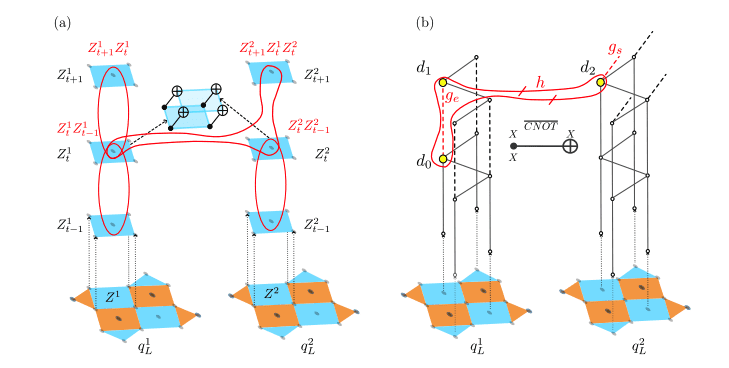
The core challenge lies in the incompatibility between fast transversal logic and existing, efficient decoding methods like lattice surgery. Transversal logic, a technique for performing quantum operations on encoded qubits without directly manipulating the physical qubits, promises to increase the logical clock rate – the speed at which quantum computations can be performed. However, it disrupts the structural properties that enable real-time decoding.
To address this, researchers have introduced two novel, windowed decoding protocols. These protocols restore modularity and locality to the decoding problem, effectively breaking down the complex task into manageable segments. Numerical simulations, utilising the Stim quantum circuit simulator, demonstrate a substantial performance gain – an order of magnitude speed-up for transversal logic compared to conventional lattice surgery – with only a minimal increase in computational overhead.
Further simulations reveal that the ‘Ghost Decoding’ strategy achieves exponential error suppression as the code distance – a measure of the code’s ability to correct errors – increases. Crucially, the number of decoding passes required does not scale beyond the code distance itself, even at high distances, suggesting feasibility for large-scale implementations.
The research highlights the importance of careful parameter tuning, specifically the number of decoding passes and the inclusion of ‘ghost singletons’ – artificial error measurements used to improve decoding accuracy. The number of passes required increases as the interval between transversal CNOT gates diminishes, demonstrating a direct relationship between circuit structure and decoding complexity. This adaptability is vital for accommodating diverse quantum algorithms and hardware constraints.
These new windowed decoding protocols restore modularity and locality to the decoding problem, unlocking an order of magnitude increase in logical clock rate with only a small increase in space overhead. This improvement addresses a critical limitation of AMO qubits – their slower syndrome extraction cadence – and supports the viability of large-scale algorithms on this promising platform.
Future work will focus on exploring the limits of these decoding protocols and developing new techniques to further improve the efficiency and scalability of quantum error correction. This research represents a significant step forward in the quest for fault-tolerant quantum computation, bringing us closer to a future where quantum computers can revolutionise fields such as medicine, materials science, and artificial intelligence. The commitment to reproducibility is underscored by the public availability of the Stim circuits used in the simulations.
👉 More information
🗞 Scalable decoding protocols for fast transversal logic in the surface code
🧠 DOI: https://doi.org/10.48550/arXiv.2505.23567