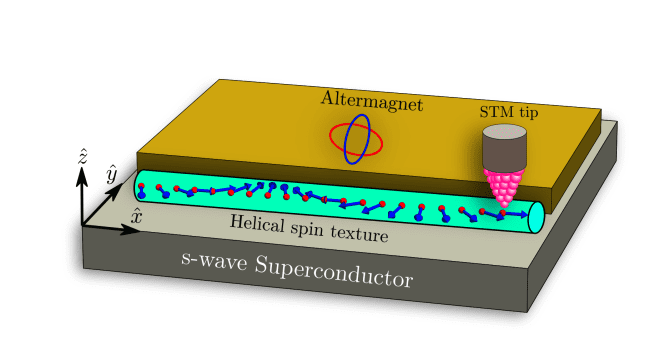
The pursuit of energy-efficient technologies receives a boost from new research into superconductivity, as Dibyendu Samanta and Sudeep Kumar Ghosh, both from the Department of Physics at the Indian Institute of Technology, Kanpur, and their colleagues demonstrate a superconducting diode effect without the need for external magnetic fields. Typically, achieving this directional flow of supercurrent requires magnetic fields, which complicates practical device development, but this work reveals a pathway to create efficient, scalable superconducting diodes using a unique combination of materials. The team shows that a specific arrangement of atomic chains, termed Shiba chains, coupled with an ‘altermagnet’, generates a special superconducting state that breaks fundamental symmetries in the material, allowing current to flow more easily in one direction than another. This innovative approach not only achieves diode efficiencies exceeding 45% but also establishes a promising platform for building advanced topological superconducting devices with intrinsic, dissipationless functionality, potentially revolutionising future technologies.
The ability to control and integrate superconducting devices remains a central challenge in advanced materials research. This work demonstrates a field-free realisation of the superconducting diode effect, a one-way flow of supercurrent, in a helical chain of magnetic atoms connected to a unique material called an altermagnet. Researchers employ sophisticated theoretical modelling to uncover a topological Fulde, Ferrell, Larkin, Ovchinnikov (FFLO) superconducting state, which hosts tunable Majorana zero modes at the chain ends. This state is stabilised by the interplay between the exchange coupling of magnetic atoms and the induced spin splitting within the altermagnet.
Superconducting Diodes and Majorana Zero Mode Potential
This research focuses on the emerging field of superconducting diodes and topological superconductivity, aiming to create materials exhibiting asymmetric current flow with superconducting current and explore pathways to achieve topological superconductivity, a state of matter hosting Majorana zero modes, promising building blocks for fault-tolerant quantum computation. Several mechanisms are being investigated to achieve the superconducting diode effect, including exploiting spin-orbit coupling, using non-centrosymmetric superconductors, applying magnetic proximity effects, and leveraging chiral structures. Researchers are particularly interested in helical Shiba chains, one-dimensional chains formed at the interface between a superconductor and a magnetic material, as a platform for realising Majorana zero modes. Non-collinear magnetism is also being investigated to induce topological superconductivity, with theoretical models like the Kitaev model used to describe this state and its Majorana zero modes.
A key focus is exploring how the superconducting diode effect can enhance or enable topological superconductivity, and vice versa. The research employs heterostructures, layering materials like superconductors, magnets, and topological insulators, to create novel properties, often using two-dimensional materials stacked with weak van der Waals forces. Magnetic materials break time-reversal symmetry and induce topological superconductivity. Challenges include achieving high-quality materials with well-defined interfaces, controlling these interfaces precisely, and mitigating the effects of disorder, which can disrupt topological superconductivity.
Distinguishing Majorana zero modes from other subgap states also presents a significant challenge. The ultimate goal is to use Majorana zero modes as qubits for fault-tolerant quantum computers and develop novel electronic devices with improved performance and energy efficiency. Future research will focus on developing new materials, improving the coherence of Majorana modes, and exploring their potential for building quantum devices.
Altermagnet Breaks Symmetry, Enables Supercurrent Diode
Researchers have demonstrated a novel platform for realising both topological superconductivity and the superconducting diode effect, a one-way flow of supercurrent, without external magnetic fields. This breakthrough combines a specially designed chain of magnetic atoms deposited on a conventional superconductor, coupled with an altermagnet, which intrinsically breaks time-reversal symmetry. The resulting heterostructure supports a topological superconducting phase, potentially hosting Majorana zero modes, and exhibits a significant superconducting diode effect. The key to this advancement lies in the interplay between the altermagnet and the magnetic atom chain, which together create a FFLO superconducting state.
This state is characterised by a unique form of pairing where electrons form Cooper pairs with a finite momentum, tunable by an applied current. Through detailed theoretical modelling, researchers have shown that this FFLO state not only supports topological superconductivity but also enables highly efficient, one-way supercurrent flow, exceeding 45% efficiency for certain configurations. This level of efficiency represents a substantial improvement over existing approaches that typically rely on external fields or complex material designs. Importantly, the system achieves this functionality without any applied magnetic field, a significant advantage for practical device integration and scalability.
The altermagnet plays a dual role, both enabling the topological superconducting state and driving the superconducting diode effect through its unique spin-splitting properties. The team’s calculations demonstrate that the system’s performance is sensitive to the arrangement of the magnetic atoms, with helical and conical configurations exhibiting different levels of efficiency. This research establishes a promising pathway towards developing dissipationless quantum technologies by combining robust topological superconductivity with efficient, field-free current control. The platform offers a versatile and experimentally feasible approach to realising Majorana-based quantum devices and opens new avenues for exploring novel superconducting phenomena. The ability to tune the system’s properties via current control further enhances its potential for practical applications in quantum information processing and low-energy electronics.
Altermagnet Heterostructure Enables High-Efficiency Diode Effect
This research demonstrates a novel platform for achieving both topological superconductivity and the superconducting diode effect within a single device, a Shiba chain connected to an altermagnet. Through detailed calculations, the team reveals that this heterostructure supports a unique superconducting state, a FFLO phase, which exhibits tunable Majorana zero modes at its ends. Crucially, this FFLO state also facilitates strong nonreciprocal supercurrents, resulting in a superconducting diode efficiency exceeding 45%, all without the need for external magnetic fields. The altermagnet plays a dual role in this system, intrinsically breaking time-reversal symmetry to enable topological superconductivity and simultaneously breaking inversion symmetry to drive the field-free superconducting diode effect.
The researchers found that the diode efficiency varies depending on the spin texture of the Shiba chain, achieving higher performance with helical configurations. This work establishes a promising pathway towards scalable, dissipationless technologies by offering a junction-free architecture for realising topological superconducting devices. The authors acknowledge that the specific properties of the altermagnet and Shiba chain, such as material composition and interface quality, will influence device performance and require further optimisation. Future research will likely focus on exploring different material combinations and refining the device fabrication process to maximise both the topological protection of Majorana modes and the efficiency of the superconducting diode.
👉 More information
🗞 Field-free Superconducting Diode Effect and Topological Fulde-Ferrell-Larkin-Ovchinnikov Superconductivity in Altermagnetic Shiba Chains
🧠 ArXiv: https://arxiv.org/abs/2507.21446