

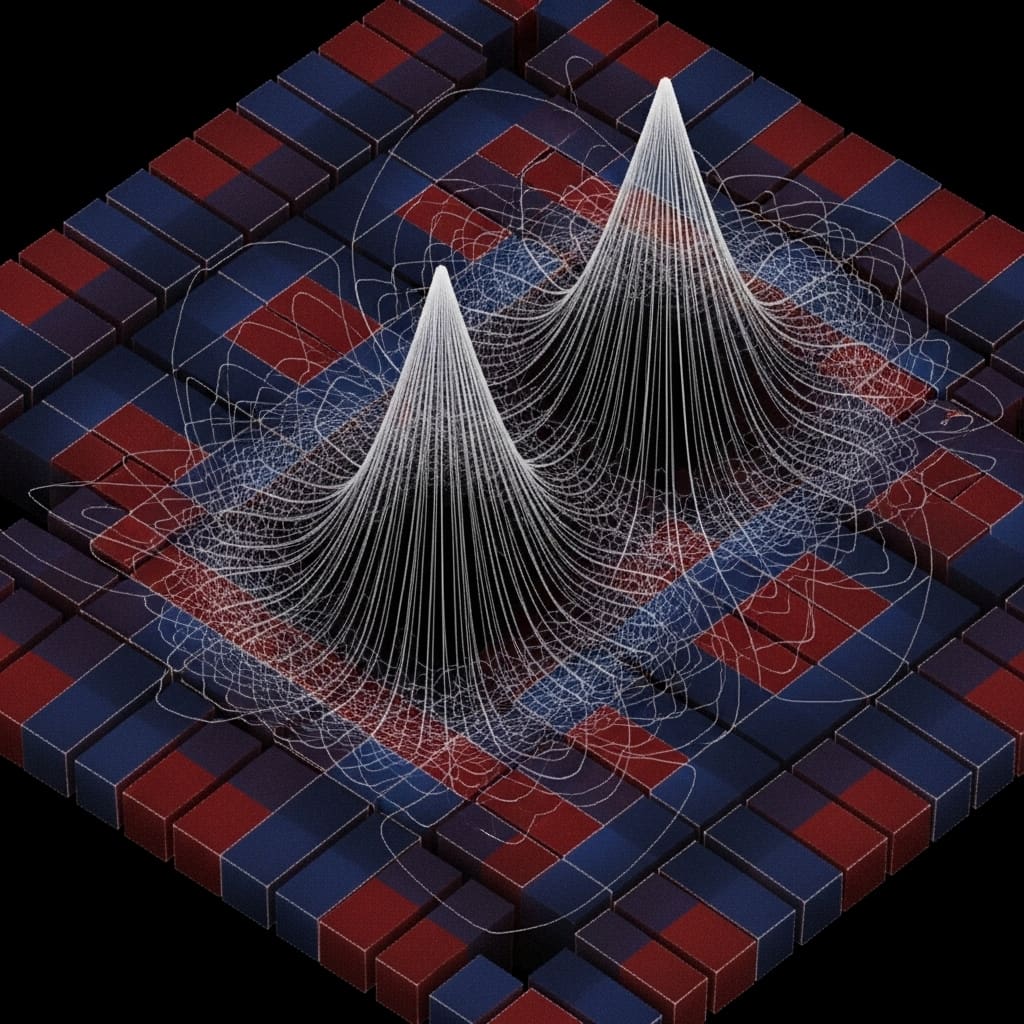
Researchers have unveiled a novel method for creating and controlling a two-dimensional Dirac-Weyl semimetal phase, offering exciting possibilities for future electronic devices. Lizhou Liu from Hebei Normal University, alongside Qing-Feng Sun from Peking University, and Ying-Tao Zhang, also of Hebei Normal University, demonstrate how introducing in-plane altermagnetism into a Dirac material allows continuous tuning of its electronic properties. This breakthrough is significant because it not only establishes a platform for manipulating Dirac-Weyl physics, but also enables control over topological edge transport in two dimensions , potentially leading to new advancements in areas like spintronics and quantum computing. Their work reveals that rotating the altermagnetic axis effectively adjusts the positions of Weyl points and the connectivity of associated edge states, providing an unprecedented level of control over these fundamental quantum phenomena.
This breakthrough relies on a tight-binding Hamiltonian in momentum space, incorporating parameters such as hopping amplitudes and exchange coupling strengths to model the electronic structure. This precise manipulation of symmetry is key to realizing the desired Topological phase and controlling the resulting edge transport properties. The research establishes altermagnetic order as a versatile control mechanism for engineering symmetry-tunable Dirac-Weyl phases in realistic two-dimensional electronic systems.
This work opens exciting possibilities for reconfigurable topological phases and device-relevant quantum functionalities. Specifically, the symmetry-controlled redistribution of Berry curvature and programmable Fermi arc connectivity offer pathways for creating momentum-selective topological transport, surpassing the capabilities of conventional semimetallic materials. The researchers anticipate that this intrinsically electronic and magnetically controllable Dirac-Weyl semimetal will constitute a significant step towards realizing advanced quantum technologies and exploring fundamental aspects of topological matter.
Altermagnetism induces tunable Dirac-Weyl semimetal phase transitions
To achieve this, the study pioneered a method of inducing altermagnetism, a specific magnetic ordering, and then characterizing the resulting electronic structure using advanced spectroscopic techniques. Experiments employed density functional theory calculations to predict the behaviour of the system, guiding the fabrication and analysis of the materials. This contrast highlights the sensitivity of the system to the direction of the applied altermagnetic field. The team’s methodology involved precise control over the altermagnetic axis, achieved through careful material growth and external field application.
They then harnessed angle-resolved photoemission spectroscopy (ARPES) to directly map the electronic band structure and observe the emergence of Dirac and Weyl points. This technique reveals the momentum-resolved electronic dispersion, allowing for unambiguous identification of topological features. Furthermore, the researchers quantified the edge state polarization using transport measurements, providing direct evidence of the chiral edge modes and their tunability. The ability to continuously tune the Weyl point positions, and thus the edge-state connectivity, represents a significant advancement in the field of topological materials, enabling the design of materials with tailored electronic properties. The findings are supported by funding from the Natural Science Foundation of Hebei Province (Grant No. A2024205025), the National Key R and D Program of China (Grant No0.2024YFA1409002), and the Innovation Program for Quantum Science and Technology (Grant No0.2021ZD0302403).
Tunable Dirac-Weyl Semimetal via Altermagnetism Demonstrated experimentally
Specifically, the research established that the parameters t = −1, t2 = 0, ts = 0.5, and J = 0.3 were used to achieve these results, meticulously controlling the material’s electronic structure. Results. A k · p expansion near X1 = (π, 0) yielded the effective Hamiltonian Heff X1 = (−t τx −ts τzσy) qx −ts τzσx qy −2J τ0σx, precisely describing the behavior of the Weyl nodes. Tests prove that the stability of the Dirac node at M relies crucially on inversion symmetry, and its destruction would occur with a staggered sublattice potential. The breakthrough delivers a Dirac-Weyl semimetal featuring coexisting Dirac and Weyl nodes, a unique state of matter with potential applications in advanced electronic devices. Measurements confirm that projecting the Hamiltonian onto the τz = −1 subspace yields a two-band model: HWeyl(q) = tsσyqx + tsσxqy, further characterizing the emergent Weyl nodes and their properties. This work establishes altermagnetic order as a versatile control knob for engineering symmetry-tunable Dirac-Weyl phases in realistic two-dimensional electronic systems.
Tunable Dirac-Weyl Semimetal via Altermagnetism enables novel electronic
This coexistence of Dirac and Weyl fermions, controlled by altermagnetic order, offers a promising platform for robust signal propagation within semi-metallic materials. The work establishes an intrinsically electronic and symmetry-guided mechanism for manipulating topological states, differing from approaches relying on strain engineering. The authors acknowledge that realizing this phase depends on specific crystalline and magnetic symmetries being present in materials. Future research could focus on identifying or designing materials that exhibit these symmetries, such as combining d-wave altermagnets like MnTe or RuO2 with nonsymmorphic Dirac semimetals. This research opens avenues for momentum-space interferometry, topological signal routing, and low-dissipation edge transport, potentially impacting future electronic devices and materials science.
👉 More information
🗞 Tunable two-dimensional Dirac-Weyl semimetal phase induced by altermagnetism
🧠 ArXiv: https://arxiv.org/abs/2601.17402


