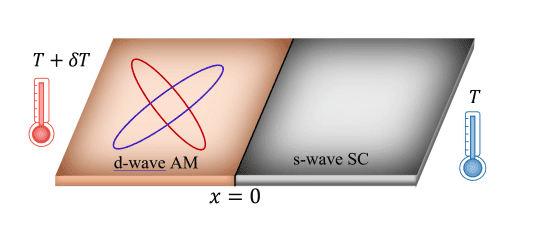
A new class of magnetic material, the altermagnet, presents exciting possibilities for future spintronic devices, and researchers are now exploring its potential in thermoelectric applications. Debika Debnath, Arijit Saha, and Paramita Dutta, from the Physical Research Laboratory and the Institute of Physics, investigate how altermagnetic materials influence thermoelectric currents when combined with conventional superconductors. Their theoretical work demonstrates that these heterostructures generate spin-polarized currents, meaning the flow of electrons possesses a preferred spin direction, and importantly, exhibits a diode effect, allowing current to flow more easily in one direction than another. This achievement significantly advances the field of spin-calotronics, offering potential for novel devices that harness both charge and spin currents with enhanced efficiency and control.
Spin Currents and Altermagnetic Phenomena
This collection of recent publications focuses on a rapidly evolving field encompassing spintronics, superconductivity, and magnetism. Research consistently explores manipulating spin currents for potential applications in information storage, processing, and quantum computing. A central theme is the investigation of altermagnetism, a novel magnetic state arising from non-collinear arrangements without net magnetization, often in conjunction with superconducting materials. Researchers are actively investigating materials exhibiting strong spin-orbit coupling, crucial for controlling spin currents and understanding spin transport phenomena.
This work extends to exploring materials with unique electronic properties, such as topological materials, and combining superconductivity with magnetic materials and altermagnets to create innovative devices like Josephson junctions, sensitive measurement tools and potential building blocks for quantum computers. These hybrid structures aim to enhance device efficiency and robustness. Beyond altermagnetism, studies continue on conventional magnetism, magnetic thin films, and heterostructures. Multiferroic materials, exhibiting both ferroelectric and ferromagnetic properties, also receive attention.
The frequent use of two-dimensional materials, including graphene and transition metal dichalcogenides, highlights their versatility as components in complex heterostructures, enabling the creation of new functionalities and tailored material properties. The research demonstrates a strong emphasis on materials design, combining concepts from condensed matter physics, materials science, and nanotechnology to create interdisciplinary solutions. Several researchers consistently appear throughout the publications, indicating their leadership in the field, including L. ˇSmejkal, J. Sinova, H.
Altermagnet-Superconductor Heterostructure Thermoelectric Response Analysis
This study investigates thermoelectric effects in a novel heterostructure combining an altermagnet with a conventional superconductor. Researchers engineered a bilayer junction to explore how temperature differences influence spin currents at the interface, employing the Bogoliubov-deGennes Hamiltonian to accurately model the superconducting properties. The team carefully defined the system’s parameters, including the kinetic energy of quasiparticles and the altermagnet’s spin-splitting characteristics, considering different orientations of the altermagnet’s symmetry by adjusting its spin-splitting strength. The temperature dependence of the superconductor’s energy gap was incorporated to ensure realistic modeling.
Researchers utilized the scattering matrix formalism to calculate the thermoelectric current, determining the probabilities of normal reflection and Andreev reflection at the interface. This allowed them to calculate the spin-resolved thermoelectric current within the linear response regime, revealing the potential for generating spin-polarized currents and achieving a diode-like effect, where current flow depends on the direction of the temperature gradient. The study reveals how the altermagnet’s parameters, junction temperature, and chemical potential regulate the thermoelectric current, paving the way for innovative spintronic devices.
Spin Current Control via Altermagnet Coupling
Recent work explores the thermoelectric properties of a heterostructure combining an altermagnet with a conventional superconductor, investigating how the unique spin-splitting characteristics of the altermagnet influence the flow of heat and electricity within the combined structure. Calculations reveal that applying a temperature difference across the interface generates spin-polarized thermoelectric currents. Experiments demonstrate that the thermoelectric current splits into separate currents for up-spin and down-spin electrons. Specifically, the magnitude of the down-spin current increases with increasing altermagnet strength, while the up-spin current decreases, signifying a more pronounced spin-splitting effect as the altermagnet enters a stronger phase, linked to the material’s density of states.
Reversing the sign of the altermagnet strength reverses the behavior of these currents, demonstrating control over spin polarization. Further analysis reveals that the temperature dependence of the thermoelectric current mirrors that of normal metal-superconductor junctions, but with the added feature of spin polarization. At low temperatures, the thermoelectric current is maximized due to strong coherence peaks in the material’s energy bands. As temperature increases, the superconducting gap diminishes, reducing the overall current and diminishing the difference between the spin currents. The team measured a maximum efficiency of 0.
2 for the thermoelectric diode effect, dependent on the strength of the altermagnet. The study also shows that the chemical potential within the heterostructure influences the spin-split currents. Increasing the chemical potential reduces the overall thermoelectric current, but can also shift which spin orientation dominates the current flow. These findings establish the altermagnet as a promising material for spin-calotronics applications, offering a pathway to control both the magnitude and direction of spin currents.
Altermagnetic Materials Enhance Thermoelectric Current Control
This research demonstrates that altermagnetic materials, possessing unique spin-splitting properties with zero net magnetization, can significantly influence thermoelectric currents in superconducting heterostructures. Theoretical examination of a bilayer system comprising an altermagnet coupled to a conventional superconductor reveals that a finite thermal bias generates spin-polarized thermoelectric currents, with the degree of polarization dependent on the strength of the altermagnetic phase. Calculations reveal that the thermoelectric current’s behavior is tunable through manipulation of the altermagnet’s parameters, specifically the strength of the spin-splitting. Researchers identified distinct regimes, weak and strong altermagnetic phases, where the spin-resolved currents exhibit contrasting behaviors, allowing for precise control over the spin polarization.
Importantly, the research confirms that the observed currents are predominantly dissipative, simplifying the analysis and highlighting the dominant mechanisms at play. While the study focuses on a specific model employing a simplified approach to the material interfaces, the findings establish a clear pathway for developing novel spintronic devices leveraging the unique properties of altermagnetic materials and offer potential for advancements in spin-calotronics. Further research could explore the impact of more complex interface effects and material compositions on the observed phenomena.
👉 More information
🗞 Spin-polarization and diode effect in thermoelectric current through altermagnet-based superconductor heterostructures
🧠 ArXiv: https://arxiv.org/abs/2509.12198