

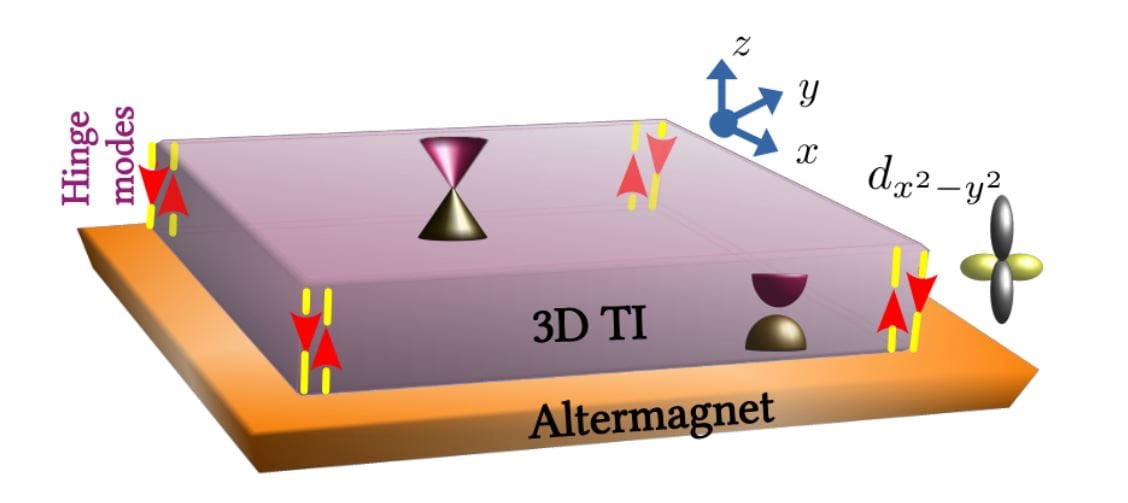
The pursuit of novel electronic devices hinges on controlling the flow of current with precision, and recent research demonstrates a promising pathway using uniquely structured materials. Minakshi Subhadarshini, Amartya Pal, and Arijit Saha, from the Institute of Physics and Homi Bhabha National Institute, investigate how combining topological insulators with a special class of magnetic materials, termed altermagnets, creates opportunities for precisely controlled current switching. Their work reveals that these hybrid structures exhibit both conventional and higher-order topological phases, supporting conducting states confined to the material’s edges and corners, known as hinge modes. Crucially, the team demonstrates that the direction and intensity of these hinge modes are tunable, offering a mechanism to actively switch current flow and potentially paving the way for advanced, energy-efficient electronic components. This achievement establishes altermagnet-based hybrid structures as a versatile platform for manipulating topological states and developing innovative device applications.
Third-Order Topological Insulator Calculations and Derivations
This research details the mathematical foundations and supporting evidence for third-order topological insulators, materials that behave as insulators internally but conduct electricity on their boundaries, specifically hinges and corners. The work establishes the topological nature of this phase, derives mathematical descriptions of the conducting states, and confirms the existence of robust, protected states through numerical simulations. The study employs a three-dimensional model using a tight-binding approach to describe electron behaviour, incorporating parameters like hopping strength, spin-orbit coupling, and mass terms. A central concept is the octupolar winding number, a topological invariant characterizing third-order topological insulators, calculated using a chiral operator to confirm the topological phase.
The core of the work involves systematically deriving effective Hamiltonians describing the conducting states on surfaces, hinges, and corners by applying specific boundary conditions. These solutions are shown to be robust and protected by the material’s topology, confirmed by finite-size scaling and analysis of the eigenvalue spectrum and local density of states. This research expands our understanding of topological phases of matter and opens possibilities for applications in spintronics and quantum computing.
Altermagnet-Topological Insulator Hybrid for Higher-Order Phases
Researchers are exploring new topological phases by combining a three-dimensional topological insulator with an altermagnet, a unique magnetic material. This hybrid structure allows for the investigation of higher-order topological phases, where conducting states appear on lower-dimensional boundaries. The study employs a tight-binding Hamiltonian to accurately represent the combined system and control its electronic properties. By analysing the energy spectrum and topological invariants, scientists identified two distinct topological phases: a hybrid-order phase combining characteristics of conventional and higher-order topological insulators, and a purely second-order topological insulator characterized solely by one-dimensional hinge-localized states. Detailed calculations confirm the presence of gapless states localized on the hinges, and researchers derived an effective low-energy surface theory providing insight into the role of the altermagnetic order. Importantly, the localization and direction of propagation of these one-dimensional hinge modes can be controlled by tuning the altermagnetic exchange orders, enabling a current-switching behaviour validated by both analytical predictions and numerical simulations.
Hybrid and Second-Order Topological Phases Realised
This work establishes a platform for controlling topological phases in three-dimensional materials by coupling a topological insulator to altermagnets. Researchers demonstrate the creation of both hybrid-order topological phases, where first and second-order topological states coexist, and purely second-order topological insulator phases. The study identifies a hybrid-order topological phase characterized by both two-dimensional surface states and one-dimensional hinge modes, alongside a second-order topological insulator phase hosting only these one-dimensional hinge modes. Topological invariants and spectral analysis were used to confirm the topological nature of these phases. Crucially, the localization and direction of propagation of these one-dimensional hinge modes are directly controllable by tuning the strength of the altermagnetic exchange orders, forming the basis for a current-switching mechanism confirmed by calculations. The work establishes a versatile platform for manipulating higher-order topology and developing novel hinge-mediated devices.
Altermagnets Induce Hybrid Topological Phases
This work establishes a theoretical framework for engineering both hybrid-order and higher-order topological phases within three-dimensional topological insulators by coupling them to altermagnets. Researchers demonstrate that introducing a specific type of altermagnetic order drives the system into a hybrid phase, confirmed through detailed spectral analysis and calculations of electrical conductance. Furthermore, the team discovered that incorporating a second type of altermagnetic order results in two distinct second-order topological insulator phases, each characterized by different edge modes whose direction and localization are controllable by adjusting the altermagnetic interactions. This control enables a proposed mechanism for current switching, potentially leading to novel device applications. The researchers analytically derived effective models describing the behaviour of these surface and edge states, clarifying how the altermagnetic fields influence the electronic structure.
👉 More information
🗞 Current switching behaviour mediated via hinge modes in higher order topological phase using altermagnets
🧠 ArXiv: https://arxiv.org/abs/2512.03478