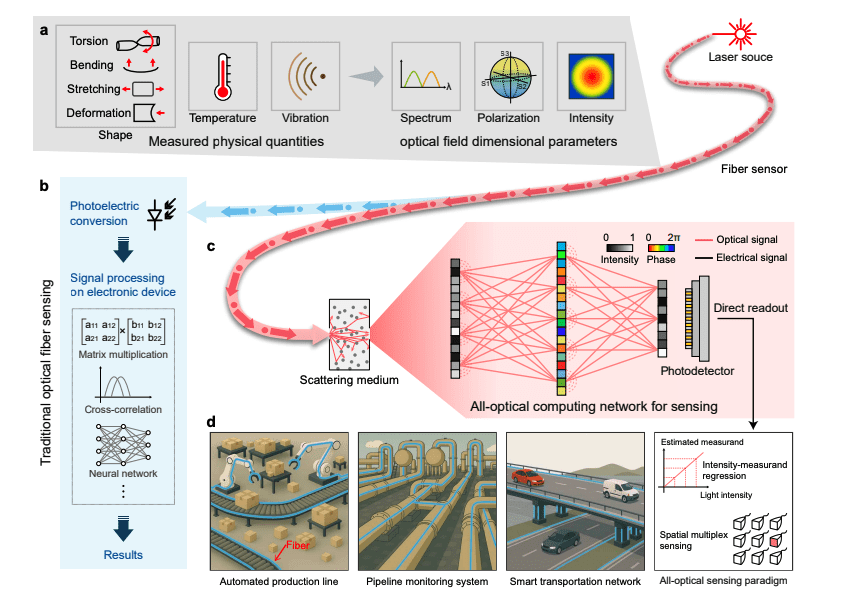
Conventional fibre sensing, vital for modern measurement systems, faces limitations due to the speed and power demands of electronic processing, but a new approach promises to overcome these challenges. Yu Tao, Yangyang Wan, and Ziwen Long, along with colleagues at the State Key Laboratory of Photonics and Communications, Shanghai Jiao Tong University, present an all-fibre sensing architecture with in-sensor computing that achieves signal demodulation at the speed of light. This innovative system directly maps physical disturbances to detectable intensity changes, eliminating the need for electronic processing and achieving a demodulation delay of less than three nanoseconds, over two orders of magnitude faster than existing fibre sensors. The research demonstrates high accuracy across multiple sensing tasks, including sub-nanometre strain resolution and precise torsional angle classification, and opens up possibilities for advanced applications requiring ultrafast, low-power measurements and fully integrated components.
Conventional electronic signal processing presents inherent limitations for high-speed, high-resolution sensing applications. To address these challenges, researchers propose an all-optical fiber sensing architecture with in-sensor computing, termed AOFS-IC, which achieves fully optical-domain sensing signal demodulation at the speed of light. This innovative system integrates a scattering medium with a carefully optimised diffractive optical network, enabling a linear mapping of physical perturbations directly to detected intensity. Consequently, sensing results can be read out without the need for electronic processing, streamlining data acquisition and reducing computational bottlenecks. The proposed system demonstrates high accuracy across a range of sensing tasks, achieving sub-nano strain resolution and 100% torsional angle classification accuracy, while also facilitating multiplexed sensing of multiple physical quantities.
Optical Sensing via Diffractive Fiber Computation
This research details a novel approach to sensing using all-optical computing, specifically leveraging diffractive computing and speckle patterns within optical fibers. The core concept involves moving away from traditional electronic sensors and computation towards a fully optical system, offering potential advantages in speed, energy efficiency, and parallel processing capabilities. Key technologies include utilizing diffractive optical elements to perform computations directly on light waves, enabling parallel processing, and leveraging speckle patterns, created when light scatters from a disordered medium, to encode information about the sensed environment. By combining these elements with machine learning algorithms, the researchers enhance sensing capabilities and data analysis.
This system achieves high-resolution sensing across various parameters and can sense a wide range of wavelengths. The all-optical nature of the system enables real-time processing, and it can perform spectroscopic analysis by reconstructing spectra from speckle patterns. The system functions as a wavemeter, accurately measuring the wavelength of light, and holds potential for all-optical image sensing and processing, even exploring 3D perception in robotics. Optical computation is inherently faster than electronic computation; all-optical systems consume less energy, diffractive computing enables massive parallel processing, and the potential for miniaturisation is significant. Overall, this research presents a promising new direction in sensing technology, moving towards fully optical systems that offer significant advantages in speed, efficiency, and functionality.
Optical Computing Bypasses Electronic Signal Processing
Researchers have developed a new all-optical fiber sensing architecture that achieves signal processing at the speed of light, eliminating the need for conventional electronic computing hardware. This innovative system, termed AOFS-IC, directly translates physical disturbances into measurable light intensity, offering a significant leap forward in speed and energy efficiency for fiber optic sensors. The core principle involves a scattering medium that encodes information about the physical world into unique speckle patterns, which are then decoded by a carefully designed diffractive optical computing module. This approach bypasses the typical process of converting optical signals into electrical data for processing, instead performing all computations within the optical domain.
The system achieves demodulation delay of less than 3 nanoseconds, representing an improvement of over two orders of magnitude compared to existing fiber optic sensing systems reliant on electronic processing. This dramatic reduction in latency is crucial for applications demanding real-time feedback and control, such as advanced robotics and high-speed monitoring systems. The researchers demonstrated the system’s capabilities through accurate strain measurement, achieving sub-nano resolution, and precise torsional angle classification with 100% accuracy. Furthermore, AOFS-IC is not limited to a single type of measurement; it can simultaneously sense multiple physical quantities and accommodate multiplexed sensor arrays, enabling comprehensive multi-dimensional monitoring.
By tailoring the scattering medium and the diffractive optical computing module, the system can be adapted to various sensing tasks, offering tunable accuracy and dynamic range. The implications of this technology extend beyond improved performance metrics; it paves the way for significantly lower power consumption and more compact sensing systems. By removing the need for energy-intensive electronic components, AOFS-IC promises to unlock new possibilities for large-scale, high-density deployments of fiber optic sensors in diverse fields, including infrastructure monitoring, precision manufacturing, and environmental sensing.
All-Optical Sensing with Nanosecond Demodulation
This research presents a new all-optical fibre sensing architecture with in-sensor computing, which significantly advances the speed and efficiency of fibre optic sensing. The system achieves fully optical signal demodulation, eliminating the need for electronic processing and reducing latency to less than three nanoseconds, over two orders of magnitude faster than conventional systems. By integrating a scattering medium with a diffractive network, the architecture directly maps physical changes to detected light intensity, allowing for immediate quantification of the measured quantity. The method has been experimentally validated using various fiber sensor types, including fiber Bragg gratings and multi-mode fibers, to measure strain, torsion, and other physical parameters. Furthermore, the system demonstrates the ability to simultaneously monitor multiple parameters and perform multi-degree-of-freedom sensing, as demonstrated by a robotic arm monitoring application.
👉 More information
🗞 Nanosecond-latency all-optical fiber sensing with in-sensor computing
🧠 DOI: https://doi.org/10.48550/arXiv.2507.15376