Magnetic field sensing plays a crucial role in diverse technologies, from communications to environmental monitoring and medical diagnostics. Current solid-state sensors, which rely on defects in materials like diamond or hexagonal boron nitride, typically demand precise alignment with the magnetic field to function reliably, creating challenges for practical device integration and large-scale production. Now, Shuyu Wen, Raul Coto, Peiting Wen, and colleagues demonstrate room-temperature magnetic field detection using boron vacancies in commercially available, hot-pressed hexagonal boron nitride. By utilizing a polycrystalline material with randomly oriented grains, the researchers achieve alignment-free sensing, as the multiple orientations naturally sample a range of spin axes. Numerical modelling confirms that this approach maintains sensitivity despite the material’s anisotropic properties, establishing hot-pressed hexagonal boron nitride as a robust and scalable platform for future magnetometry applications and paving the way for low-cost, mechanically stable magnetic field sensors suitable for widespread deployment.
Magnetic field sensing is essential for applications in communication, environmental monitoring, and biomedical diagnostics. Quantum sensors based on solid-state spin defects, such as those found in materials like hexagonal boron nitride, typically require precise alignment between the external magnetic field and the defect’s spin. This alignment sensitivity limits practical implementation, demanding complex magnetic shielding and calibration procedures. Consequently, developing sensors insensitive to magnetic field orientation represents a significant advancement, potentially simplifying device design and broadening application possibilities. Researchers are therefore investigating methods to achieve orientation-independent magnetic field detection, focusing on exploiting specific defect properties or employing novel measurement techniques to overcome this fundamental limitation.
Boron Vacancy Creation and Confocal Detection
Researchers engineered a novel approach to magnetic field sensing by harnessing boron vacancies within hot-pressed polycrystalline hexagonal boron nitride. This method circumvents the limitations of traditional solid-state spin defect sensors, which typically require precise alignment between the external magnetic field and the defect’s spin. Scientists employed ion irradiation, using a high-energy helium ion beam, to generate these defects to a depth of approximately 5 μm within the material, effectively creating a high density of boron vacancy centers. To detect the magnetic resonance signal, the team constructed a custom confocal microscope and implemented optically detected magnetic resonance spectroscopy.
Optical excitation was achieved using a laser, and a high-numerical aperture objective lens focused the beam onto the sample. The resulting light emission was then collected through the same objective, filtered to isolate the signal, and detected by a sensitive detector. To enhance signal detection, scientists implemented a lock-in amplifier, modulating the radiofrequency output to create periodic on/off states and measuring the difference in light emission to isolate the signal originating from resonant boron vacancy defects. This innovative approach allows for reliable magnetic field detection without the need for precise alignment, paving the way for scalable and mechanically robust quantum sensors.
Alignment-Free Magnetic Sensing with Boron Vacancies
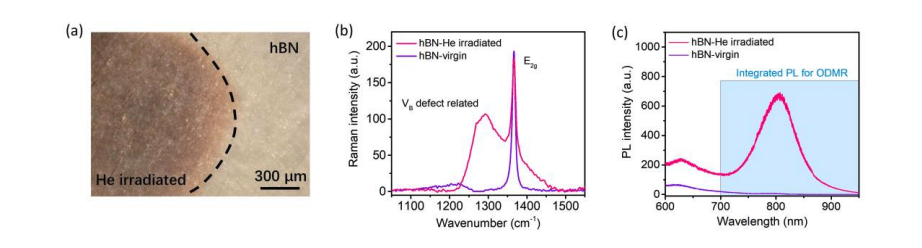
Researchers have achieved room-temperature optically detected magnetic resonance from negatively charged boron vacancies within commercially available, hot-pressed polycrystalline hexagonal boron nitride, demonstrating a significant advance in magnetic field sensing technology. The team discovered that the random grain orientation inherent in polycrystalline material inherently samples a broad range of spin orientations, enabling alignment-free magnetic field detection and simplifying device integration. Experiments revealed the creation of boron vacancy defects within the material through irradiation with a focused ion beam, confirmed by spectroscopic measurements. A distinct spectral feature emerged, indicating successful defect creation, while changes in light emission confirmed their generation upon irradiation.
The boron vacancy defect, behaving as an artificial atom with a spin, exhibits distinct energy levels, allowing for resonant excitation with microwave frequencies. The team developed a measurement setup to probe the signal, positioning the material above a microwave waveguide and monitoring changes in light emission as the microwave frequency was swept. Results demonstrate a clear resonant peak under zero magnetic field, indicative of a specific energy splitting parameter, confirming the feasibility of alignment-free magnetic field sensing using polycrystalline material and paving the way for low-cost, scalable, and mechanically robust quantum magnetic sensors suitable for real-world deployment in applications like communication, environmental monitoring, and biomedical diagnostics.
Alignment-Free Quantum Sensing in Boron Nitride
This research demonstrates room-temperature optically detected magnetic resonance from negatively charged boron vacancies within commercially available, hot-pressed polycrystalline hexagonal boron nitride. Crucially, the random orientation of grains within the polycrystalline material eliminates the need for precise alignment between the magnetic field and the defect’s spin, a significant limitation of previous solid-state magnetic sensors. The results confirm that effective magnetic field detection remains feasible despite variations in sensitivity due to this anisotropy, potentially through calibration techniques, establishing hot-pressed hexagonal boron nitride as a promising platform for developing scalable, alignment-free, and mechanically robust quantum magnetic sensors. Compared to sensors relying on single-crystal materials or other defect types, this method offers a pathway towards lower-cost and more practical devices suitable for applications like navigation, environmental monitoring, and biomedical diagnostics. The authors acknowledge that the sensitivity is not uniform across all directions, but modelling suggests vector magnetic field sensing is still achievable, and future work will likely focus on refining calibration methods to fully leverage the benefits of this new material platform.
🗞 Room-temperature alignment-free magnetometry with boron vacancies in hot-pressed hexagonal boron nitride
🧠 ArXiv: https://arxiv.org/abs/2509.00734