Researchers Diego Ruiz (Alice & Bob and Inria) and collaborators have demonstrated an improved methodology for magic state preparation on superconducting quantum computers, achieving a significant reduction in qubit requirements. Utilizing noise-biased cat qubits, developed by Alice & Bob, the team implemented an unfolded code, internally termed the “Heart Code,” derived from a three-dimensional arrangement, to facilitate a two-dimensional layout. This approach necessitates only 53 qubits to generate a single magic state, representing an 8. 7% reduction compared to leading methodologies, and reduces the number of required quantum error correction cycles by five, achieving approximately five-fold faster preparation at an error rate of less than one in a million. This protocol leverages existing components of Alice & Bob’s quantum error correction architecture, including fundamental operations and physical cat qubits, eliminating the need for further development, and builds upon prior work exploring low-density parity-check (LDPC) codes for error correction. The research, conducted in collaboration with Inria, the French national institute for research in digital science and technology, highlights the advantages of cat qubit noise bias in minimizing hardware overhead for practical quantum computation, and builds on Alice & Bob’s prior demonstrations of up to 200x hardware reduction in large-scale quantum computer construction.
Magic State Preparation
The efficient preparation of magic states represents a critical challenge in the development of scalable, fault-tolerant quantum computation. These non-stabilizer states are essential resources for universal quantum computation, enabling the implementation of gates beyond those directly achievable through native operations on a quantum processing unit (QPU). While the theoretical necessity of magic states is well established, their practical realization has historically been hampered by significant resource overhead, particularly in terms of qubit requirements and circuit complexity. Recent collaborative research conducted by scientists at Alice & Bob, a quantum computing firm, and Inria, the French national institute for research in digital science and technology, details a novel approach to magic state preparation that substantially reduces these demands.
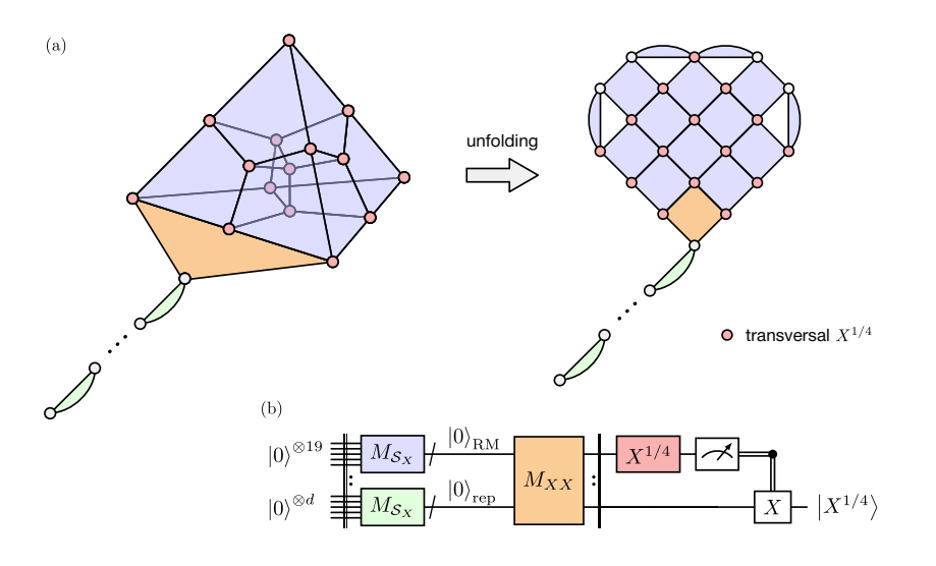
The research, outlined in the paper Unfolded distillation: very low-cost magic state preparation for biased-noise qubits, centres on an innovative distillation protocol tailored for use with cat qubits – a specific type of superconducting qubit exhibiting inherent protection against bit-flip errors, a common source of noise in quantum computations. This noise bias is crucial, as it allows for the exploitation of simplified error correction schemes and, consequently, reduced qubit overhead. Traditional methods for optimal magic state distillation often necessitate complex three-dimensional arrangements of qubits, posing considerable engineering challenges for solid-state QPUs. The Alice & Bob and Inria team have successfully ‘unfolded’ this three-dimensional code into a more practical two-dimensional layout, internally dubbed the “Heart Code” due to its distinctive shape. This unfolded code achieves a significant reduction in qubit requirements, necessitating only , 53 qubits to generate a single magic state.
This represents an 8.7-fold decrease compared to leading alternative approaches, including a recent theoretical proposal from Google which estimated 463 qubits for comparable performance. Furthermore, the protocol requires five fewer quantum error correction cycles, resulting in an approximate five-fold acceleration in preparation speed for the same error rate of less than one in a million. Diego Ruiz, a Ph. student at Alice & Bob and Inria and author of the paper, notes that “The most advanced players in quantum have lined up breakthrough after breakthrough to reduce the costs of magic state preparation, and it’s exciting to see how our work further improves the state of the art on noise-biased qubits. ” Importantly, this magic state preparation protocol leverages components already integrated into Alice & Bob’s existing quantum error correction architecture, including both the fundamental operations and the physical cat qubits themselves. This eliminates the need for additional hardware development, streamlining the path towards achieving targeted performance levels.
Thau Peronnin, CEO of Alice & Bob, highlights this advantage, stating that “This looming obstacle to useful quantum computers is finally being solved by the community, with some players even achieving the first proof-of-concept magic state preparation in experimental settings. ” He further emphasizes that “Capitalizing on the cat qubits, this work further de-risks our roadmap while showcasing the long-term advantages of our universal platform. ” The research underscores the potential of noise-biased qubits, such as cat qubits, to substantially reduce the hardware overhead associated with practical quantum computation, not only in the context of error correction but also in the crucial area of magic state preparation.
Qubit Efficiency
The pursuit of scalable quantum computation necessitates continuous improvements in qubit efficiency, particularly concerning resource-intensive operations like magic state preparation. Recent research conducted jointly by Alice & Bob and Inria demonstrates a significant advancement in this domain, achieving a substantial reduction in qubit requirements and preparation time for these critical quantum states. Magic states, essential for implementing universal quantum computation beyond the natively achievable gate set, traditionally pose a considerable overhead. Their creation demands complex quantum circuits and substantial qubit resources, hindering the realization of fault-tolerant quantum computers. The team’s innovation centres on an ‘unfolded distillation’ technique, effectively translating a three-dimensional qubit arrangement into a more practical two-dimensional layout. This unfolded code, internally dubbed the ‘Heart Code’ due to its distinctive shape, is predicated on the utilization of noise-biased qubits – specifically, the cat qubits developed by Alice & Bob. Cat qubits, a type of superconducting qubit, exhibit inherent protection against bit-flip errors, a prevalent source of noise in quantum systems. This noise bias is crucial, enabling the simplification of quantum circuits and a reduction in the number of qubits required for magic state distillation. The researchers report a requirement of only – 53 qubits to generate a single magic state, representing an 8. This reduction is not merely architectural; the unfolded code also streamlines the quantum circuits and s.
More information
External Link: Click Here For More