
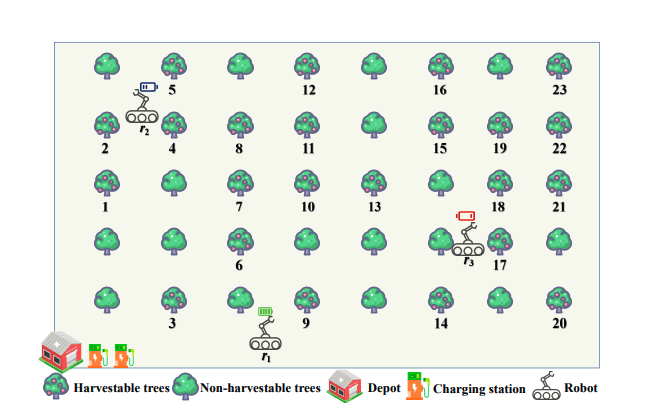
Efficiently coordinating teams of robots holds immense potential for transforming labour-intensive industries, and Peng Chen, Jing Liang, and Kang-Jia Qiao, along with their colleagues, now address a critical challenge in smart farming: planning harvesting schedules for electric robots. The team’s research tackles the complex problem of optimising both speed and cost while simultaneously managing robot payload and limited battery life, a combination that often disrupts traditional scheduling methods. They introduce the segment anchoring-based balancing algorithm, or SABA, which uniquely uses charging decisions as ‘anchors’ to rebuild disrupted routes and then fine-tunes schedules for optimal performance. Through rigorous testing on real-world data and benchmark problems, SABA consistently outperforms existing algorithms, offering a significant advance in multi-robot task allocation under energy constraints and providing a new theoretical framework for this important field.
The study focused on optimizing harvesting schedules for a fleet of electric robots, considering both completion time and transportation cost while managing payload and battery limitations. A key innovation lies in SABA’s ability to handle unexpected disruptions, such as unplanned recharges due to limited battery life, which can derail traditional optimization methods. The algorithm effectively reconstructs disrupted routes and fine-tunes schedules for optimal performance.
Scientists leverage charging decisions as ‘anchors’ to rebuild interrupted routes, systematically addressing the impact of unscheduled recharges. This sequential anchoring mechanism ensures the overall schedule remains feasible even when robots require unexpected energy replenishment. Complementing this, a proportional splitting-based rebalancing mechanism fine-tunes the final solutions, balancing completion time and optimizing task execution sequences. This allows for flexible distribution of workload, maximizing resource utilization and improving overall efficiency. To rigorously evaluate SABA, the team conducted extensive comparative experiments using real-world data and benchmark scenarios. Results demonstrate that SABA consistently outperforms existing methods, delivering improved solutions in complex scenarios. This research provides a novel theoretical perspective and an effective solution for multi-robot task allocation under energy constraints, paving the way for more efficient and adaptable robotic systems in demanding agricultural environments.
Segment Anchoring Balances Robot Energy and Tasks
The research team developed the segment anchoring-based balancing algorithm (SABA), a novel approach to multi-robot task allocation, specifically designed to address challenges arising from energy constraints in dynamic operational environments. This work demonstrates a significant advancement in scheduling robots for tasks like harvesting, where robots must manage both payload and battery life simultaneously. Experiments reveal that unplanned recharges, triggered by limited battery capacity, can disrupt entire schedules, rendering traditional optimization methods ineffective. SABA overcomes this disruption through two core mechanisms: sequential anchoring and balancing, and proportional splitting-based rebalancing.
The sequential anchoring mechanism systematically reconstructs disrupted routes by leveraging charging decisions as ‘anchors’, effectively repairing plans compromised by forced recharging. This process minimizes the negative impact of these charging stops on overall schedule efficiency. Subsequently, the proportional splitting-based rebalancing mechanism fine-tunes the completion times within the best solutions, ensuring optimal performance. The team conducted extensive comparative experiments using a real-world case study and a suite of benchmark instances, demonstrating that SABA comprehensively outperforms six state-of-the-art algorithms.
Results show that SABA achieves superior solution convergence and diversity, consistently delivering higher-quality scheduling plans. This allows for precise control over task allocation and service ratios. The team’s work delivers a novel theoretical perspective and an effective solution for multi-robot task allocation under energy constraints, paving the way for more efficient and robust robotic systems in labor-intensive industries.
Segment Anchoring Improves Multi-Robot Scheduling
This research presents a novel approach to multi-robot task allocation, specifically addressing the challenges encountered in complex environments like smart agriculture. Scientists developed the segment anchoring-based balancing algorithm, or SABA, to efficiently schedule tasks for a fleet of robots while considering constraints such as payload capacity and limited battery life. The algorithm uniquely combines sequential anchoring and balancing with proportional splitting-based rebalancing, allowing it to reconstruct disrupted routes caused by unexpected energy demands and fine-tune schedules for optimal performance. Extensive testing, using both real-world data and benchmark scenarios, demonstrates that SABA consistently outperforms six existing state-of-the-art algorithms. The results indicate that SABA not only achieves higher quality solutions, but also generates a more diverse range of viable scheduling options, proving its robustness and adaptability. This work contributes a new theoretical framework for routing problems involving dynamic interruptions and provides a practical decision-support tool for automated systems in agriculture and logistics.
👉 More information
🗞 A segment anchoring-based balancing algorithm for agricultural multi-robot task allocation with energy constraints
🧠 ArXiv: https://arxiv.org/abs/2511.17076