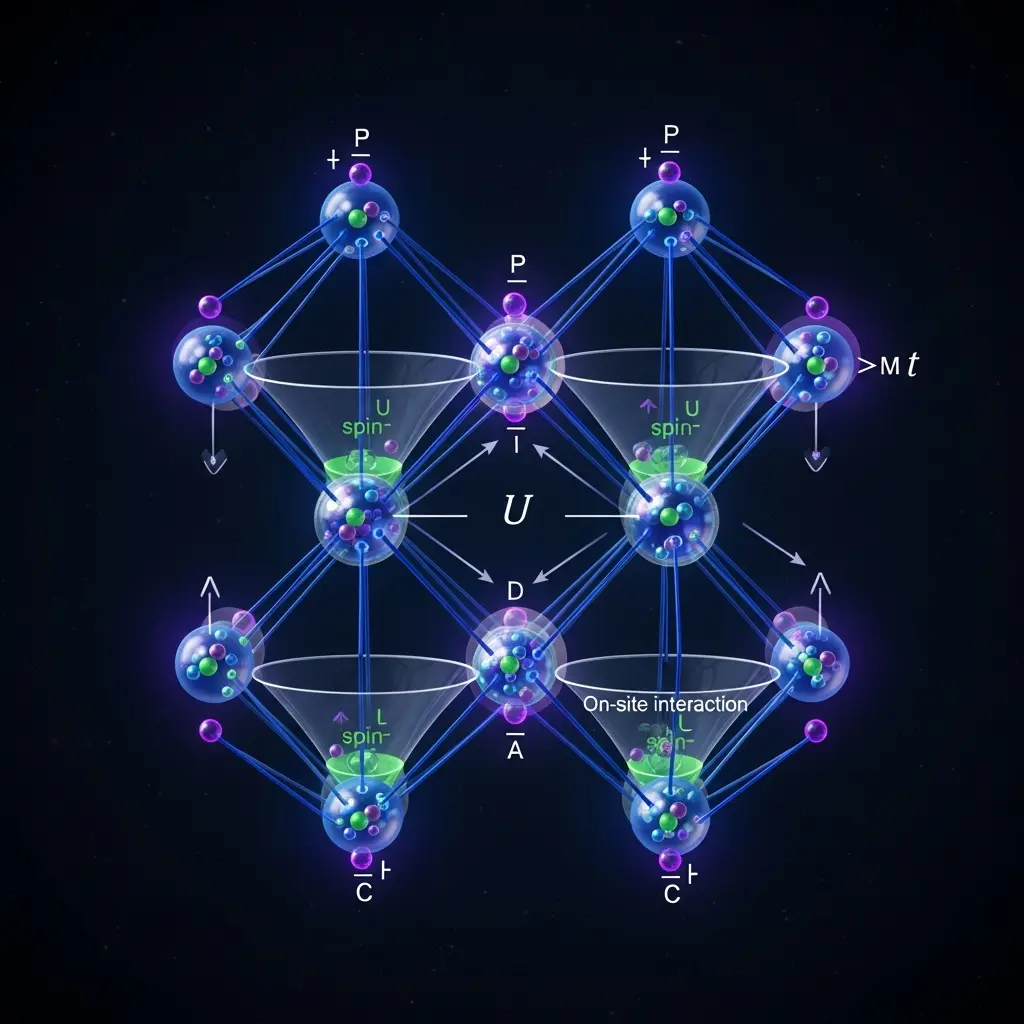
Benchmarking complex many-body systems presents a significant challenge, often requiring immense computational power for accurate simulations, especially when considering finite temperatures. Wei-Bo He, Yun-Tong Yang from Lanzhou University, and Hong-Gang Luo address this problem with a new algorithm for efficiently generating thermal pure states, enabling more accurate calculations of material properties at realistic temperatures. This advancement overcomes limitations of existing methods, delivering a substantial performance boost, approximately times faster than current standards for the Hubbard model, and extending the range of accessible temperatures across various doping levels. By combining algorithmic innovation with robust software engineering in their open-source Physica library, the team significantly expands the possibilities for benchmarking and understanding complex materials.
Physica Software, Architecture and Condensed Matter Focus
Physica is a comprehensive software package designed for advanced numerical simulations, particularly in condensed matter physics. The software’s architecture prioritizes flexibility and power, enabling researchers and developers to tackle complex physical models. At its core, Physica is written in C++, leveraging the language’s performance capabilities for computationally intensive tasks. The software relies heavily on robust linear algebra libraries, including Eigen, Intel oneMKL, and NVIDIA CUDA, to accelerate calculations, and data is stored and retrieved using the HDF5 format for efficient management of simulation results.
Physica integrates with Qt, a cross-platform application framework, to provide 2D and basic 3D visualization capabilities. The software is adaptable to various physical models, with the Hubbard model serving as a key example, and supports the simulation of complex quantum states using imaginary time evolution. The codebase is available on Gitee, a Chinese code hosting platform, and includes classes such as TPQ for representing continuous vectors, HubbardMatrix for implementing the Hubbard model Hamiltonian, SquareLattice for defining lattice geometry, H5File for handling HDF5 files, and Plot for 2D plotting. Physica’s development relies on C++, Qt, Eigen, Intel oneMKL, NVIDIA CUDA, and HDF5, and is hosted on Gitee at [https://gitee.
com/newsigma/Physica](https://gitee. com/newsigma/Physica). The software is valuable for condensed matter physics research, materials science, and quantum computing.
Thermal Pure States via Novel Algorithm
Scientists have developed a novel algorithm for obtaining thermal pure quantum states, enabling efficient computation of mechanical and thermodynamic properties at finite temperatures. This work addresses a significant challenge in benchmarking many-body systems, traditionally requiring substantial computational resources. The team implemented this algorithm within Physica, an open-source C++ template library, prioritizing both high performance and numerical stability through state-of-the-art software engineering practices. Researchers rigorously tested the performance of their method against an established package, demonstrating a substantial speedup of approximately 103times for the 4×4 Hubbard model.
Furthermore, the team extended the accessible temperature range down to across arbitrary doping levels, significantly broadening the scope of benchmarking possibilities. This improvement overcomes a key limitation of existing methods, which often struggle with calculations at low temperatures or away from half-filling. The method leverages efficient indexing of basis states, employing techniques like perfect hashing to further enhance performance and reduce memory requirements. This study pioneers a practical and high-performance approach to thermal pure quantum state simulations, offering a valuable tool for advancing research in strongly correlated electron systems and pushing the frontiers of benchmarking for quantum many-body physics. The team’s commitment to open-source development ensures that this innovative method is readily available to the wider scientific community, fostering collaboration and accelerating progress in the field.
Thermal Pure States Enable Faster Simulations
Scientists have developed a new algorithm for simulating the behavior of complex quantum systems at finite temperatures, achieving significant improvements in both speed and accuracy. This work addresses a longstanding challenge in computational many-body physics, where obtaining reliable thermal properties requires substantial computational resources. The team’s approach centers on generating thermal pure states, which provide an efficient way to calculate mechanical and thermodynamic properties. This speedup is achieved through a refined algorithm for generating thermal pure states, allowing for more efficient computation.
Furthermore, the new method extends the accessible temperature range down to across arbitrary doping levels, enabling simulations of systems previously inaccessible due to computational limitations. The core of the advancement lies in a novel approach to constructing these thermal pure states, overcoming limitations of traditional methods relying on Taylor series expansion, which can be computationally inefficient and prone to numerical errors. The team’s improved algorithm delivers greater accuracy and stability, stemming from a reduction in the computational steps required to converge on an accurate thermal state. Measurements confirm that the new algorithm not only runs faster but also delivers more precise results, validated through direct comparisons with existing methods. This advancement significantly pushes forward the frontiers of benchmarking for many-body systems, opening new avenues for research in areas such as superconductivity and materials science.
Thermal State Simulation with Physica Library
Scientists have presented a high-performance algorithm for simulating thermal pure states, significantly advancing the benchmarking of many-body quantum systems. The researchers developed a new computational method and implemented it within Physica, an open-source C++ template library, prioritizing both computational efficiency and numerical stability. This implementation demonstrates substantial improvements over existing methods, achieving a speedup of three orders of magnitude in certain calculations and extending the range of accessible temperatures for simulations. By overcoming limitations in computational resources, this research enables more accurate and scalable investigations of complex quantum phenomena. The team acknowledges discussions with Fu-Zhou Chen and support from the National Key Research and Development Program of China and the National Natural Science Foundation of China. Future development will likely focus on expanding the capabilities of the Physica library and applying the algorithm to a wider range of quantum many-body problems, further solidifying its role as a valuable tool for researchers in the field.
🗞 Practical algorithm for simulating thermal pure quantum states
🧠 ArXiv: https://arxiv.org/abs/2510.19504