The fundamental question of what resources enable the power of quantum algorithms continues to drive research in the field, and a team led by Si-Qi Zhou and Hai Jin from Shanghai Jiao Tong University, alongside Jin-Min Liang from Peking University, now reveals a crucial element beyond entanglement and coherence. Their work demonstrates that the success of the Grover search algorithm, a powerful tool for accelerating database searches, depends significantly on a newly identified property called the ‘coherence fraction’. This fraction quantifies how closely an initial quantum state resembles a perfect superposition, and the researchers, including Shao-Ming Fei from Capital Normal University, Yunlong Xiao from Agency for Science, Technology and Research, and Zhihao Ma, show it directly impacts the algorithm’s probability of success. By introducing a generalized Grover search algorithm and exploring its application to minimization problems, this research not only deepens our understanding of quantum advantage but also suggests new avenues for designing even more effective quantum algorithms.
Quantum Algorithms And Foundational Searches
This compilation details a comprehensive overview of quantum computing, quantum information, and quantum machine learning, covering foundational principles and algorithms like Grover’s, Deutsch-Jozsa, Bernstein-Vazirani, and Shor’s, which demonstrate potential speedups over classical computation. The collection also explores quantum search techniques, the quantum Fourier transform, and the crucial roles of quantum entanglement and coherence in computation, alongside concepts like quantum discord and coherence measures, quantum error correction, complexity theory, and quantum key distribution. A significant portion focuses on quantum machine learning, encompassing variational quantum algorithms like VQE and QAOA, quantum neural networks, support vector machines, and principal component analysis. The bibliography details methods for encoding classical data into quantum states and utilizing quantum circuits to create higher-dimensional feature spaces, alongside hybrid quantum-classical approaches. Further topics include quantum information theory, covering entropy, mutual information, quantum discord, coherence, and entanglement measures, as well as specific algorithms like quantum amplitude amplification and phase estimation. The collection also addresses near-term quantum computing, including noisy intermediate-scale quantum devices and techniques for mitigating errors.
Coherence Fraction Dictates Grover Search Advantage
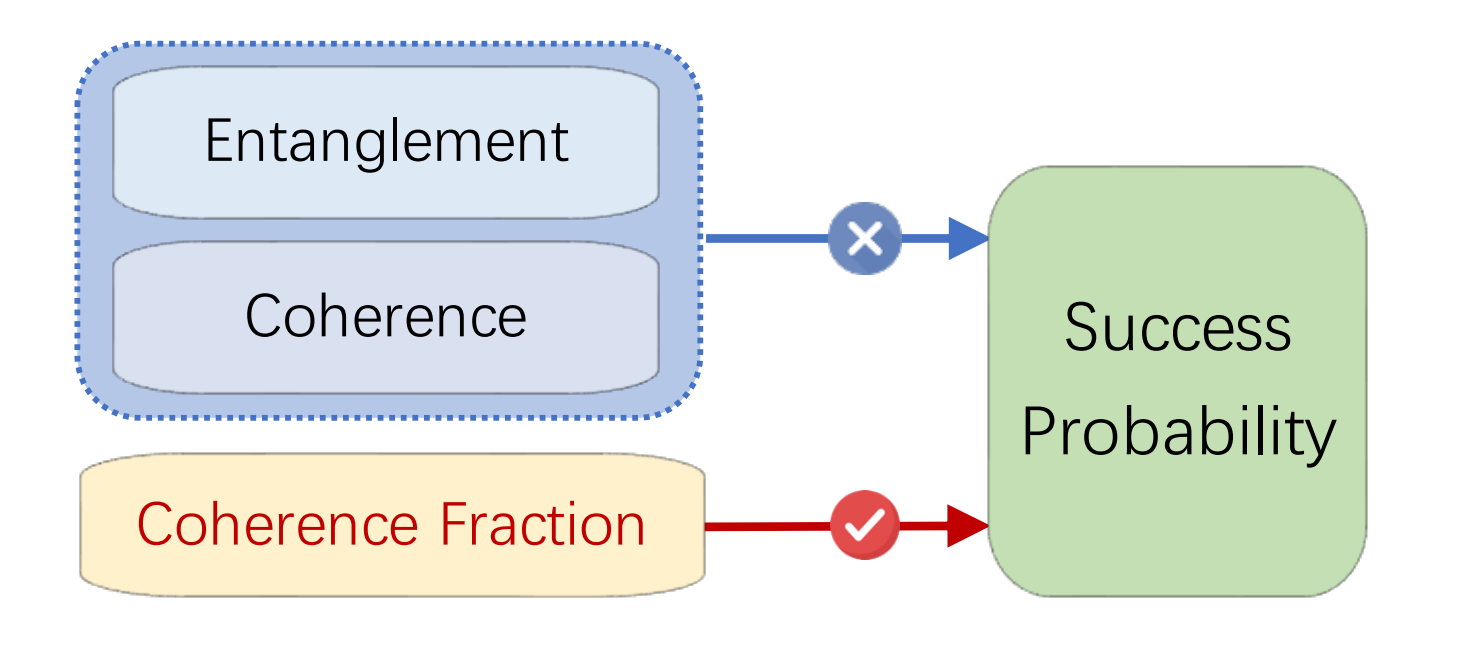
Scientists have made a significant advance in understanding the origins of quantum advantage, demonstrating that the success of a generalized Grover search algorithm depends critically on the coherence fraction of the initial quantum state. This work reveals that while entanglement and coherence are important in many quantum algorithms, they do not fully explain the advantage gained by the Grover search. Researchers introduced a generalized version of the algorithm, replacing the standard Hadamard gate with an arbitrary unitary gate, and derived an exact equation for the average success probability. Experiments demonstrate that the upper limit of the average success probability is determined solely by the coherence fraction, which quantifies how closely a quantum state approaches perfect coherence, an equal superposition.
This finding establishes a direct connection between the average success probability of the generalized Grover search algorithm and the coherence fraction of the initial state, measured using Uhlmann’s fidelity. Measurements confirm that a state achieving perfect coherence yields the highest success probability, explaining why the Hadamard gate is typically used in Grover’s algorithm, as it generates this maximally coherent state. The team’s analysis provides a fundamental insight into the resources driving quantum speedups and opens pathways for developing new quantum algorithms optimized for coherence.
Coherence Fraction Drives Grover Search Advantage
This research demonstrates that the advantage gained by the Grover search algorithm stems from the coherence fraction of quantum states, rather than solely from quantum coherence and entanglement. By introducing a generalized Grover search algorithm, scientists established a clear relationship between the success probability of the search and this coherence fraction, which quantifies the fidelity between an arbitrary initial state and a state of equal superposition. The team showed that a higher coherence fraction directly correlates with a greater probability of successfully finding the target solution, offering new insight into the origins of quantum speedup. These findings refine our understanding of how quantum algorithms achieve their advantages, moving beyond the previously emphasized roles of entanglement and coherence. The research highlights the importance of preparing quantum states close to equal superposition, explaining why the Hadamard gate is frequently used in algorithm design. While acknowledging that not all quantum algorithms outperform their classical counterparts, the team confirms the substantial speedups offered by algorithms like Grover’s search and Shor’s factoring algorithm, attributing the advantage of Grover’s search specifically to this coherence fraction.
🗞 Coherence Fraction in Grover Search Algorithm
🧠 ArXiv: https://arxiv.org/abs/2511.06835