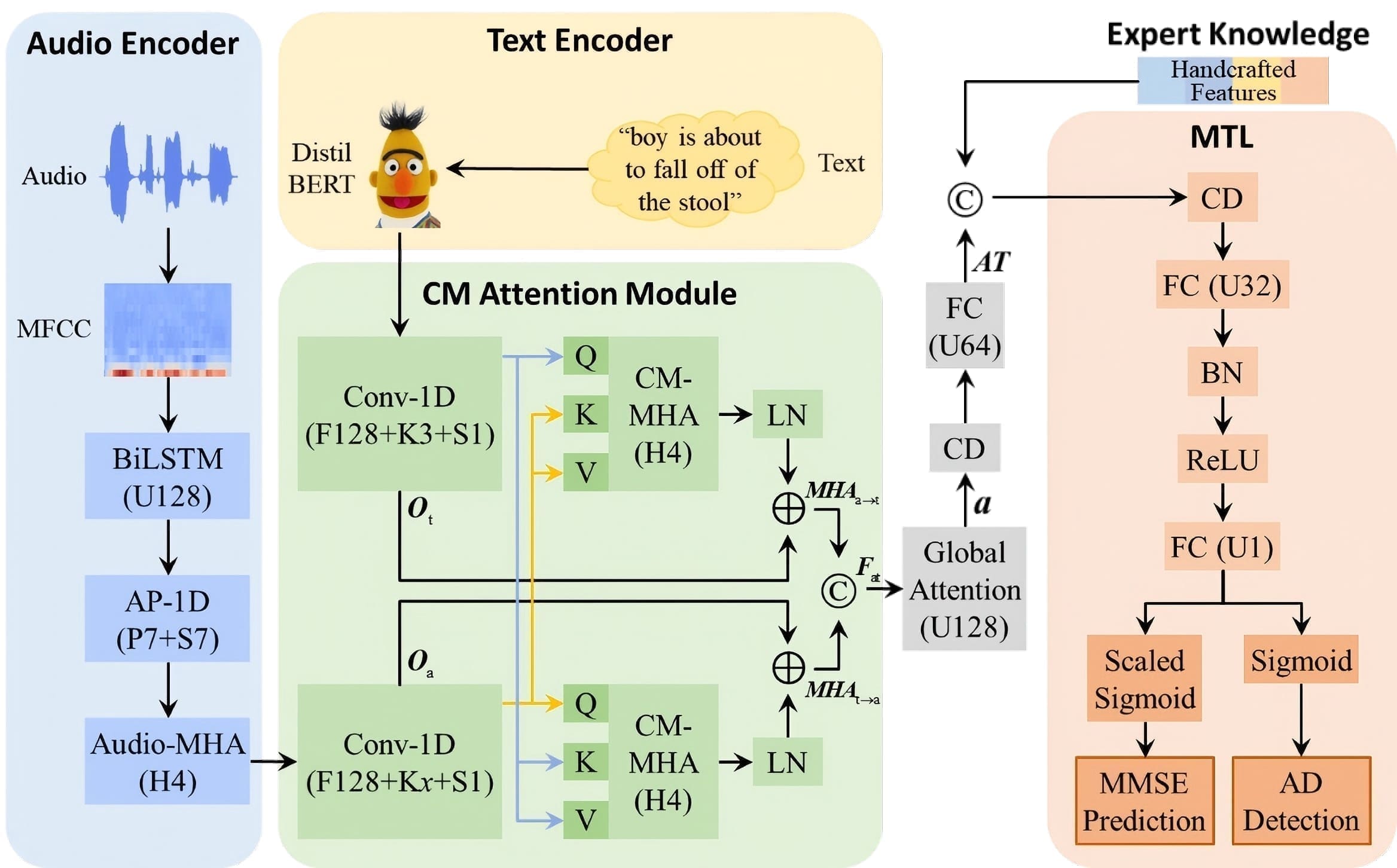
Prof. LI Hai of the Hefei Institutes of Physical Science at the Chinese Academy of Sciences has developed a novel multi-task learning framework called DEMENTIA, designed to enhance early detection and assessment of Alzheimer’s disease (AD).
This approach integrates speech, text, and expert knowledge using a hybrid attention mechanism, improving accuracy and clinical interpretability. Published in IEEE Journal of Biomedical and Health Informatics, the framework leverages large language model technologies to capture complex interactions between data types, offering robust tools for early AD screening and cognitive decline monitoring.
Alzheimer’s Disease Detection Challenges
Early detection of Alzheimer’s disease (AD) is crucial for improving patient outcomes, as it allows for timely intervention to slow progression. Language decline often serves as one of the earliest indicators of cognitive deterioration, making speech analysis a promising avenue for early diagnosis.
Current automated methods for AD detection face significant challenges. These include high complexity, poor interpretability, and limited integration of multiple data types, which collectively hinder accuracy and practical application in clinical settings.
To address these limitations, Prof. Li Hai developed the DEMENTIA framework, a multi-task learning approach that integrates speech, text, and expert knowledge with a hybrid attention mechanism. This integration enhances accuracy and clinical interpretability by capturing complex interactions across different data modalities. Using large language model technologies within this framework allows for a more nuanced understanding of intra- and inter-modal relationships, significantly improving detection accuracy.
DEMENTIA Framework Development
The integration of large language model technologies within DEMENTIA enables a deeper understanding of intra- and inter-modal relationships, improving detection accuracy and facilitating the prediction of cognitive function scores. This capability provides valuable insights for clinical decision-making, offering a more holistic approach to assessing cognitive decline.
Comprehensive interpretability analyses have demonstrated the framework’s robustness across diverse datasets, highlighting its potential as a reliable tool for early AD screening and monitoring. By leveraging multimodal data and advanced attention mechanisms, DEMENTIA represents a promising solution for improving the accuracy and practical application of voice-based Alzheimer’s detection in clinical settings.
Implications for Early Alzheimer’s Screening
The DEMENTIA framework introduces a non-invasive and cost-effective method for early Alzheimer’s detection through voice-based analysis. This approach significantly reduces the need for invasive procedures, making it more accessible and comfortable for patients during initial screenings.
Voice-based methods offer scalability in healthcare settings, allowing for widespread implementation without requiring extensive infrastructure or specialized personnel. This scalability is crucial for reaching underserved populations where access to advanced diagnostic tools may be limited.
Integration of DEMENTIA into routine check-ups can facilitate early detection among at-risk individuals, such as those with a family history of Alzheimer’s. By incorporating voice analysis during regular visits, healthcare providers can monitor cognitive health proactively and initiate interventions earlier.
The framework’s ability to predict cognitive function scores enables continuous monitoring of disease progression and treatment effectiveness. This capability is vital for adjusting therapies in response to changes, potentially slowing disease advancement and improving patient outcomes.
From a societal perspective, early detection through voice-based methods can reduce the financial and emotional burden on healthcare systems and families. By identifying Alzheimer’s early, patients may experience a better quality of life, and resources can be allocated more effectively to support them.
More information
External Link: Click Here For More