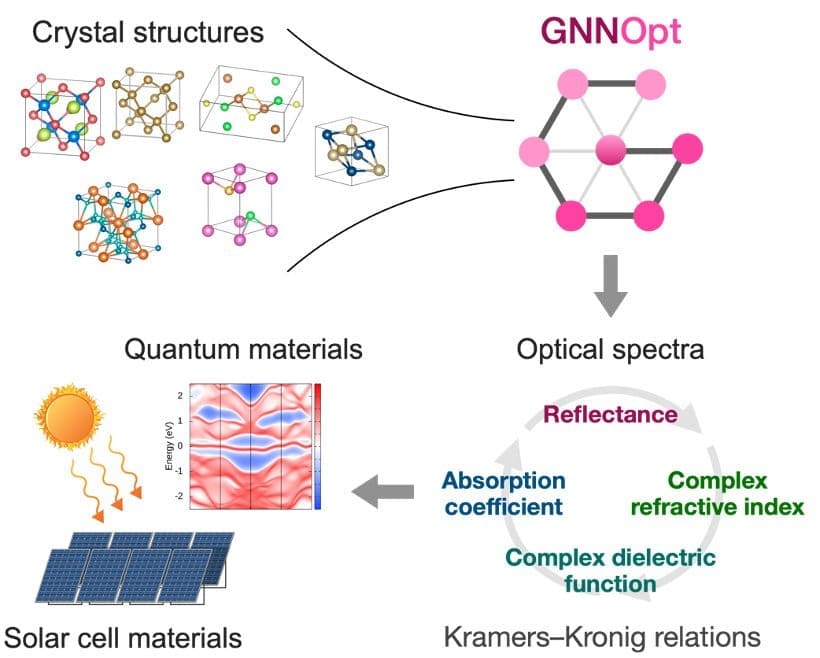
Researchers from Tohoku University and the Massachusetts Institute of Technology (MIT) have developed a revolutionary AI tool that can predict high-quality optical spectra with the same accuracy as quantum simulations, but at a speed that is a million times faster. This breakthrough has the potential to accelerate the development of photovoltaic and quantum materials, which are crucial for advancing optoelectronic devices such as LEDs, solar cells, and photonic integrated circuits.
Led by Nguyen Tuan Hung from Tohoku University and Mingda Li from MIT’s Department of Nuclear Science and Engineering, the team has created an AI model that can predict optical properties across a wide range of light frequencies using only a material’s crystal structure as input. This innovation overcomes the traditional challenges of complex mathematical calculations and immense computational power required for quantum simulations.
The new AI tool, called GNNOpt, utilizes graph neural networks (GNNs) to provide a natural representation of molecules and materials. By introducing a universal ensemble embedding method, the researchers have enabled highly precise optical prediction based solely on crystal structures, making it suitable for various applications such as screening materials for high-performance solar cells and detecting quantum materials.
Accelerating the Discovery of Energy and Quantum Materials with AI
The development of photovoltaic and quantum materials is crucial for advancing optoelectronic devices, such as LEDs, solar cells, photodetectors, and photonic integrated circuits. However, understanding the optical properties of materials is a complex task that requires immense computational power and mathematical calculations. To overcome this challenge, researchers from Tohoku University and the Massachusetts Institute of Technology (MIT) have developed an AI tool that can predict high-quality optical spectra with the same accuracy as quantum simulations, but at a speed that is a million times faster.
The Importance of Optical Properties
Optical properties are essential for developing optoelectronic devices, which are pivotal in the semiconductor industry’s current resurgence. However, traditional means of calculation using the basic laws of physics involve complex mathematical calculations and immense computational power, rendering it difficult to quickly test a large number of materials. Overcoming this challenge could lead to the discovery of new photovoltaic materials for energy conversion and a deeper understanding of the fundamental physics of materials through their optical spectra.
The AI Model: A Game-Changer in Materials Science
The AI model, called GNNOpt, predicts optical properties across a wide range of light frequency using only a material’s crystal structure as an input. This is made possible by a universal ensemble embedding method that unifies the data representation, allowing for highly precise optical prediction based solely on crystal structures. The researchers have demonstrated that this approach can accurately predict optical spectra with complete frequency coverage, which is challenging to obtain in experiments due to laser wavelength limitations.
The Science Behind the AI Model
The AI model utilizes graph neural networks (GNNs), which provide a natural representation of molecules and materials by representing atoms as graph nodes and interatomic bonds as graph edges. However, GNNs lack universality, especially in representations of crystal structures. To work around this conundrum, the researchers devised a universal ensemble embedding method that can be seamlessly applied to any neural network model without modifying the neural network structures.
The Potential Impact on Materials Science
The development of GNNOpt has the potential to accelerate the discovery of photovoltaic and quantum materials, enabling the development of high-performance solar cells and the detection of quantum materials. Furthermore, the researchers aim to develop new databases for various material properties, such as mechanical and magnetic characteristics, to enhance the AI model’s capability to predict material properties based solely on crystal structures. This could lead to a profound impact on data science, enabling the rapid development of new materials with tailored properties.
The Future of Materials Science
The integration of AI tools like GNNOpt into materials science has the potential to revolutionize the field, enabling researchers to rapidly screen and develop new materials with unprecedented speed and accuracy. As the researchers continue to refine their approach, it is likely that we will see a surge in the development of new photovoltaic and quantum materials, leading to breakthroughs in energy conversion and storage.
External Link: Click Here For More