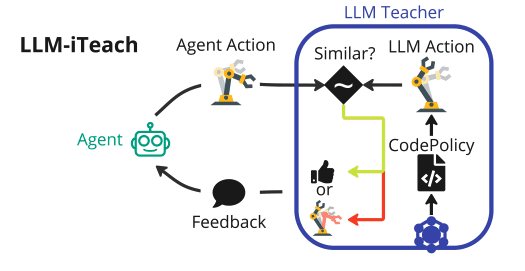
On April 30, 2025, a study titled LLM-based Interactive Imitation Learning for Robotic Manipulation was published. It introduced LLM-iTeach, a framework that uses large language models as interactive teachers to improve robotic manipulation tasks with reduced human involvement.
The study introduces LLM-iTeach, a novel framework leveraging large language models (LLMs) as interactive teachers to enhance autonomous robot learning. By employing hierarchical prompting and similarity-based feedback mechanisms, LLM-iTeach generates policies in Python code while reducing reliance on human involvement. Evaluations across robotic manipulation tasks demonstrate that LLM-iTeach surpasses traditional imitation learning methods like Behavior Cloning and matches or outperforms state-of-the-art interactive approaches using human teachers. The framework’s success highlights the potential of LLMs as cost-effective, human-like teachers in robotics training.
Revolutionising Robotics with Large Language Models
In recent years, large language models (LLMs) have emerged as transformative tools across various industries, and their integration into robotics is paving the way for significant advancements. Traditionally, robots relied on pre-programmed tasks, limiting their adaptability. However, with LLMs, robots can now interpret complex, dynamic tasks through natural language instructions, opening up new possibilities in automation and human-robot collaboration.
The integration of LLMs into robotics primarily involves prompt engineering, where specific prompts guide the model to generate task plans or reward functions. For instance, ProgPrompt utilises LLMs to create detailed robot task plans by translating user commands into actionable steps. Similarly, research by Yu et al. explores using language to design reward functions, enabling robots to learn skills through natural language feedback. This approach allows robots to adapt to new tasks without extensive reprogramming.
By understanding human instructions, robots can perform diverse activities, from assembling products to assisting in healthcare settings. However, challenges remain, particularly in ensuring safety and reliability when interpreting commands, as errors could lead to unintended actions. The future of robotics lies in leveraging LLMs for more adaptable and versatile machines. This integration could revolutionise industries by enabling robots to perform a wide range of tasks with minimal programming.
👉 More information
🗞 LLM-based Interactive Imitation Learning for Robotic Manipulation
🧠 DOI: https://doi.org/10.48550/arXiv.2504.21769