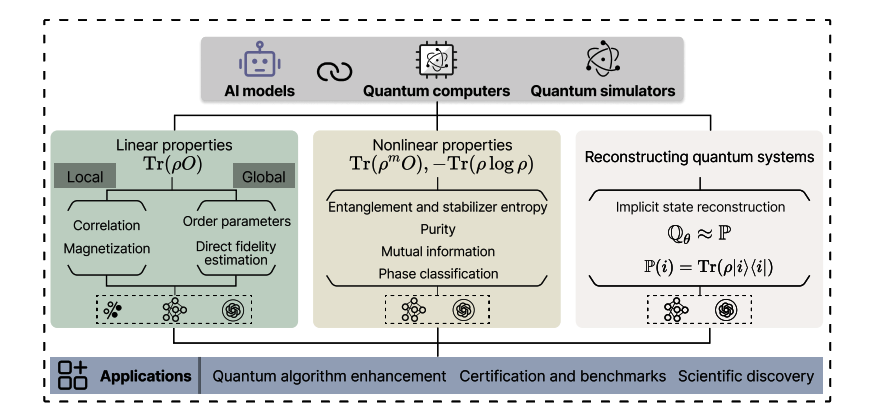
Characterising increasingly complex quantum systems presents a major hurdle for modern science, as the information needed to describe them grows exponentially with size. Yuxuan Du, Yan Zhu, and Yuan-Hang Zhang, alongside colleagues including Min-Hsiu Hsieh, Patrick Rebentrost, and Weibo Gao, investigate how artificial intelligence offers a potential solution to this problem. Their work demonstrates that AI’s ability to identify patterns and approximate complex functions provides powerful new tools for representing and understanding these systems. By exploring different AI approaches, including deep learning and language models, the researchers reveal how these techniques can both predict system properties and create simplified models of quantum states, ultimately paving the way for advancements in quantum computing, algorithm development, and the study of complex materials.
Quantum Variational Algorithms and Neural Networks
Research at the intersection of machine learning and quantum physics spans core algorithms to practical applications. Scientists are developing quantum neural networks, exploring diverse architectures and potential uses, and refining variational quantum algorithms for various problems. Quantum kernel methods underpin much of this work, and researchers are developing methods to reconstruct quantum states from limited measurements using machine learning techniques. Researchers are also investigating how to best represent quantum states for machine learning models and understanding the fundamental limits of quantum machine learning compared to classical approaches.
Generative models, like diffusion models, are used to learn and generate complex quantum states, aiding in solving challenging quantum many-body problems, simulating materials and molecules, and discovering new materials with desired quantum properties. Machine learning is also accelerating quantum simulations and improving the accuracy of quantum error correction. The application of machine learning extends to improving quantum hardware and experimentation. Scientists are using machine learning to characterize and calibrate qubits, mitigate noise in quantum experiments, and optimize the design of quantum hardware.
Machine learning is also proving valuable for quantum process tomography and assessing the robustness of quantum systems to adversarial attacks, employing techniques like deep learning, unsupervised learning, transfer learning, and graphical models. Researchers are also leveraging regularization techniques to improve model performance. Fundamental concepts like symmetry principles are being incorporated into machine learning models for quantum systems. Scientists are also exploring continual learning approaches to adapt models to changing quantum environments and developing methods to interpret the predictions of machine learning models. Creating large-scale datasets for training machine learning models is also a key area of focus. Many research papers address multiple areas simultaneously.
AI Reveals Transferable Insights in Quantum Systems
Artificial intelligence is transforming how scientists analyze complex systems generated by simulations and advanced computing. These systems often produce vast amounts of data that grow exponentially with system size, presenting significant challenges. Researchers are leveraging AI’s ability to recognize patterns and approximate functions to represent and understand these scalable systems, employing machine learning, deep learning, and language models. This approach focuses on data-driven insights transferable across different systems. Scientists have developed learning protocols applicable to both analog quantum simulation and digital quantum computing.
These protocols focus on predicting physical properties like magnetization and fidelity, and reconstructing quantum states. The core workflow involves data collection, model implementation and optimization, and model prediction, shared across different learning paradigms. Data collection involves generating a training dataset comprising system parameters, measurement outcomes, and auxiliary information. The learning models are then trained to predict linear properties, such as energy and correlation functions, and nonlinear properties, including von Neumann entropy and Uhlmann fidelity. This represents a paradigm shift in how scientists approach the characterization of complex systems.
AI Accelerates Quantum System Characterization
The synergy between artificial intelligence and the characterization of complex, scalable quantum systems is rapidly growing. Researchers are increasingly leveraging AI models to address the exponentially increasing computational demands as system size grows. They are exploring property prediction, constructing surrogates for states, and using AI to explore fundamental phases of matter. Current approaches largely rely on supervised learning, but unsupervised methods are also proving valuable for tasks like phase classification. Progress is being made in developing efficient learning algorithms for specific types of quantum states, unitary operations, and processes, offering potential for provably scalable solutions.
While many of these methods are simplified variants of broader quantum reconstruction problems, existing reviews already cover those areas comprehensively. Despite the promise of these AI-driven techniques, current approaches have limitations regarding their applicability to fully general quantum systems. Future research directions include expanding the scope of these methods and exploring the potential of deep learning to further enhance the representation and characterization of scalable quantum systems.
🗞 Artificial intelligence for representing and characterizing quantum systems
🧠 ArXiv: https://arxiv.org/abs/2509.04923