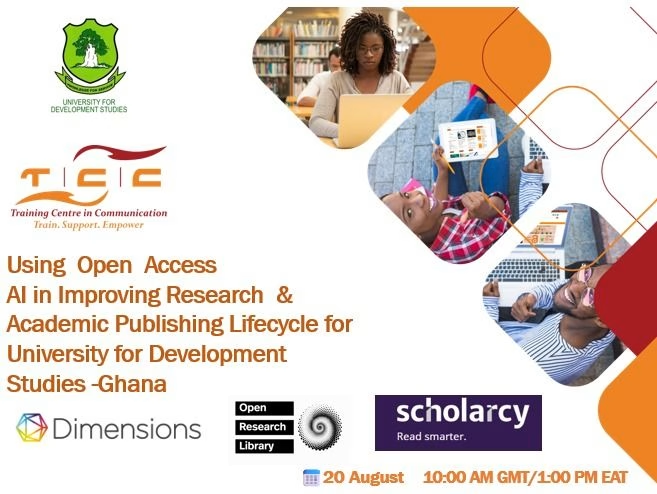
The integration of artificial intelligence (AI) into academic research has the potential to revolutionize the way scholars work. A recent virtual workshop on Open Access Solutions showcased two powerful tools that can streamline research processes: Scholarcy, an AI-powered online summarization tool, and Dimensions, a citation database developed by Digital Science. These innovative platforms can help researchers automate tedious tasks, increase productivity, and accelerate knowledge dissemination.
By leveraging Scholarcy’s AI-driven summarization capabilities, researchers can quickly grasp the main arguments and findings of a paper, making it easier to stay up-to-date with the latest developments in their field. Dimensions provides a comprehensive platform for exploring research grants, publications, and citations, helping researchers identify potential collaborators, funding opportunities, and areas of interest.
The workshop also highlighted the importance of open access (OA) in modern academic research. OA enables scholars to share their findings with a wider audience, fostering collaboration and accelerating the dissemination of knowledge. The Open Research Library (ORL), introduced by Knowledge Unlatched, is a user-friendly platform that enhances the discovery of worldwide open-access publications.
As the academic community continues to evolve, it is essential to explore new ways of leveraging AI-powered tools like Scholarcy and Dimensions. By integrating these tools into their workflows, researchers can increase productivity, accelerate knowledge dissemination, and drive innovation. The future of academic research depends on our ability to develop innovative solutions that bridge the gap between researchers and librarians, promoting collaboration and accelerating the advancement of knowledge.
Can AI Revolutionize Academic Research?
The University for Development Studies, in collaboration with Training Centre in Communication (TCC Africa), recently co-hosted a virtual workshop on Open Access Solutions. The event aimed to equip researchers and librarians with hands-on tools to enhance research efficiency, increase output, and elevate the quality and visibility of academic work across various fields.
During the workshop, TCC Africa’s Nicholas Outa led a demonstration on how to access and utilize Dimensions, a citation database developed by Digital Science. This powerful tool allows users to explore research grants, publications, citations, clinical trials, patents, and policy documents in one place. By leveraging Dimensions, researchers can streamline their search for relevant information, saving time and increasing the accuracy of their findings.
The workshop also introduced Scholarcy, an AI-powered online summarization tool developed by Scholarcy Inc. This innovative platform enables users to quickly identify key points and arguments in research papers, as well as critically analyze papers to understand how they build upon or differ from prior studies. With Scholarcy, researchers can effectively interpret large collections of articles, making it easier to stay up-to-date with the latest developments in their field.
How Can AI Enhance Academic Research?
The integration of AI-powered tools like Scholarcy and Dimensions has the potential to revolutionize academic research. By automating tedious tasks such as literature reviews and data analysis, researchers can focus on higher-level thinking and creativity. This, in turn, can lead to breakthroughs in various fields, from medicine to environmental science.
Scholarcy’s AI-driven summarization capabilities can help researchers quickly grasp the main arguments and findings of a paper, allowing them to make more informed decisions about their own research. The tool’s ability to critically analyze papers also enables users to identify gaps in existing knowledge, sparking new ideas and areas of investigation.
Dimensions, on the other hand, provides a comprehensive platform for exploring research grants, publications, and citations. This can help researchers identify potential collaborators, funding opportunities, and areas of interest that may not be immediately apparent through traditional search methods.
What Role Can Open Access Play in Academic Research?
Open access (OA) has emerged as a crucial component of modern academic research. By making scholarly articles freely available online, OA enables researchers to share their findings with a wider audience, fostering collaboration and accelerating the dissemination of knowledge.
The Open Research Library (ORL), introduced by Knowledge Unlatched, is a user-friendly platform that enhances the discovery of worldwide open-access publications covering various disciplines. ORL’s OA model allows authors to retain copyright while making their work freely available online, promoting transparency and accountability in research.
Can AI-Powered Tools Bridge the Gap Between Researchers and Librarians?
The workshop highlighted the importance of collaboration between researchers and librarians in the academic lifecycle. By leveraging AI-powered tools like Scholarcy and Dimensions, librarians can provide researchers with targeted support, helping them navigate the vast amounts of information available online.
Scholarcy’s summarization capabilities can help librarians quickly identify key points and arguments in research papers, enabling them to provide more effective support to researchers. Dimensions, on the other hand, provides a comprehensive platform for exploring research grants, publications, and citations, allowing librarians to offer targeted guidance on funding opportunities and collaboration.
What’s Next for Open Access AI in Academic Research?
As the academic community continues to evolve, it is essential to explore new ways of leveraging AI-powered tools like Scholarcy and Dimensions. By integrating these tools into their workflows, researchers can streamline their research processes, increase productivity, and accelerate the dissemination of knowledge.
The ORL platform, with its user-friendly interface and comprehensive coverage of open-access publications, has the potential to become a go-to resource for researchers seeking to stay up-to-date with the latest developments in their field. As OA continues to grow, it is crucial that we continue to develop innovative solutions like Scholarcy and Dimensions to support the academic community.
Conclusion
The University for Development Studies’ virtual workshop on Open Access Solutions demonstrated the potential of AI-powered tools like Scholarcy and Dimensions to revolutionize academic research. By automating tedious tasks, streamlining search processes, and providing targeted support, these tools can help researchers increase productivity, accelerate knowledge dissemination, and drive innovation.
As we move forward, it is essential that we continue to develop innovative solutions that bridge the gap between researchers and librarians, promoting collaboration and accelerating the advancement of knowledge.
Publication Date: 2024-08-20
Authors: Joy Owango, Oliver Back, Emma Warren-Jones, Wilson de Souza, et al.
Source:
DOI: https://doi.org/10.21428/359fb1d2.3f988139