

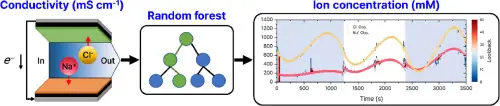
A team of researchers led by Dr. Son Moon at the Korea Institute of Science and Technology (KIST) has developed an artificial intelligence technology that can accurately predict ion concentration in water, a crucial step towards improving social water welfare. This breakthrough is significant as approximately 2.2 billion people worldwide lack access to safe drinking water, with half experiencing severe water scarcity at some point during the year. The researchers utilized machine learning techniques, specifically random forest models, to predict ion concentrations in electrochemical water treatment processes. Their model was able to accurately predict electrical conductivity and individual ion concentrations (Na⁺, K⁺, Ca2⁺, and Cl-) with an R² value of approximately 0.9. This technology has the potential to be applied to national large-scale automatic water quality measurement networks, enabling real-time monitoring of specific ions in water. The research was supported by the Ministry of Science and ICT and published in the international journal Water Research.
Artificial Intelligence for Clean Water: Predicting Ion Concentration in Electrochemical Water Treatment
The lack of access to safe and managed drinking water is a pressing global issue, affecting over 2.2 billion people worldwide. To address this problem, researchers have been exploring decentralized water production technologies, such as electrochemical-based methods like capacitive deionization and battery electrode deionization. However, existing water quality measurement sensors used in these technologies have limitations, including the inability to measure and track individual ions in water. A recent breakthrough by a research team at the Korea Institute of Science and Technology (KIST) has developed an artificial intelligence (AI) technology that can accurately predict ion concentration in water during electrochemical treatment processes.
The researchers employed a random forest model, a machine learning technique used for regression problems, to predict ion concentrations in electrochemical water treatment technologies. The developed AI model was able to accurately predict the electrical conductivity of the treated water and the concentration of each ion (Na⁺, K⁺, Ca2⁺, and Cl-) with an R² value of approximately 0.9. This achievement has significant implications for improving social water welfare by enabling more precise monitoring of individual ions in national water quality management systems.
Ion Concentration Prediction using Machine Learning Techniques
The random forest model used in this study is a tree-based machine learning technique that has several advantages over complex deep learning models. It requires significantly fewer computing resources to train, making it an economically superior option. The researchers found that updates were necessary every 20-80 seconds to improve the accuracy of the predictions, which means that water quality measurements need to be taken at least every minute to train the initial model.
The application of this AI technology to national water quality measurement networks has the potential to revolutionize the way we monitor and manage water resources. By accurately predicting ion concentrations in real-time, water treatment plants can respond quickly to changes in water demand, reducing socioeconomic costs associated with sewer irrigation and alternative water sources. Furthermore, decentralized water production technologies can be optimized to provide clean drinking water to communities in need.
Decentralized Water Production Technologies
Electrochemical-based water treatment methods, such as capacitive deionization and battery electrode deionization, are gaining popularity due to their ease of adoption and potential for decentralized water production. However, existing water quality measurement sensors used in these technologies have limitations, including the inability to measure and track individual ions in water. The development of AI technology that can accurately predict ion concentration in water has the potential to overcome this limitation, enabling more precise monitoring and control of electrochemical water treatment processes.
The application of decentralized water production technologies has significant implications for improving social water welfare, particularly in communities with limited access to clean drinking water. By providing a reliable source of clean water, these technologies can reduce socioeconomic costs associated with water scarcity and improve public health outcomes.
National Water Quality Management Systems
The development of AI technology that can accurately predict ion concentration in water has significant implications for national water quality management systems. By integrating this technology into existing measurement networks, water treatment plants can respond quickly to changes in water demand, reducing socioeconomic costs associated with sewer irrigation and alternative water sources. Furthermore, the ability to monitor individual ions in real-time enables more precise control of electrochemical water treatment processes, improving overall water quality.
The researchers involved in this study have highlighted the significance of their research, not only in developing a new AI model but also in its application to national water quality management systems. The potential for this technology to contribute to the improvement of social water welfare is substantial, and further research is needed to explore its full potential.
DOI: http://dx.doi.org/10.1016/j.watres.2024.122092


