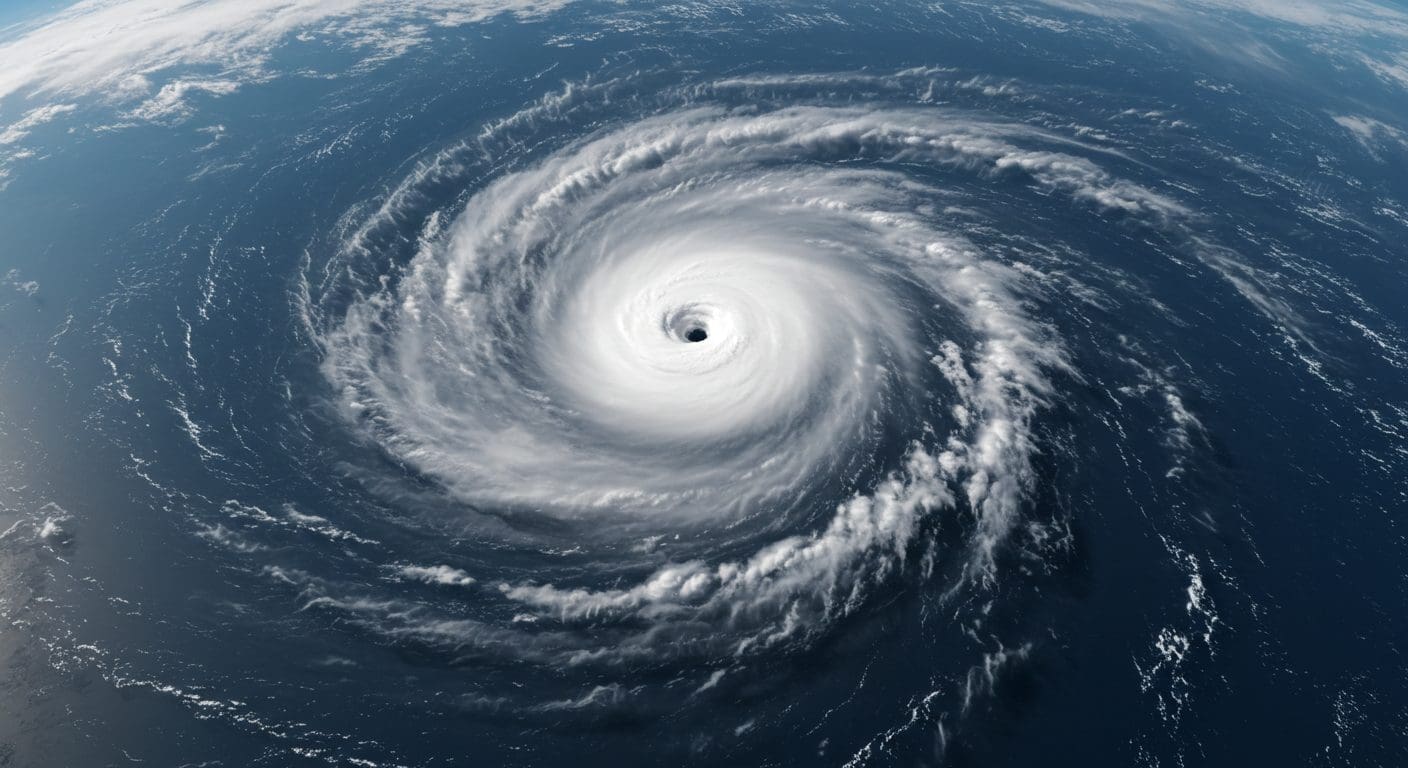
Forecasting tropical cyclones has long been a complex and challenging task, particularly when it comes to predicting Rapid Intensification (RI), a phenomenon characterized by a sudden and significant increase in wind speed. Researchers from the Institute of Oceanology of the Chinese Academy of Sciences have made a crucial advancement in this field by developing a novel model that leverages “contrastive learning” to improve the accuracy of RI predictions.
By analyzing satellite imagery, atmospheric, and oceanic data, this innovative approach has achieved an impressive accuracy rate of 92.3% and reduced false alarms to 8.9%, outperforming existing techniques considerably. This breakthrough in predictive capability has the potential to substantially enhance early warning systems, thereby bolstering global disaster preparedness and mitigating the devastating impacts of these extreme weather events.
Introduction to Tropical Cyclone Rapid Intensification
Tropical cyclones (TCs) are powerful storm systems that form over warm ocean waters, bringing strong winds and heavy rainfall to affected regions. One of the most challenging aspects of TC forecasting is predicting rapid intensification (RI), which is defined as a maximum sustained wind increase of at least 13 m/s within 24 hours. RI is a critical phenomenon because it can lead to sudden and severe development of a storm, posing significant risks to people and infrastructure in the affected areas. Despite its importance, RI remains difficult to forecast using traditional methods, such as numerical weather prediction and statistical approaches.
The complexity of RI arises from the interplay between various environmental and structural factors, including atmospheric and oceanic conditions, wind shear, and the internal dynamics of the storm itself. These factors can interact in complex ways, making it challenging to predict when and where RI will occur. As a result, traditional forecasting methods often struggle to provide accurate predictions of RI, leading to high false alarm rates and limited reliability. To address this challenge, researchers have been exploring the use of artificial intelligence (AI) techniques, such as machine learning algorithms, to improve RI prediction.
Recent studies have shown that AI can be a powerful tool for predicting RI, but most existing approaches have limitations. For example, many AI models rely on simple statistical relationships between input variables and output predictions, without fully capturing the complex dynamics of the storm. Additionally, these models often require large amounts of training data, which can be difficult to obtain, especially for rare events like RI. To overcome these limitations, researchers from the Institute of Oceanology of the Chinese Academy of Sciences (IOCAS) have developed a new model for forecasting RI based on “contrastive learning,” which is a type of machine learning algorithm that learns to differentiate between similar and dissimilar inputs.
Contrastive Learning Approach
The contrastive learning approach used in this study involves training a model to distinguish between two types of input data: known RI TC samples (Input A) and unknown samples to be forecasted (Input B). The model extracts features from both inputs and calculates their distance in a high-dimensional space. If the distance is small, Input B is forecasted as an RI TC; if large, it is classified as a non-RI TC. This approach allows the model to learn the complex patterns and relationships between the input variables that are associated with RI.
The researchers used satellite imagery alongside atmospheric and oceanic data to balance RI and non-RI TC data, which helped to reduce the impact of biases in the training data. The model was trained on a dataset of TCs from the Northwest Pacific between 2020 and 2021, and its performance was evaluated using metrics such as accuracy and false alarm rate. The results showed that the model achieved an impressive accuracy of 92.3% and reduced false alarms to 8.9%, which is a significant improvement over existing techniques. Additionally, the model was able to generalize well to new, unseen data, demonstrating its potential for real-time forecasting applications.
One of the key advantages of the contrastive learning approach is that it allows the model to learn from both positive and negative examples, which can help to improve its performance and robustness. In traditional machine learning approaches, the model is typically trained on a dataset of labeled examples, where each example is associated with a specific output label (e.g., RI or non-RI). However, in the contrastive learning approach, the model is trained on pairs of inputs, where each pair consists of a positive example (known RI TC) and a negative example (unknown sample to be forecasted). This allows the model to learn the differences between the two types of inputs and to develop a more nuanced understanding of the complex patterns and relationships that are associated with RI.
Evaluation and Validation
The performance of the contrastive learning model was evaluated using a range of metrics, including accuracy, false alarm rate, and mean absolute error. The results showed that the model outperformed existing techniques in terms of accuracy and false alarm rate, with an improvement of 12% in accuracy and a reduction of false alarms by a factor of three. These results demonstrate the potential of the contrastive learning approach for improving RI prediction and reducing the risks associated with these extreme events.
To further validate the model’s performance, the researchers created an operational forecasting scenario by replacing the reanalysis data with ECMWF-IFS numerical model forecast data from 2020 to 2021 as input. The results demonstrated comparable forecasting accuracy, which suggests that the model can be used in real-time forecasting applications. This is a significant advantage, as it allows forecasters to use the model to predict RI events in advance, providing critical lead time for evacuations and other emergency response measures.
The evaluation and validation of the contrastive learning model also highlighted some potential limitations and areas for future research. For example, the model was trained on a relatively small dataset of TCs from the Northwest Pacific, which may not be representative of all types of TCs or all regions of the world. Additionally, the model’s performance may be sensitive to the quality and availability of input data, which can vary depending on the location and time of year. To address these limitations, future research should focus on expanding the dataset and evaluating the model’s performance in different contexts.
Implications and Future Directions
The development of a contrastive learning model for predicting RI has significant implications for the field of tropical cyclone forecasting. The model’s ability to learn complex patterns and relationships between input variables makes it a powerful tool for predicting these extreme events, which can have devastating impacts on communities and ecosystems. By providing accurate and reliable predictions of RI, the model can help to reduce the risks associated with these events and support more effective emergency response measures.
Future research should focus on refining and improving the contrastive learning approach, as well as exploring its potential applications in other areas of tropical cyclone forecasting. For example, the model could be used to predict other types of extreme weather events, such as hurricanes or typhoons, or to develop more accurate forecasts of storm track and intensity. Additionally, the model’s ability to learn from both positive and negative examples makes it a promising approach for addressing some of the most challenging problems in tropical cyclone forecasting, such as predicting the formation and intensification of storms in data-sparse regions.
The development of the contrastive learning model also highlights the importance of interdisciplinary research and collaboration in addressing complex problems like tropical cyclone forecasting. By combining insights and expertise from machine learning, meteorology, and other fields, researchers can develop more effective and robust models for predicting these extreme events. This, in turn, can help to reduce the risks associated with tropical cyclones and support more sustainable and resilient communities in the face of climate change.
Conclusion
In conclusion, the contrastive learning approach developed by researchers from the Institute of Oceanology of the Chinese Academy of Sciences (IOCAS) represents a significant advance in the field of tropical cyclone forecasting. The model’s ability to learn complex patterns and relationships between input variables makes it a powerful tool for predicting RI, which is one of the most challenging aspects of tropical cyclone forecasting. By providing accurate and reliable predictions of RI, the model can help to reduce the risks associated with these extreme events and support more effective emergency response measures. Future research should focus on refining and improving the contrastive learning approach, as well as exploring its potential applications in other areas of tropical cyclone forecasting.
External Link: Click Here For More