

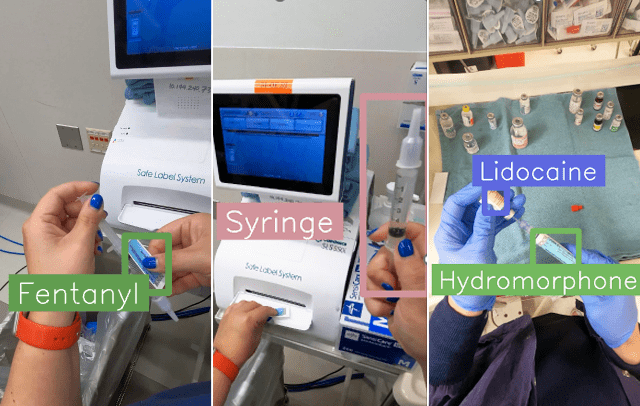
Researchers at the University of Washington have developed a wearable camera system that uses artificial intelligence to detect potential errors in medication delivery. The AI-powered system, tested in busy clinical settings, recognized and identified medications with high proficiency, achieving 99.6% sensitivity and 98.8% specificity at detecting vial-swap errors.
According to Dr. Kelly Michaelsen, co-lead author of the study, this technology could become a critical safeguard, especially in operating rooms, intensive care units, and emergency medicine settings. The system uses a GoPro camera paired with a deep-learning model that recognizes the contents of cylindrical vials and syringes, rendering a warning before the medication enters the patient.
The researchers, including Shyam Gollakota from the Paul G. Allen School of Computer Science & Engineering, trained the model using 4K video of 418 drug draws by 13 anesthesiology providers. The Toyota Research Institute built and tested the system, which has the potential to improve safety and efficiency across various healthcare practices.
Wearable Cameras and AI: A Potential Safeguard Against Medication Errors
Medication administration errors are a significant concern in healthcare, with an estimated 5% to 10% of all drugs associated with errors. These errors can have devastating consequences, affecting approximately 1.2 million patients annually for $5.1 billion. Researchers have developed a wearable camera system that utilizes artificial intelligence (AI) to combat this issue to detect potential medication delivery errors.
Accurate Identification of Medication Contents
The AI-powered camera system, developed and tested at the University of Washington, has demonstrated high proficiency in identifying the contents of vials and syringes. In a test, the video system recognized and identified medications with 99.6% sensitivity and 98.8% specificity at detecting vial-swap errors. This achievement is significant, as it surpasses the goal of 95% accuracy desired by anesthesia providers.
The AI model was trained using 4K video footage of 418 drug draws by 13 anesthesiology providers in operating rooms with varying setups and lighting conditions. The video captured clinicians managing vials and syringes of select medications, which were later logged and annotated to train the model to recognize the contents and containers.
The AI model does not directly read the wording on each vial but instead scans for other visual cues such as vial and syringe size and shape, vial cap color, and label print size. This approach is particularly challenging, as the camera must detect medications in real-time while clinicians are handling them, often with their hands covering parts of the objects.
The wearable camera system has the potential to become a critical safeguard in high-stakes clinical settings such as operating rooms, intensive care units, and emergency medicine settings. By detecting medication errors in real time, the system can prevent adverse events before they occur. This is especially important when clinicians forget to perform safety checks due to high-stress levels.
This study demonstrates the potential of AI and deep learning to improve safety and efficiency across various healthcare practices. As researchers continue to explore AI’s capabilities, similar systems will likely be developed to address other critical issues in healthcare.
The development and testing of the wearable camera system involved a collaborative effort between researchers from the University of Washington, Carnegie Mellon University, Makerere University in Uganda, and the Toyota Research Institute. The project was funded by the Washington Research Foundation, Foundation for Anesthesia Education and Research, and a National Institutes of Health grant (K08GM153069).
External Link: Click Here For More


