

Scientists are increasingly recognising the limitations of network topology in fully representing the complex functional relationships within biomedical data. Hasi Hays and William J. Richardson, both from the Department of Chemical Engineering at the University of Arkansas, alongside Hasi Hays et al., have developed a novel retrieval-augmented generation (RAG) embedding framework to address this challenge. Their research integrates graph neural network representations with dynamically retrieved knowledge from biomedical literature using contrastive learning, offering a significant advance in precision medicine. Benchmarking demonstrates that while topology-focused methods excel at link prediction, RAG-GNN uniquely facilitates functional clustering, and importantly, identifies potential therapeutic targets such as DDR1 in cancer signalling networks based on evidence of synthetic lethality with KRAS mutations. This work establishes that combining topological data with retrieved knowledge provides complementary benefits, enhancing both the predictive power and functional interpretability of network analysis.
Graph Neural Networks and Retrieval Augmentation for Biomedical Knowledge Discovery offer a powerful synergistic approach
Scientists are developing a comprehensive framework for unifying graph neural network (GNN)-based topology encoding with retrieval-augmented generation (RAG)-based knowledge retrieval for precision medicine applications. The research establishes theoretical foundations, performs comprehensive benchmarking, conducts information-theoretic validation, and demonstrates a practical application to cancer signaling networks.
Contributions include joint optimization objectives for training network encoders, dense retrievers, and fusion mechanisms, alongside generalization bounds and geometric characterization of embedding spaces. A systematic comparison against ten embedding methods, DeepWalk, Node2Vec, LINE, GCN, GAT, GraphSAGE, and others, was conducted across functional clustering, link prediction, and node classification tasks, revealing task-specific performance patterns.
Mutual information decomposition demonstrated that 8.6% of predictive information derives exclusively from retrieved documents, complementing the 77.3% contributed by network topology. Applied to cancer signaling networks consisting of 379 proteins and 3,498 interactions, the framework identifies DDR1 as a therapeutic target based on retrieved evidence of synthetic lethality with KRAS mutations.
RAG-enhanced embeddings achieve positive silhouette scores for functional clustering (0.001) where all topology-only methods fail, while GCN achieves 0.983 AUROC for link prediction. The results establish that topology-only and retrieval-augmented approaches serve complementary purposes; structural prediction tasks are solved by network topology alone, while functional interpretation uniquely benefits from retrieved knowledge.
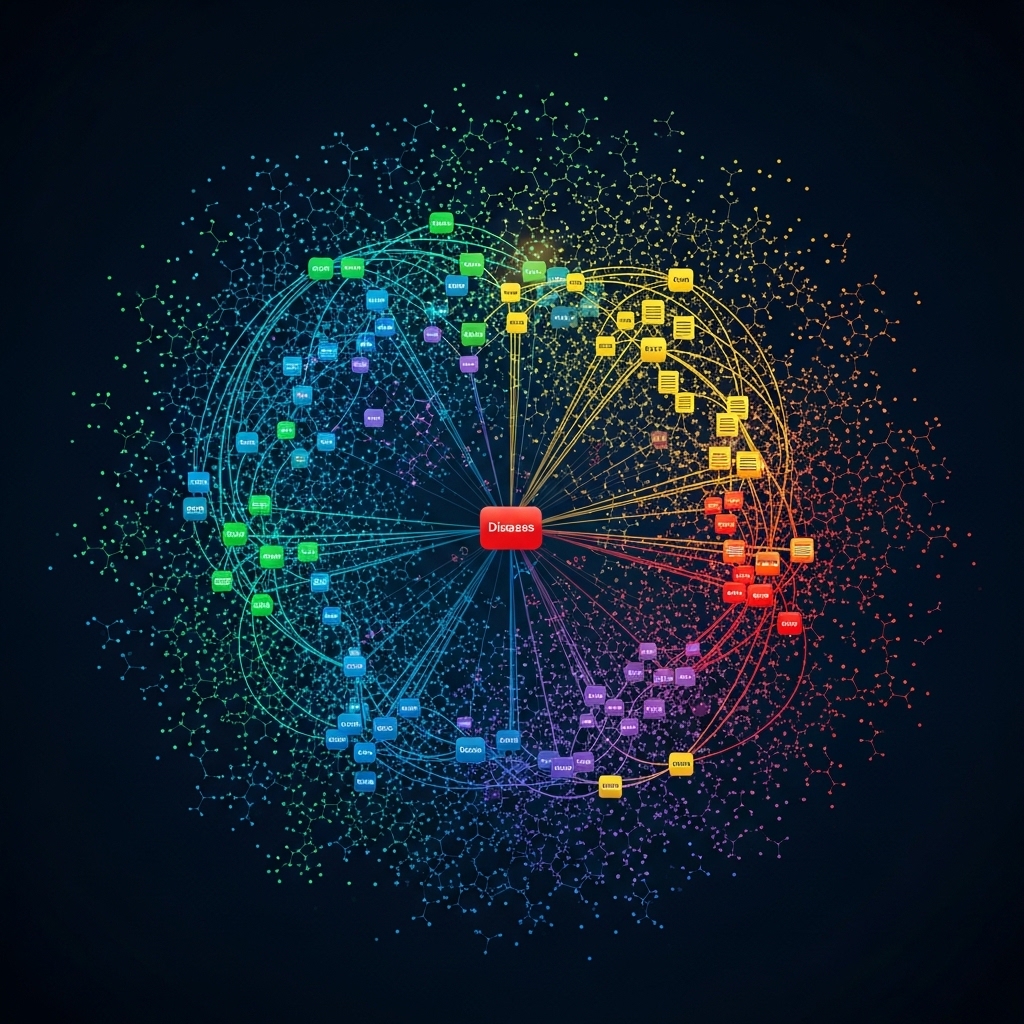
The framework integrates six interconnected components: biological network input, neural conversion, a GNN encoder and retrieval module, a knowledge corpus, joint embedding, and multimodal data integration, enabling downstream applications such as therapeutic target identification and drug response prediction. The system utilises a graph attention (GAT) or graph convolutional (GCN) layer to perform iterative message passing with edge updates and hierarchical pooling operations to generate node embeddings.
The dense retriever queries diverse external knowledge sources including molecular docking predictions, immune cell interaction networks, ADMET properties, archived literature (PubMed, DrugBank, pathway databases), and expert-curated domain knowledge. Contrastive learning aligns network topology embeddings with retrieved knowledge representations in a unified semantic space.
Retrieval-augmented graph neural networks for protein function prediction leverage external databases to enhance performance
A graph neural network framework incorporating dynamically retrieved literature formed the basis of this study’s methodology. Researchers implemented a retrieval-augmented generation (RAG) embedding system to integrate graph neural network representations with knowledge sourced from biomedical literature via contrastive learning.
This approach aimed to bridge the gap between network topology and functional semantics, addressing limitations in purely topology-based methods for tasks requiring biological context. The study benchmarked the RAG-GNN framework against ten existing embedding methods, evaluating performance on both link prediction and functional clustering.
Link prediction accuracy was assessed using the area under the receiver operating characteristic curve (AUROC), revealing that topology-focused methods, specifically GCN, achieved a near-perfect score of 0.983. Functional clustering performance was quantified using silhouette scores, where RAG-GNN uniquely attained a positive score of 0.001, contrasting with negative scores observed for all baseline methods.
To dissect the contributions of network topology and retrieved literature, an information-theoretic decomposition was performed. Results indicated that network topology accounted for 77.3% of the predictive information, while the dynamically retrieved documents contributed 8.6% unique information. The framework was then applied to a cancer signaling network comprising 379 proteins and 3,498 interactions, successfully identifying DDR1 as a potential therapeutic target based on evidence of synthetic lethality with KRAS mutations found within the retrieved literature. This targeted identification demonstrates the framework’s capacity to translate network structure and external knowledge into actionable biological insights.
Network topology and retrieved knowledge enhance cancer target prediction accuracy
Link prediction using graph convolutional networks achieved an area under the receiver operating characteristic curve (AUROC) of 0.983. Functional clustering, however, demonstrated a significant advantage for the retrieval-augmented generation (RAG) embedding framework, yielding a silhouette score of 0.001, contrasting with negative scores observed for all baseline methods.
Information-theoretic decomposition of predictive power revealed that network topology accounted for 77.3% of the total information, while dynamically retrieved documents contributed an additional 8.6% of unique information. This research applied the framework to cancer signaling networks comprising 379 proteins and 3,498 interactions, successfully identifying DDR1 as a potential therapeutic target based on retrieved evidence supporting its synthetic lethality in combination with KRAS mutations.
The study establishes a complementary relationship between topology-focused and retrieval-augmented approaches, demonstrating that structural prediction tasks are effectively solved using network topology alone. Functional interpretation, however, uniquely benefits from the incorporation of retrieved knowledge, enhancing the understanding of biological mechanisms beyond network structure.
The work highlights the limitations of relying solely on network topology for functional prediction, as functionally related proteins may not always reside in close network proximity. By integrating information from biomedical literature, the RAG-GNN framework addresses the structure-function gap and provides a more comprehensive approach to precision medicine applications. This method dynamically accesses unstructured text, adapting to new information without the need for retraining and offering interpretable evidence through the retrieved documents used in its analysis.
Synergistic Network Embedding via Topology and Literature Retrieval leverages both structural and semantic information
Network topology and dynamically retrieved knowledge offer complementary strengths in biological network analysis. A retrieval-augmented generation embedding framework, integrating graph neural networks with literature-derived information via contrastive learning, demonstrates this principle. Benchmarking against ten alternative embedding methods revealed that topology-focused approaches excel at link prediction, achieving an AUROC of 0.983 with Graph Convolutional Networks.
Simultaneously, this RAG-GNN framework uniquely achieved positive silhouette scores for functional clustering, indicating improved performance in discerning functional groupings within networks. Decomposition of information sources showed that network topology accounts for 77.3% of predictive information, while retrieved documents contribute an additional 8.6% of unique information.
Application of the framework to cancer signaling networks identified DDR1 as a potential therapeutic target, supported by evidence of synthetic lethality with KRAS mutations obtained through literature retrieval. Experiments corrupting the retrieval process confirmed that the observed improvements in clustering stem from the content of the retrieved documents, rather than simply the model’s capacity.
These results establish that topology-based methods are best suited for structural prediction, while retrieval-augmented approaches enhance functional interpretation, suggesting task-specific method selection is crucial. Further research could incorporate causal inference methods to enable interventional predictions and improve interpretability through natural language explanations and counterfactual analysis.
👉 More information
🗞 RAG-GNN: Integrating Retrieved Knowledge with Graph Neural Networks for Precision Medicine
🧠 ArXiv: https://arxiv.org/abs/2602.00586