

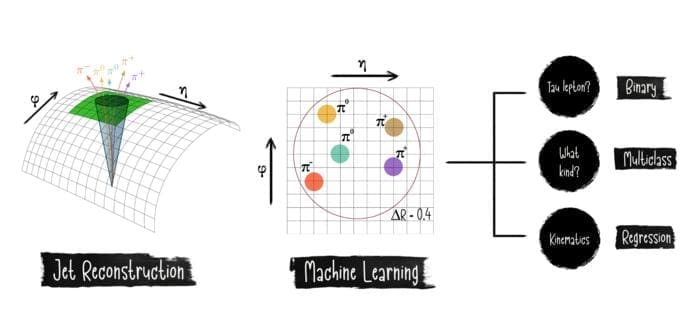
The quest for precision in particle physics has led researchers to harness the power of artificial intelligence, specifically language models, to enhance the analysis of complex data from collider experiments. By treating the intricate patterns of particles produced by decaying tau leptons as a linguistic sequence, scientists can leverage transformer-based algorithms akin to those used in natural language processing tools like ChatGPT to decipher the properties and energies of these elusive particles with unprecedented accuracy.
This innovative approach, which utilizes machine learning to reconstruct hadronically decaying tau leptons, has the potential to substantially refine the signal-to-background ratio in future analyses, including the pursuit of rare phenomena such as double-Higgs production, thereby illuminating new avenues for discovery in the realm of high-energy physics.
Introduction to Tau Lepton Reconstruction
The reconstruction of tau leptons is a crucial aspect of particle physics, particularly in the analysis of collider data. The tau lepton, a fundamental particle in the Standard Model of particle physics, decays into a spray of low-energy particles, known as a jet. This jet contains valuable information about the energy and decay properties of the tau lepton. To extract this information, scientists employ computer algorithms that analyze the subtle patterns within the jet. Recently, researchers have explored the application of artificial intelligence (AI) models, specifically transformer-based language models, to improve the accuracy of tau lepton reconstruction.
The use of AI models in particle physics is not new, but the application of language-based models to reconstruct tau leptons is a novel approach. By treating the jet of particles as a sentence, where each word corresponds to a particle, researchers can utilize transformer algorithms to identify relationships between particles and determine the energy and decay properties of the tau lepton. This method has shown promising results, with improved performance in rejecting background noise compared to traditional computer vision-based methods. The potential implications of this approach are significant, as it could enhance the signal-to-background ratio in future analyses involving the tau lepton, such as the search for double-Higgs production.
The research paper, “A unified machine learning approach for reconstructing hadronically decaying tau leptons,” presents a comprehensive study on the application of language-based models to tau lepton reconstruction. The authors demonstrate that their approach can accurately identify tau leptons and determine their energy and decay properties from the jet patterns. This achievement is attributed to the ability of transformer algorithms to capture complex relationships between particles in the jet, allowing for more precise reconstruction of the tau lepton.
Background on Tau Lepton Decay
Tau leptons are produced in various processes, including the decays of the Higgs boson. When a tau lepton decays, it makes a jet of low-energy particles, which can be composed of hadrons, such as pions and kaons, or other particles like electrons and muons. The pattern of these particles within the jet contains information about the energy and decay properties of the tau lepton. However, the reconstruction of tau leptons is challenging due to background noise, which can mimic the signal produced by the tau lepton.
To overcome this challenge, scientists employ algorithms that analyze the jet patterns and identify the subtle differences between signal and background events. Traditional methods use multiple steps of combinatorics and computer vision to reconstruct the tau lepton. However, these approaches have limitations, particularly in rejecting background noise. The introduction of AI models, specifically transformer-based language models, offers a new paradigm for tau lepton reconstruction. By treating the jet as a sentence, researchers can leverage the strengths of natural language processing (NLP) techniques to improve the accuracy of tau lepton reconstruction.
The decay properties of tau leptons are also an essential aspect of their reconstruction. The energy of the tau lepton is distributed among its daughter particles, and the way it decays provides valuable information about its properties. Researchers can use this information to constrain models of particle physics and search for new phenomena beyond the Standard Model. The improved accuracy of tau lepton reconstruction using language-based models can enhance the sensitivity of these searches, allowing scientists to probe more deeply into the fundamental nature of matter and forces.
Application of Transformer-Based Language Models
The application of transformer-based language models to tau lepton reconstruction is a novel approach that has shown promising results. By treating the jet of particles as a sentence, researchers can utilize transformer algorithms to identify relationships between particles and determine the energy and decay properties of the tau lepton. This method is particularly effective in rejecting background noise, which is a significant challenge in tau lepton reconstruction.
The transformer algorithm is a type of neural network architecture that is well-suited for NLP tasks. It uses self-attention mechanisms to weigh the importance of different words in a sentence and capture complex relationships between them. In the context of tau lepton reconstruction, the transformer algorithm can be used to analyze the jet patterns and identify the subtle differences between signal and background events. The output of the transformer algorithm can then be used to reconstruct the tau lepton and determine its energy and decay properties.
The use of transformer-based language models in particle physics is an active area of research, with potential applications beyond tau lepton reconstruction. Researchers are exploring the use of these models in other areas, such as jet classification and event reconstruction. The success of these models in tau lepton reconstruction demonstrates their potential to improve the accuracy and efficiency of particle physics analyses, enabling scientists to probe more deeply into the fundamental nature of matter and forces.
Implications for Future Analyses
The improved accuracy of tau lepton reconstruction using language-based models has significant implications for future analyses involving the tau lepton. One of the most promising applications is in the search for double-Higgs production, a process that is sensitive to the properties of the Higgs boson and the Standard Model. The enhanced signal-to-background ratio achieved with language-based models can improve the sensitivity of this search, allowing scientists to probe more deeply into the fundamental nature of the Higgs boson.
Another potential application of language-based models is in the search for new phenomena beyond the Standard Model. The improved accuracy of tau lepton reconstruction can enhance the sensitivity of searches for new particles and forces, such as supersymmetric particles or extra dimensions. The use of language-based models can also improve the efficiency of these searches, allowing scientists to analyze larger datasets and explore more complex scenarios.
The success of language-based models in tau lepton reconstruction demonstrates their potential to revolutionize the field of particle physics. By leveraging the strengths of NLP techniques, researchers can improve the accuracy and efficiency of particle physics analyses, enabling scientists to probe more deeply into the fundamental nature of matter and forces. As the field continues to evolve, it is likely that language-based models will play an increasingly important role in shaping our understanding of the universe.
External Link: Click Here For More


